
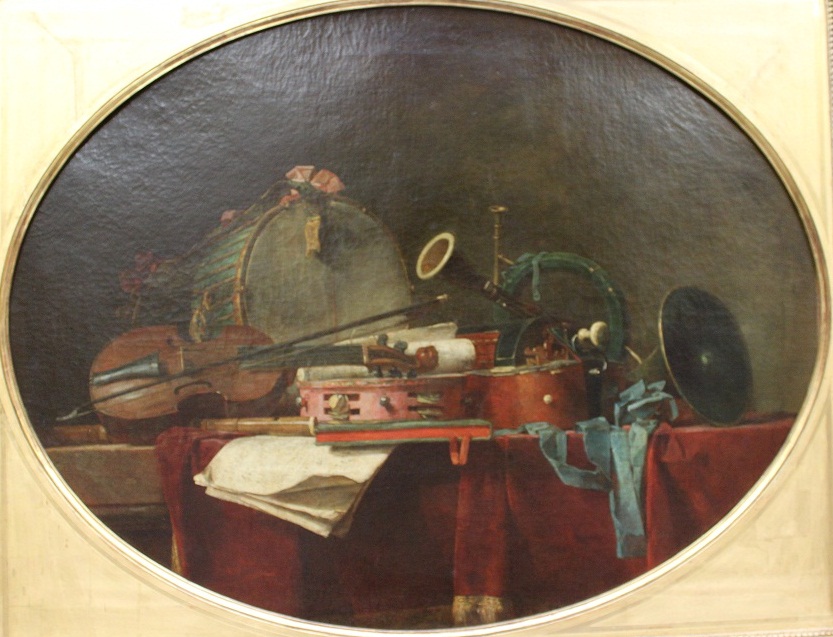
Jean Siméon Chardin, Les attributs de la musique civile (1767), 122 x 144 cm, Musée du Louvre, Paris.
I would like to offer a supplement to my memoire, which has been available since June this year and which concluded with a quasi-aporetic attempt to propose an ethics of interpretation. Quasi-aporetic, because it was formulated in the negative: to liberate the expression of a phenomenal, or affective, authenticity within the new framework imposed by historical-musicological research into instrument-making and the historicity of works. I therefore offer you a first attempt to resolve this tension in positive terms – namely, those of the affects at play in the act of interpretation. This involves an analysis of the affective dimension inherent in the post-Romantic paradigm: the process of sympathy, whereas recognition of the composer’s otherness appears to require the engagement of a process of empathy. Thus, two forms of affect can be distinguished at the heart of the interpretative act. On the one hand, there are the expressed affects, which move from their point of origin, which originate in the interpreter’s subjectivity, to constitute the meaning of the musical discourse. And then, on the other hand, there are the guiding affects, which consist of the set of preconscious links operating between preconceptions within the performer’s own subjectivity, and then should be sifted through a process of conscious analysis on the part of the performer so as not to distort the composer’s work by failing to recognise it. This ethic does not lie in any content inherent in the performer’s work, but in an awareness of the guiding emotions. However, this can only constitute a desirable ideal: awareness of one’s own guiding affects is itself guided by those affects, and cannot therefore lie entirely outside the realm of emotional experience. But recognising the composer’s work does not amount to showing deference to the past on the sole grounds that tradition in itself could be a principle of justification, nor does it aim to place the performance within a framework of truth, although research into the historicity of works may be regarded as progress inherent to the history of performance. It would then be possible to distinguish the validity of an interpretation from its truth: if an interpretation is not false, in the sense that its choices do not distort the composer’s work, then it is valid, which implies that the assessment of its aesthetic success – or lack thereof – must be left to the listener’s subjectivity, which is never detached from the affective nature of experience. Finally, the fundamental importance of empathy could be extended to the aesthetic reception of musical interpretations, through the notion of resonance – as discussed by Rosa – and to what this implies in terms of rejecting some institutional processes of classical music, in order to reaffirm that the otherness at play in the interpretative act entails confrontation and division.
Laisser un commentaire