
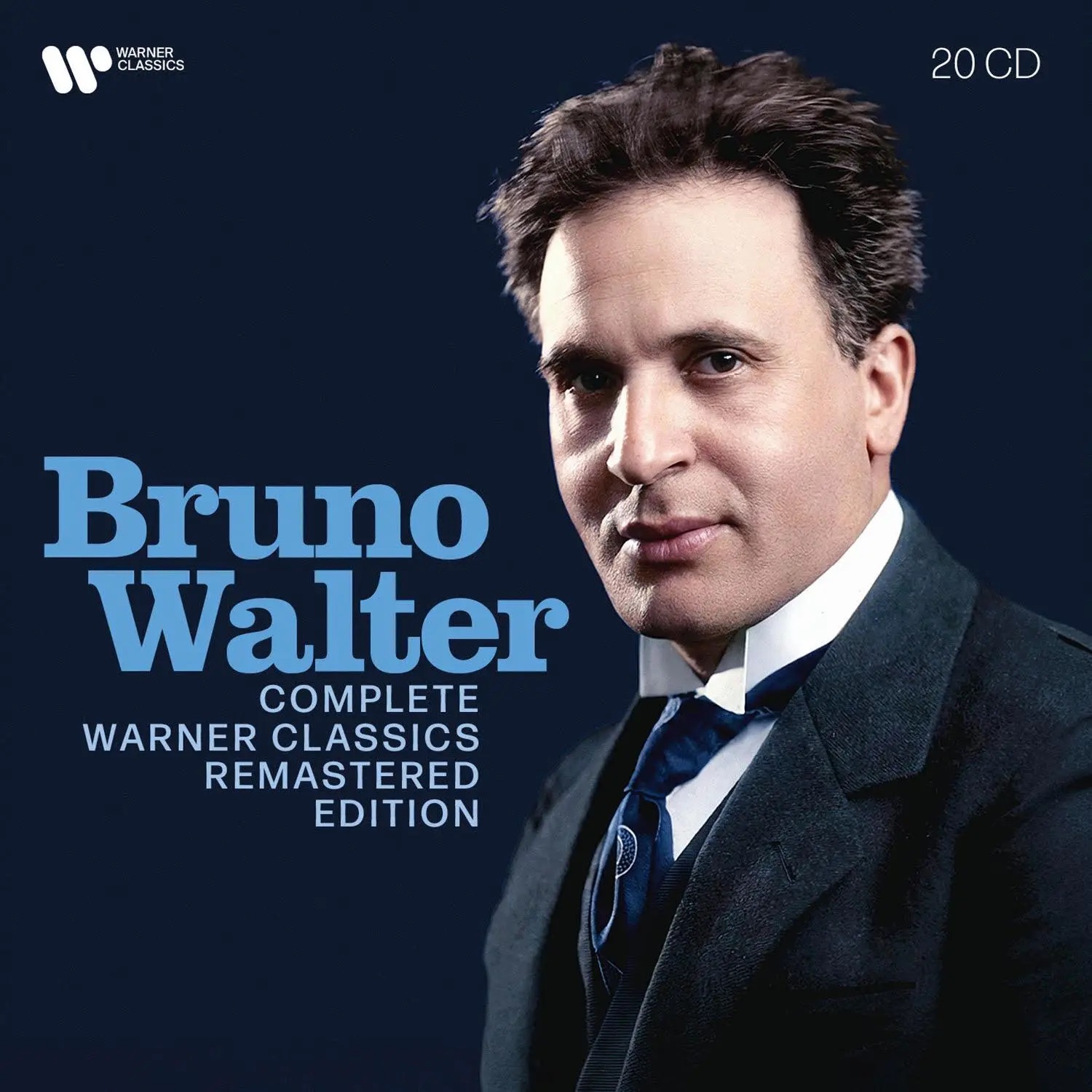
To mark the 150th anniversary of Bruno Walter’s birth on September 15, 1876, Warner Classics is reissuing all of the conductor’s recordings for HMV and Graphophone between 1924 and 1939, beautifully restored by Christophe Hénault from Studio Art et Son. To look back at this major period—undoubtedly the most striking and foundational of Walter’s career—I had the pleasure of speaking with Rémy Louis, a critic for Diapason since 1986, a long-time classical music journalist, and above all, the author of the French liner notes for this release. The podcast of this interview can be found higher up in this article.
Guilhem Chameyrat: Right from the start, could you look back at Bruno Walter’s life and his relationship with his numerous orchestras?
Rémy Louis: Well, it’s a very long life, since he was born in 1876 and died in 1962. This means, chronologically speaking, he was 25 around 1900, so he was already a young man and quite advanced in his musical career. He died around the time of the Cuban Missile Crisis—not that this has anything to do with it as such, but it illustrates the temporal paradox and above all the eras he lived through. He lived through a time of sound and fury for a thousand reasons, experiencing World War I and World War II, and in between, emigration due to the rise of Nazism in Germany starting in 1932-1933. As for orchestras, he was of German origin, a true Berliner. In his youth, he spoke of having been deeply imbued with the spirit of the ‘Berlin street urchin,’ which is hard to imagine when we talk about Bruno Walter! He was trained in the absolute classical tradition of a great German or Austro-German conductor of the time, beginning his early studies in Berlin at various conservatories with different teachers. Then, he worked in a whole set of small theaters—that’s where one learned the trade, primarily in opera, naturally. The first major milestone that truly shaped Walter’s personality was his arrival in Vienna in 1901, invited by Gustav Mahler. He stayed there until 1912, conducting the Vienna Philharmonic Orchestra—or more accurately, at that time, primarily the Vienna Opera Orchestra, as it was only gradually that he began conducting concerts with the Vienna Philharmonic itself. He was already building an international career, being invited to London as early as 1909 while still based in Vienna. His first major Generalmusikdirektor post, which was extremely important, was in Munich during the 1910s, after leaving Vienna, until the early 1920s. He wrote in his memoirs: ‘Napoleon intoxication: I am going to conquer Munich, and from there I am going to conquer the musical world!’ Which shows he certainly had true ambition! Meanwhile, he continued to conduct very regularly in Vienna. He also played a lot of chamber music, conducting both the Vienna Symphony Orchestra and the Vienna Philharmonic, like many great conductors truly rooted in Vienna. But his second post after Munich was the Berlin Municipal Opera (Städtische Oper), where he stayed for only five years. Yet, it was there that he extended the work he had begun in Munich—work that, in my opinion, was absolutely foundational and formative for everything he wanted to achieve as an opera director, and sometimes even as a stage director himself. Of course, dark clouds were gathering, and he left Berlin in 1929 to take up the post of Generalmusikdirektor in Leipzig. There, history caught up with him, as concerts were banned in both Munich and Berlin in 1933, forcing him to flee rather quickly and find refuge in Austria. Austria was a place where he had every conceivable tie, even though from the time he was assistant and then principal conductor under Mahler, he had faced latent anti-Semitism; but it was not yet the kind he confronted starting in 1933. Unfortunately for him, things went well in Vienna at first; he was welcomed without any issue, conducted frequently at the Vienna Opera again, and took part in various productions in Salzburg—which became, given the repertoire he played, a kind of contradiction to what was happening in Germany. However, in 1938 the Anschluss occurred, and from that moment on, he came to be viewed almost caricaturally as the ‘Wandering Jew,’ against his own will. Having already built a major international career in London, Paris, Stockholm, Amsterdam, and occasionally Italy, he was forced to leave Austria. He arrived in the United States in 1939, having changed his nationality several times in the meantime: naturally German by birth, then Austro-German while working in Vienna, then France literally offered him French nationality in 1938. Having left France and Europe in 1939 after passing through Switzerland, he settled in the United States, taking US citizenship in 1946. But he returned to Europe very quickly; from 1946-1947 he began conducting in London, Edinburgh, returning to Vienna in 1948—if I’m not mistaken, he even conducted the Vienna Philharmonic in England beforehand—and thus reclaimed his place. Yet, what is striking for someone who undoubtedly possessed personal generosity and humanism is that he returned very rarely to Germany, conducting just once in Munich and once in Berlin in 1950. Afterwards, his European hubs were primarily London, a tiny bit of Paris, Italy from time to time, and of course Vienna and Salzburg. That in itself is a sign; something had probably broken permanently within him. Thus, he became an American conductor, but with all the virtues of European émigrés to the United States: preserving and acculturating the old European culture into a burgeoning American society that was conquering—having won World War I and World War II—and developing with almost violent, extreme rapidity economically and geopolitically.
G.C.: You mentioned humanism, and I want to pick up on that because it was also reflected in Walter’s very relationship with his orchestras. We have rehearsal excerpts, for instance, regarding his working and creative method, and this is something we observe by contrast with certain conductors who also emigrated to America—we can think of George Szell, Leopold Stokowski, or the great orchestral trainers who shaped Chicago, or Philadelphia in the case of Stokowski, who was rather English. But in any case, returning to that humanism: how can we precisely define it within Walter’s working relationship with the orchestra, facing the orchestra?
R.L.: I think it is above all a personal dimension, precisely because he had suffered from disapproval in a certain way very early on, really in his twenties when he was in Vienna. It strengthened him, but it strengthened him—it seems to me at least—without hardening him; on the contrary, by giving him this notion of openness to others. Now, Walter’s humanism is a bit of a double-edged sword. He is a figure, after all, of his generation, who is slightly Faustian because he has—as we can hear in rehearsal—this kind of friendliness, ‘My friends,’ for example, when he speaks to the musicians, etc. He has this kind of friendliness, but on the other hand, he was extremely demanding. When he had decided on something, he did not expect anyone to contest his point of view, and it appears he occasionally had ungracious behaviors with certain musicians, saying, ‘You know, this person during rehearsal, you see…’ speaking to the orchestra manager. So we shouldn’t blow that out of proportion, because it’s true that for his singers, musicians, and soloists, he possessed this dimension and above all, as you pointed out, like a conductor of that generation, he was a great orchestral trainer. He was someone who possessed an authority that could be called implacable, but very natural through what emanated from him. And so it is sometimes difficult, I find, to truly pin down and explain what a human relationship with an orchestra is. Today, we are much more used to it, and that’s why you are right to point out that it is somewhat different compared to a whole set of other conductors. The one we think of—though you didn’t mention him—is obviously Toscanini, of course. But it is true that Walter has this dimension of understanding, of patience too, which is a very important virtue for a conductor. And so this made working with him extremely easy, also because the way he had strengthened himself meant he possessed extreme clarity in stating, knowing, and getting what he wanted. He himself said, if I quote from memory: ‘The greatest tragedy for a conductor is failing to communicate one’s conception and thus failing to achieve it, to draw it out of the orchestra.’ And this clearly begins, let’s say, from the turn of the century, almost from his training alongside Mahler, whom he obviously observed a great deal, with whom—as you know—he was extremely close, a close friend, truly observing and studying him work, rehearse, etc. When he arrived in Munich, he was still young, naturally, but he was already a fully complete conductor, a conductor who knew exactly what he wanted.
G.C.: We’ll come back to Mahler a bit later, but in the meantime, you spoke of naturalness and clarity, and these two elements seem to converge as well in Walter’s conception of music—namely, that the first thing we often have in mind when talking about Walter is that he is a singing conductor, a lyrical conductor, a conductor who essentially guides the singing of each section. How would you define this lyrical dimension specific to Walter’s very art?
R.L.: Probably because, in my opinion, it is first and foremost an intimate impulse, an inner impulse; it is an admiration for the voice, obviously. And in particular women’s voices, by the way, but this dimension is extremely important in him. And also because he conducted opera enormously; he trained in opera, and indeed, when one was Generalmusikdirektor as he was in Munich, and thus had the opportunity to have a symphonic concert season, it’s almost like the cherry on top, because within the framework of working in repertory theaters in Germany or Austria at the time, you didn’t always have the opportunity to rehearse as much as you wanted. Of course, the Generalmusikdirektor, when he has a new production with a director, etc., can impose a certain type of work. Revivals are different, and I think with him, it is the meeting—to perhaps answer your question—it is the meeting between an inner impulse, even with an almost feminine, sometimes sensual dimension, and this extraordinary, highly virtuous habit he had of accompanying the voice. Because indeed, you are right, you pointed it out: his orchestra sings, the strings in particular, but it should also be said that—just as for an instrumentalist singing is relatively easy—the orchestra speaks, and speaking is much harder, and that, he does that too.
G.C.: Speaking, singing, all of this undoubtedly presupposes a certain unity, and a unity of the orchestra’s sections. And I wondered how, in your view, this lyricism reflects on this unity of the sections, given that the theme of sectional unity in the orchestra is a fairly central topic in the history of conducting, particularly at that moment in the history of conducting which is the first half of the 20th century?
R.L.: Yes, because in fact, it’s true that today when we hear an orchestra, the level of orchestras is so high in purely technical terms that the formation of a sound can happen in a way much faster than what existed before. And we can naturally imagine, for example, that the Vienna Philharmonic at the end of the 19th century did not play Bruckner’s Eighth, say with Hans Richter, the way it plays it today with Christian Thielemann. So with him, I think there is this requirement first in relation to the instrumentalists themselves and, of course, to have a quality of singing—meaning a quality of sound, a quality of color, working on timbres. There is this work highlighted by a French critic, in this case Bernard Gavoty, who is a bit forgotten today, and he made a very nice booklet in the collection Les Grands Interprètes on Bruno Walter, and he said that ultimately, one of his favorite words was ‘more’. Meaning, more requirement, more pursuit of unity, which is both a technical unity and a spiritual unity. So, of course, using these words, for example if we speak of spirituality in music today, immediately seems a bit outdated, because we are no longer truly in a spiritual time, but for a generation like Walter’s, it was indeed an extremely important dimension. So, then, by what means… one would have had to attend many of Walter’s rehearsals to know how he achieved this lyricism! There is a form of lightness in the string playing, but never at the expense of intensity. At the same time, there is an inner animation—that is extraordinary when you hear it; meaning he is one of the best examples, it seems to me, in the history of recording during those years, in the interwar period (since that is truly the period covered by the box set), of a conductor who does not seem to suffer from the transition from the podium or the pit to the studio, even though, of course, all these recordings were made in short 4-minute sequences, which makes unity difficult. Yet he doesn’t seem to suffer from it, and the kind of momentum we hear in Walter, and this extremely vibrant, I would even say trembling lyricism we hear in his conducting, is equally present in the studio. I can imagine it—neither you nor I heard him live, of course—but we can assume that heard live, the dimension was naturally even greater. Still, the recordings, even right from the beginning, even in acoustic recordings, this dimension you were right to point out is already very, very present. So lyricism is indeed one of his signatures.
G.C.: You mentioned Mahler, and Bruno Walter and Mahler shared a certain slice of life together! And, of course, there is a recording in this box set that materializes this, and undoubtedly even more so by anchoring itself in lived experience, including tragic lived experience: that is, of course, Mahler’s 9th Symphony from 1938. Now, I re-listened to it just before we recorded this podcast, and it proceeds from an absolutely extraordinary commitment and a completely alert tension. So could you look back a bit at both the genesis and the strictly aesthetic properties of this cult recording—and no doubt much more than that, profoundly moving—of Mahler’s 9th by Walter?
R.L.: Yes, for me—I did like you, I listened to it when I was asked to write this text, which as you can imagine was a great responsibility, and I re-listened to a huge amount of things. And I re-listened to this 9th, which people sometimes said the orchestra was a bit this, a bit that—it’s the Vienna Philharmonic, let’s emphasize that—and that compared to the version he made at the end of his life, it was a bit different, etc. Different it certainly is, because he himself evolved a lot, but the recording, you are entirely right, is capital. Now, for historical reasons, since he premiered Mahler’s 9th in 1912. So from the manuscript in Vienna. At the same festival, by the way, there was also Arthur Nikisch, which gives an idea of the historical depth for the conductors present at that time. But the very strange thing that I actually realized while working a bit, checking archives, books, etc., is that very surprisingly, Bruno Walter did not conduct Mahler’s 9th Symphony with the Vienna Philharmonic between the 1912 premiere and this 1938 concert, and—I was going to say worse yet, but even more surprisingly perhaps—once emigrated, he would only perform it in concert in 1945 in New York, and much later still, he made the recording. Why? I don’t know if there is a particular reason; is it the Ninth Symphony syndrome, which affects composers but sometimes also performers in the wake of Beethoven? I don’t know, but the fact is that the other major work he premiered, namely Das Lied von der Erde, he never stopped conducting. Should we see in this precisely the prevalence of farewell? Should we see a greater proximity to Das Lied von der Erde, though that would perhaps come down to the voices, naturally, rather than this purely symphonic Mahler? It’s difficult; it’s difficult to answer in his place, naturally. But consequently, this makes the recording in a way almost unmoored from reality, because when he records it, we cannot imagine—obviously, at that period—we are just a few weeks away from what is going to happen in Austria in 1938. He has already suffered immensely from having to leave Germany, of which he was clearly one of the three or four greatest conductors, there is no discussion on that subject. And therefore, recording Mahler in Austria between 1936 and 1938, since Das Lied von der Erde is also there, is obviously probably a profession of faith, a tribute paid to Mahler because in 1936 Walter published his book on Mahler, and of all his written essays, it was the most reissued and commented upon, with different prefaces by Ernst Křenek, for example, the composer, or even Pierre Boulez. So you see that a whole group of people returned to this text by Walter on Mahler. Thus, the whole cluster of these things gives, as you perfectly highlighted, an extreme intensity to this interpretation. But for me, two things are quite striking: there is, in a way, the maelstrom of the two central movements, but the first and perhaps even more so the last are much less, in my view—and this is a matter of perception—tragic than they have been made out to be today. The last movement, first of all, because it is at a fairly fast tempo compared to what we are used to today, but it is much more melancholic. In other words, and given what his future was going to be—I would almost say immediate, since a new emigration and settlement in a country he only knew as a guest conductor, namely the United States, on another continent, was coming—I think this 9th, truly, more than the tragedy of the times (even though it is present), is a farewell to a certain Europe. It is a melancholy, it is The World of Yesterday by Stefan Zweig in a way—which he knew very well, by the way. So I think it is this dimension, and aesthetically, beyond the fact that he conducted the work very little—oddly enough, but there it is—it is a kind of suspended moment, obviously before the atrocities, the collapse into war, etc., but for him, it is in a way a way of gently closing the door, I would almost say, on what he had lived through. I must add that the following year, his youngest daughter was seemingly murdered by a jealous husband, which would be an additional tragedy, even before arriving in the United States, or the very year he was to arrive in the United States. So for us, this testimony is of course an essential stylistic testimony, since he is a disciple of Mahler and, probably from my point of view at least, the most sensitive, the most—I would say—raw-nerved compared to what we know of Mahler’s other disciples, because they were all very different after all. If we take Oscar Fried, if we take Otto Klemperer, if we take—though we know him less—Heinz Unger, because he recorded extremely little, but these are people, or Georg Solti who played him a lot, or of course Willem Mengelberg, though we have few recordings, obviously. They are precious, but we have few. Consequently, all these people who knew Mahler very personally, very professionally, give us an image of him that is completely different. So whenever we have a testimony from one of the disciples that is still contemporary in a way—since we can easily imagine that a number of musicians who were in the 1912 premiere were still there in 1938, Vienna Philharmonic musicians easily spending 35 or 40 years in the orchestra, so there is every chance that a number of musicians were still there, naturally.
G.C.: Yes, and it is all the more a profession of faith, no doubt, because playing Mahler as a Jewish composer in the Vienna of 1938, a few weeks before the Anschluss, is no small thing. And it is a work about mourning, a work about mourning that opens—and this is not insignificant—perhaps also with, indeed, you spoke of this nostalgic commitment in the final movement. And there is something else that strikes me very much in the commitment; it undoubtedly stems also from Walter’s extreme closeness to Mahler’s music. In particular, something that struck me is the utter flexibility of the rubato, which is something we are not necessarily used to with Walter, especially when listening to Walter conducting the music of his time (Mahler being, as you reminded us, a contemporary composer for that generation). And it is a recording that—returning to the word commitment—strikes me much more than the 9th recorded with Columbia, one of his very last recordings. And so it is one of the jewels of this box set that we invite everyone to re-listen to, and perhaps re-listen to with a new ear as well, casting off the preconceptions we often have in mind when thinking about the history of criticism and the idea that this would be a rushed interpretation. Is it not rather early?
R.L.: Yes, indeed. Absolutely, you are right; it is a rather fast interpretation compared to our current codes, which is a bit surprising, even though people are beginning to try playing Mahler today—I don’t mean on period instruments, but with philological work; this is extremely recent work, it’s just starting, we’ll see what it yields over time, we are starting to have one or two examples of it. But actually, the inner intensity in this interpretation is not in the realm of pathos either. And I think the rubato you are alluding to is, in my view, a dimension he has in fact in many of his recordings—that is, this kind of inner impulse that is both extremely free and extremely spontaneous. We cannot imagine, of course, that this interpretation at that moment, in that place, under the circumstances we both recalled, is entirely external to all this substrate, all these circumstances. Yet it is ultimately not all that crepuscular, whereas we have heard many conductors in the 1990s or 2000s who tended to play a 9th Symphony that was crepuscular. I could cite the example of Claudio Abbado, for instance, whom I heard conduct it several times—that is naturally not a value judgment, just an aesthetic differentiation. And here Walter, after all, did not forget that Mahler was composing a tenth symphony which he never conducted, but which was nevertheless at the sketch stage, and therefore, in a way, there was a future. When Mahler died, he was still relatively young, and so, in a way, perhaps for Walter himself, this dimension—because he had known this man alive, evolving, teaching him so many things, exchanging with him on so many things, naturally on the practical aspects of conducting opera, for example, on scores of course (you know Mahler’s famous, extraordinary remark, which is both arrogant and brilliantly panache-filled, when Bruno Walter visits him in his hut while he is writing the third symphony, and to not disturb him looks at the nature around him—a great, important, spiritual moment for all these Austro-German conductors regarding their relationship with nature; and at one point, Mahler addresses him by saying: ‘Do not look at nature, it is entirely contained in my symphony,’ which is quite extraordinary, as it is both infinitely arrogant and superbly panache-filled)—well, Walter himself draws upon his origins, his culture, his training, through his intercourse with Mahler, which was so intimate, so friendly too—though, let’s be honest, not always easy, as he says in his memoirs, even with him, but still, there was this absolute respect and admiration. And therefore, for him, a phrase like that speaks volumes, naturally. He doesn’t have to ironize about a phrase like that; he understands immediately what it means, because Mahler’s orchestral imagination is of such power compared to so many composers around him at the time that one cannot but grant him this remark!
G.C.: Somewhere, Walter seems to reconnect in this 1938 interpretation of the 9th with the incarnate lived experience that this symphony is—meaning that it is a symphony, I won’t say it has no beginning and no end, but fundamentally, it seems, and all the more so in this interpretation which, as you recalled, is not crepuscular, to be an almost isolated moment that strictly speaking has no introduction: we are straight into it, the train is already moving somewhere. And then, it ends by opening onto something, and indeed Walter, by committing himself notably through that rubato, gives a form of intimacy—we can speak of intimacy—almost a vital impulse somewhere. There is truly an idea of an organism at heart; it is something very organic and very living in the moment, very deeply anchored.
R.L.: Yes, absolutely, but I believe that in his way of conducting, he had that dimension, and that is what made him extremely precious when conducting opera. Because in opera, he lived the characters on stage, he chose his singers and especially his female singers, and consequently his orchestra took on the colors of the voice—meaning he let himself be inspired by the voices, he himself inspired the voices, and you can still hear that even in the symphonic conductor. You mentioned this rubato; he still has that freedom, meaning that in a way, he is not like a conductor today might be, who is obviously no longer of that generation, who didn’t know Mahler; he is not a vestal walking through a cold temple! For him, it is something lived, vibrant, because I think when he conducts this—I don’t want to engage in armchair psychology, of course, but I think when he conducts this, a thousand things from Mahler’s personality, attitudes, shouts, kindness—well, you see, many things return and tie in with the context. And that is what I find particularly admirable, and yes, it is not crepuscular, you used the word, it remains open. In fact, when we re-listen to it if we haven’t heard it for a while and if we are used to, so to speak, listening to Mahler’s 9th in concert today, all of a sudden we realize it has—as you also said earlier—this kind of life principle anchored in its very body; it is extremely vibrant, immediate, anchored, it is concrete in a way, and yet, of course, it is bathed in an incredible spirituality besides. But it is there, a man is playing it for us, the composer is with us, and that is truly absolutely fascinating. Here precisely, we have a perfect example of Walter’s ability to instill in the orchestra what he wanted to hear, since once again, in work, he was extremely demanding and extremely precise about what he wanted to achieve, even though afterwards there was the freedom of the concert, naturally, but still, that dimension comes through. And in fact, if this ninth symphony is a kind of cardinal example, it is almost an articulation point, perhaps a tipping point with a whole set of other recordings we can experience and rediscover. I think for many people this will be a rediscovery in this box set, since it truly covers the interwar period—well, not strictly from one war to the other, since there is still the 1949 recording and recordings starting in 1918, of course—but still, it is that period, and probably, it seems to me that for Walter’s achievements as an artist, I think it is the most important period. If he is to remain in the history of music, it is probably for that period, and for everything he did as a boss, as a director, discovering singers, premiering works—that is obviously very important. The American period is harvesting the fruits of what was sown. He is a very great Walter; he is a global reference, naturally. Every time he comes to France, England, Vienna, Amsterdam, he is celebrated as such. But the life principle of the great Bruno Walter is probably rather in those years, in a way.
G.C.: You spoke of Bruno Walter in history, and if there is one recording of Walter that also remains in history, it is an opera recording. A small aside, though, about an opera recording that is not in this box set because it is a live performance, and that is of course the 1942 recording of Don Giovanni with Ezio Pinza, of unheard-of sensuality, and we invite everyone to go listen to it or re-listen to it right away. But I return to what is in the box set, and to a landmark studio recording for history and posterity—perhaps the greatest Wagnerian recording in history, who knows?—and that is obviously this first act of Die Walküre, recorded in 1935 at the head of the Vienna Philharmonic with Lotte Lehmann and Lauritz Melchior. Can it get any better in the genre? I don’t think so! And could you present this project, which was unprecedented at the time and of very great ambition for 1935, to record an opera in the studio on 78 rpm segments that could only last 4 minutes and 30 seconds?
R.L.: Which you don’t even hear! What you don’t hear—meaning Walter’s mastery as an opera conductor was such that indeed, you don’t hear the seams. You asked me at the beginning about humanism; this is one of Bruno Walter’s recordings—as far as he and his orchestra are concerned, even before speaking of the voices—that displays his humanism and, moreover, a vision of Wagner that is lighter, more chamber-like (it is true that this first act lends itself to that naturally, of course). But despite all that, this humanism present in the sound of his orchestras, and particularly with the Vienna Philharmonic, well, here we truly have a kind of illustration of it, and this humanism is itself fueled by the capacity of the two singers—there is also Emanuel List, of course, as Hunding, but particularly the two twins, namely Lauritz Melchior, who is like a cello, and Lotte Lehmann, who has an absolutely incredible feminine sensitivity! And so there, the relationship between the one group, meaning the singers—the three singers—and the other, meaning Walter and his orchestra, is an achievement, a transcendence, so much does the sum of the elements open up onto something—it’s a bit of a cliché—even greater than the elements taken by themselves. But what is interesting to note is that when he makes this recording, he had not conducted Die Walküre at all in those years, neither in Vienna nor in Berlin. The place where he had conducted it, where he did Ring cycles, was London, and this cast is rather a London cast because at the time, major opera casts where the greatest conductors and lyrical artists of the era were invited were rather in London, because you had the opportunity to bring someone who was in a troupe in Berlin, another in Vienna, a fourth in Hamburg, the last in Dresden or Munich, and thus create somewhat ideal casts. So this recording corresponds quite closely to performances Walter could give—he had therefore already left Germany, but this was not at all at the Vienna Opera. So this is a bit like a diamond that is—I would say—like the spaceship from 2001: A Space Odyssey, in a sort of space entirely apart, but which is—in my opinion you are right, though I don’t know if we can call it the greatest Wagnerian recording in history—an absolutely essential recording to revisit even what the Wagnerian tradition is; on that, there is no doubt.
G.C.: A recording also to be related, perhaps—as a suggestion—when we speak of light Wagner, singing Wagner, almost a bit smiling in a way (I am thinking obviously of the lyrical phrases, the deep strings at the beginning of the first act in particular, which are absolutely sublime), with also Furtwängler’s excerpts from 1937, once again, where the orchestra is lighter, livelier, perhaps even more colorful than in 1954, for example.
R.L.: But it’s staged! Of course, but it’s staged. But nevertheless, it seems to me there is perhaps a difference. We are talking here perhaps of the two greatest conductors in the history of recorded music—I almost kick myself for pointing it out, naturally, but it goes without saying. Yet there is, it seems to me, in Walter first of all a light: there is a light of timbres, whereas Furtwängler always claimed the dark side of things for himself, so it is already much darker and I would say intellectually, philosophically, even in a way spiritually, they are not at all the same musicians, even though this remains a Furtwängler slightly younger than the Furtwängler deeply tested by the war, of course, since he would not survive World War II by very much—barely 10 years, barely even that. And consequently, we can say for us who did not hear it live, of course, that this 1930s Furtwängler, who was also a great opera conductor, was someone who had in a way slightly disappeared after the war because—without comparing the works naturally, of course—his Don Giovanni, for example, or his Magic Flute in Salzburg in the postwar period do not give that impression, I would say, of lightness and that kind of dramatic momentum, whereas with Walter, that endured even beyond the postwar period, when he conducted Fidelio at the Metropolitan Opera in New York, or when he conducted his last opera production, namely The Magic Flute, which he absolutely wanted to stage for Mozart’s bicentennial. There, we still have that extremely vibrant and once again sensual dimension, as you said—I completely agree with that—but in a sort of… how to put it? It is empathy, in fact it is a sympathy toward the characters: when Walter conducts an opera, you hear in his orchestra what the character is, not just the person singing who is there to embody them, but his orchestra itself embodies at a given moment the color, the sensitivity, the emotions in a way of the character who is there. And from that point of view, for me, on recordings—on these recordings which are of course only snippets, since there aren’t that many left of either Walter or Furtwängler in opera—in this dimension Walter seems to me almost closer to his singers than Furtwängler. But in both cases, they have the best singers of the era!
G.C.: Well, I don’t know if we can summarize this opposition—which isn’t really one—between Walter and Furtwängler as the Apollonian and the Dionysian. Is it canonical to mobilize Nietzsche to talk about Wagner, and is it entirely canonical? I don’t know, but in any case, no doubt these qualities of Walter reveal themselves in the Apollonian, and that is what also makes the quality of the recordings in this box set, from this roughly Viennese period, let’s say, because precisely those qualities reveal themselves there, whereas somewhere, this Apollonian character—it seems to me at least—certainly goes through a somewhat more Dionysian phase upon arriving in New York, because there is the color of the orchestra with more flesh, with more substance, and New York is a darker orchestra simply; and at the same time, notably during the Columbia period, that’s a bit of what always bothered me and why I always preferred the Viennese Walter, because he becomes a bit more transparent afterward, the Apollonian mutes into transparency, whereas the Apollonian is somehow more engaged in the Viennese period, and really it is like a setting in which both this lyricism, this light, this clarity are at the service of naturalness, and where at the same time there is more rubato because there is more commitment.
R.L.: Yes, but in fact, it is one of Walter’s women, as my admired colleague André Tubeuf used to say—Lotte Schöne, who sang a lot with him in Berlin, Vienna, Salzburg, etc.—who said that from the moment emigration happened, in fact, the color of his orchestra and even, she said, the timbre of his voice altered. So that is a way of saying just how much of a shock and a tearing apart it was for him, as for so many artists—but not just artists—who had to leave Germany and then Austria at that time. But still, there is something very Faustian about it—meaning… there is still the diabolus in musica, if I dare say so, moving away from the expression which is very precise musically, but that dimension is still there in him; yet it is not that prophetic nature one can hear in Furtwängler in a certain way. It remains within the concrete reality of theatrical life, the emotion of the characters, what the orchestra must give to that emotion, and therefore from that point of view, in opera at least, you are quite right about your remark regarding the early New York years, but he kept that, whereas people always talk about three major periods for Furtwängler, you know it as well as I do—before the war, which is quite broad and where we have the fewest recordings, during the war, and after the war. But it’s true that if we talk about opera, and even though very important things by Furtwängler remain, both in the studio and live, we still have a bit of the impression—and you underlined it yourself by speaking of that kind of lightness and liveliness in Furtwängler’s London recordings, since they are also London recordings, which is important to specify after all—that in postwar Furtwängler, I won’t say the spring is broken, but musically I think it’s no longer the same. It is almost Schopenhauer in a way: we are heading toward something else, we are toward the high peaks and the rarified air of transcendence, you see, in a way. And Walter has an aspect, once again, that is extremely vibrant, epidermal even I would say, but not in the sense of superficiality, but because things are immediately given and above all immediately understandable and perceptible by the listener. Katia Mann, Thomas Mann’s wife, said: ‘I always wondered how music could plunge this being into such states of exaltation.’ That exaltation, Walter never lost. I really like that dimension. In the studio, it’s different: the body fading away, of course, as time goes on; studio recordings, sometimes under specific conditions depending on the orchestras brought together specifically for the studio, give us another image of Walter, it’s true. But Walter live right up to his last concerts in Vienna keeps that inner tremor. When you hear Mahler’s 4th given in 1960, so for the great festival honoring Mahler, with Elisabeth Schwarzkopf, and also the Vienna Philharmonic, those are farewells to the Vienna Philharmonic. It is his last concert in Vienna, yet there is no resignation in what we hear; perhaps there is already an elsewhere, we can imagine it, we project it naturally too because we know it’s the last one, because he died two years later, okay, but the tremor and almost the juvenility we can hear in so many versions of Mahler’s 4th by Bruno Walter, even right up to the end, are present. And that is indeed a feature that is, it seems to me, extremely moving and—to use your word from the beginning—human in Walter’s art.
G.C.: Human, a humanity that also incarnates in a form of vitality, and I think of it right now: there is a recording by Walter in Vienna that demonstrates not only vitality through its liveliness, but also mischievousness, quite simply—that is the Emperor Waltz! Which is a recording one doesn’t always think of, but which is absolutely brilliant—perhaps the most beautiful Emperor Waltz I have ever listened to (perhaps, I don’t know, it’s complicated to make hierarchies)—precisely through both the scale of the gesture and the bounce, the elasticity of the bounce, almost pre-Kleiberian fundamentally, and at the same time, a little bit of mischief, it’s a little bit Faustian after all.
R.L.: Yes, precisely. Meaning the Apollonian and Dionysian sides—when you hear the first act of Die Walküre, you find both of those elements in a way. But when he plays that utterly Viennese repertoire, it is interesting to recall that at the same time, during the same period, two other of the greatest Austro-German conductors of the era, namely Clemens Krauss and Erich Kleiber, were also absolutely wonderful interpreters of the Viennese dynasty—though none of them really did the exact same thing. And we must speak of humor—I would even say almost, more than humor, but wit, in fact. Wit, meaning in its freest, most unbuttoned aspect, as demonstrated indeed by Strauss’s waltzes, the Die Fledermaus Overture, etc. But there are the finales of Haydn’s symphonies that Walter recorded in London, but also and above all with the Société des Concerts du Conservatoire de Paris—there is a symphony in Vienna too. And in Vienna—now you mentioned one of our recent gods, naturally, which is Carlos Kleiber—there is a kind of almost unbridled, almost border-line fantasy; at times there are moments where Walter is truly at the limit, and yet we are in the studio, once again, and that dimension is still there. And it seems to me that, even more than humor (because humor is very important when talking about Haydn of course), it is wit. Meaning wit in the Greek sense, you know, a bit mischievous, going wherever it wants in a way, liberating itself as it pleases—it’s almost Till Eulenspiegel conducting! I won’t go quite that far, but there is a bit of that dimension. And as for Walter, people always talk about his Mozart recordings for a thousand reasons, whereas he himself said he came late to Mozart. It’s worth recalling, since he is truly stamped as the great pre-war Mozart conductor—well, with one or two others, but still, it’s him above all. But the Haydns are in my opinion at the very same level! And when you spoke earlier of those concerts—truly electrifying ones given in the 1940s to the early 1950s with the New York Philharmonic, at the time when he had a role as musical advisor, so he conducted them regularly—you find a few recordings of Haydn symphonies that are pure madness. Meaning no one today among baroque interpreters, I think, would have that freedom, that liveliness, and even sometimes purely and simply in terms of tempo—though that is obviously only one element of an interpretation, but even in terms of tempo, none of them today would dare do what he does. And that is quite extraordinary. And that is why, as the years went by, I began by listening to Walter’s Mozart, like everyone naturally because of his reputation, but as years passed, the Haydns became true treasures to me. There are few of them, but those that remain are an absolute treasure, whether in the studio or live! And there indeed, the comparison with Carlos Kleiber is justified: they are elves! Hans Hotter, the great German singer and bass, said when he saw—I think—the first New Year’s Concert, he was stunned by what he saw, observing Kleiber conducting, and he said to someone with him: ‘He is a dancing god!’ And that dimension is equally true for someone like Walter, and without diminishing him at all, you would never dream of saying that about Furtwängler or Toscanini. So there is a light-footed side; it is agility, and that dimension is very strong. This is not to say of course that Furtwängler or Toscanini lacked wit or humor—that is obviously not the point—but rather the way they transcribed them.
G.C.: Well, talking about Haydn, talking about Mozart, naturally brings to mind a form of duality at the core of Walter’s art and artistic personality: on one hand, he is a post-romantic interpreter, and on the other, modernity and the music of his time constantly permeate his work. And so, I was thinking of several works: on one side, there is a somewhat lesser-known recording that I went back to listen to, which is in this box set and which really must be re-listened to, embodying Walter’s post-romanticism through permanent tempo variations and post-romantic orchestral texture play—that is Beethoven’s Emperor Concerto with Walter Gieseking in 1934, which is an absolutely brilliant recording, featuring both complicity and boundless imagination. Every phrase is a world unto itself, and every phrase feels like an improvisation; it is very impressive, and undoubtedly one of the most overlooked recordings in this box set. And on the other side, when we think of modernity, we think of a form of rigor in Walter. So there is the idea of Mozart conducted as fast as possible, of course, but there is also the recording of Schubert’s 8th, and in both cases, Walter’s rigor serves this symphony greatly, it seems to me, by giving it structure. It is a Viennese recording, which, for Schubert, is all the more fitting; and by the way, there is a very interesting recording that is just as brilliant perhaps, which is the Philadelphia recording right after the war, in 1946, and in that conception, truly, it seems to me his modernity is embodied. So I’ll end with a very general question: how can we define this relationship between post-romanticism and modernity in Walter?
R.L.: Well, there is probably a strictly stylistic analysis to be made regarding his way of approaching music and transcribing it, but quite simply, he still belongs to a generation that was—and obviously we aren’t speaking exclusively of Walter here—in relation with the composers of his time. He himself premiered numerous works, even in opera, not as many as certain specialized interpreters, but at the time that was part of natural things. In the 1930s, he was already playing Dohnányi, Schreker; he premiered Braunfels’s The Birds, which had been forgotten but were rediscovered as a major work—he premiered them in 1920; and he premiered, in a completely different aesthetic, The Crystal Palace in 1917. He premiered works by Korngold; he played Ravel, Debussy, Dukas, for instance. So in fact, the modernity of style goes hand in hand with two things. In my opinion, first, the repertoire one plays on a daily basis, whether in the pit but of course also in concert; and second, I think—since as I said earlier, he is an interpreter who does not seem to suffer from the transition from pit or podium to studio… because, of course, the history of recording forced people to be more rigorous. You made a whole set of takes naturally, but despite all that, recording suddenly brought the idea that something was going to remain. So some people didn’t really adapt to it all that well at first, while others arrived, raised the baton, recorded, and then left—that was somewhat Richard Strauss’s style in a way. But regarding Walter himself, I think this modernity is first and foremost a question of period, since the very evolution of different musical styles moves enormously. When you see the appearance of a Hindemith, a Kurt Weill, and of course Schreker or Korngold much more within the Viennese sphere naturally, and then the Second Viennese School themselves of course—Schoenberg, Berg, Webern. And so at that time, music itself was moving at breakneck speed. So anyway, this modernity—you are right—Walter applies it in a way to the classical and classical-romantic Viennese repertoire. But I would say that in this dimension of rigor, due to the fact that we are in the studio and must try to make a recording that will endure over time, there is also simply the effect of this period. And despite everything, for me—because you said earlier he is a post-romantic conductor, which is perfectly accurate by his generation, he is 25 in 1900—it seems to me he keeps classicism above all else. He has a wonderfully marvelous dimension of classicism; perhaps—is it a feature of classicism?—there is an almost unalterable side to him in a way. It is a commitment I hear in him, meaning that what we said about the life emanating from these recordings—contextually, the nature of recording, potential weaknesses, limitations that send us far back in time—remains as vibrant as on day one, and that is not always true of all great interpreters.
G.C.: Now, there is another instance of modernity embodied in Walter: among the conductors of what is usually called the golden age, he is one of those who recorded the most. A history with recording that began very early and continued until the end of his life. So how would you invite us to define Walter’s relationship with studio recording?
R.L.: Well, that’s difficult; I don’t have immediately in mind whether he talks about it… His memoirs, Theme and Variations, are sometimes a little disappointing—pardon me, who am I to say Bruno Walter’s memoirs are disappointing? But there is an ‘easy-going’ side; he moves through things, sometimes suddenly focuses on a subject, but it doesn’t always appear very strongly. He has a kind of—I almost want to say—relaxation and perhaps detachment by the time he writes his memoirs, since that’s already when he’s in the United States. But actually, I want to answer you in a way with what we’ve already said: I believe, even if I don’t have an example in mind of what he might have expressed about the studio, that he was comfortable in the studio because that life principle, so immediate in him, so physical in a way—well, that life principle does not always depend on the presence of an audience, which is such a driver, as we all know—even for us, when we listen, we don’t listen the same way when we’re at home or when we’re in a concert hall. And I think that didn’t pose any particular problem for him. We can compare that to the fact that, for example, Furtwängler, even in the immediate postwar period around 1947-1948, was saying that ‘To record Bruckner’s symphonies, we must still wait,’ because we were still in the era of 78s. Yet Bruckner’s 7th was recorded as early as 1924—acoustically of course, which is difficult—by Eduard Mörike, who was the poet’s grand-nephew, who is of the exact same generation as Walter, but since he died in 1929, not much of him remains; if he had lived Walter’s career, it might have been very different. And Horenstein, very young, records it in 1928 with the Berlin Philharmonic—a recording that, as you should know, utterly fascinated Walter Levin, who discovered it late in life, he’s the one who told me, who was the first violinist of the LaSalle Quartet; and once, when I spoke with him, he said to me: ‘Do you know that recording?’ I said: ‘Yes, absolutely.’ And he said: ‘Ah, but that is Bruckner!’ And he seemed to imply that afterward, Bruckner’s interpretation became much heavier. And so, modernity—is it fueled by the repertoire one plays? For that generation, it seems completely normal to propose that as an element of reflection. Is it fueled simply by the conception one has of the studio—meaning entering the studio with the idea that suddenly, you are leaving a trace? When we remember what all composers say in the very first acoustic recordings where they already hear their voice at the start, occasionally at the piano: to us the sound is utterly appalling, whereas when we read their testimonies we read: ‘But it’s marvelous, it has such fidelity to who I am, to my playing!’ etc. So the very perception of recording, the way people experienced it, the way they interacted with it has changed a lot. And Walter truly went from acoustic to LP, from mono to stereo, and let’s not forget he is supposed to have recorded a few rolls at the very beginning of the century on the piano. So of course he accompanied, but as I would almost say, it is a movement—I don’t know if it was intentional—but a movement of modernity that was somewhat inevitable with the evolution of technology, without technology becoming a leaden weight that constrained him, hardened him, or closed him off—not at all.
G.C.: We are reaching the conclusion of this podcast. But one last, slightly more personal question, since this box set published by Warner Classics offers a new remastering of these recordings. It gives back naturalness and color to legendary engravings we know well, just as this remastering undoubtedly restores brilliance to lesser-known recordings. So I wanted to ask you—since we’ve already touched upon a number of these recordings—if there are others you would absolutely recommend as a top priority to our listeners and viewers, and if there is one you prefer?
R.L.: No, well, it’s curious, but it’s often a question that comes up, which is completely legitimate; but as time passes and given that I’ve heard an enormous number of different things, whether on record or in concert, it’s hard for me to determine a favorite recording. Naturally—and we’ve talked about it a lot—the first act of Die Walküre is an absolute pinnacle, there is no doubt for the ten reasons we gave, but there are twenty others we didn’t mention! Mahler’s 9th because of its historical context as well, but the various Siegfried Idylls, since there are several, which are absolutely magnificent, and which furthermore allow us to see the evolution of playing style, because there are portamentos at the beginning. In the text I wrote, I said that in the first Siegfried Idyll, it’s still a spirit of childhood, a bit like Hansel and Gretel in a way in the treatment of timbres, a form of lightness, a kind of humor or wit as we were saying earlier; and in the one made in 1936-1937 with Vienna, well suddenly it is fueled by something a bit different. So choosing is difficult; I also love the Pastoral enormously, then, Brahms’s symphonies—the 3rd Symphony is absolutely fabulous! In truth, once again, I’m going to dodge the question in a way: since for me we are in what is the most flamboyant and intoxicating incarnation of Walter’s art for us as listeners—reverence aside for everything he left in an even superior sound in the postwar period, or even in quite a few live postwar recordings—the very heart of what Walter was artistically and humanely, as you were right to target at the very beginning, is the Viennese period. And as we hear in all these recordings, choosing is difficult! You cited the Emperor with Gieseking, which is a marvel; also naturally the Emperor Waltz, the Die Fledermaus Overture in Paris, which is absolutely delightful. If sometimes I have to make a hierarchy, for example, one of the earliest recordings in this box set, Schumann’s 4th Symphony recorded in Paris in 1928, is a bit abrupt for me, a bit stiff; the one he makes ten years later is already much more flexible. So there, comparing by placing Walter in echo with himself, in mirror to himself, we can make a differentiation. But in a legacy of such overall quality, where once again we find the fact that the studio apparently didn’t pose a problem for him, we have something very vibrant. But—and you underlined it yourself—one must always and absolutely, as with any artist, go seek out everything around it, meaning the live recordings. You mentioned the 1942 Don Giovanni, but there are also The Marriage of Figaro or Don Giovanni from 1937 in Salzburg, which are before emigration, where he is straight-up in madness at times! It’s extraordinary, and there his inner tension during that period is very important. So that’s perhaps something we don’t discover or hear exactly in all this studio legacy, but making a choice—good grief, it’s difficult, truly! The recordings function a bit like permanent echoes of one another, regardless of the repertoire, the orchestra, or recording techniques, even though they evolve a lot over this period. So that life principle truly innervates all of his recordings. In a way, it’s true it’s difficult to choose, because the best-known, most famous ones—we mentioned them, they are best-known and most famous for excellent reasons, and everyone can fully experience them that way today. But you were right; it’s already proof of good taste to mention the Emperor Waltz, because effectively one wouldn’t think of it right away. He did play that repertoire later in the US too, but since it’s a bit of a standalone recording—though there is also the Die Fledermaus Overture, Fledermaus which he conducted in London, which he conducted in Paris at the Théâtre Pigalle, so it was a work very close to him—it is also an explanation of his physical lightness, the fact once again of being an elf with winged feet: he liked works that had a form of lightness, he loved Don Pasquale for example, he conducted it regularly. So there is the richness of the character; we have walked inside Bruno Walter thanks to the box set—that is obviously the raison d’être of the show and our interview—but it’s one possible path, because there are others. And I believe the hallmark of a great artist is precisely when we return to them, even if in a way we have memorized the recordings we’ve heard, and even if they are fixed—it’s the studio—well, suddenly we re-listen to them in the morning, afternoon, evening; there’s a storm outside or conversely the weather is gorgeous, and suddenly we discover a new element, a modulation, a transition we hadn’t paid attention to at first. That is precisely what always keeps these recordings alive, and here in this box set, it seems to me I would go listen to, I think, 95% of things. Unfortunately I don’t have the box set itself right now, so I haven’t heard the quality of the remastering, but we can obviously anticipate that it’s better, or at least different from what was done previously. But having re-listened to all that, in fact, I moved from one recording to another without weariness, with on the contrary a lot of curiosity, a lot of… I mentioned the word exaltation earlier too. He has that dimension; we are very permeable to what he does. We are not indifferent, we are not in a distanced admiration: he talks to us, that is also his humanity—you evoked the word right from the start—he talks to us with a presence and I would almost say a form of conviviality, a simplicity in relating to others that passes through his music, via his music, and which is very perceptible even for us today who didn’t know him naturally. We can only gloss over him based on the recordings, but we didn’t see him laugh, we didn’t see him talk, we didn’t see him have a bout of the blues—you see, all those things that people who lived with him experienced, and God knows there were reasons. But here we have something: the intrinsic, permanent, constant life, the life principle that runs through all recordings. So, making a choice—difficult!
G.C.: Thank you endlessly, Rémy Louis!
R.L.: You’re very welcome, it was a great pleasure to have this conversation; it’s very important to know what we’re talking about. And once again, we haven’t covered everything by a long shot, and for the people who will listen, who will perhaps gain the curiosity to discover Walter—even people your age, even thirty-year-olds who don’t know him or know him little, or for whom it’s just a name—I think they too will forge their own path inside the corpus, if I may dare say so, and thus react for themselves with everything he offers that is extremely radiant, generous, solar… we haven’t said solar yet!
G.C.: That’s true, no! It’s funny that word comes up so late!
R.L.: There you go, he is the most fascinating interpreter of the first half of the century, and even a little bit beyond squarely. And he was recognized as such.
Laisser un commentaire