
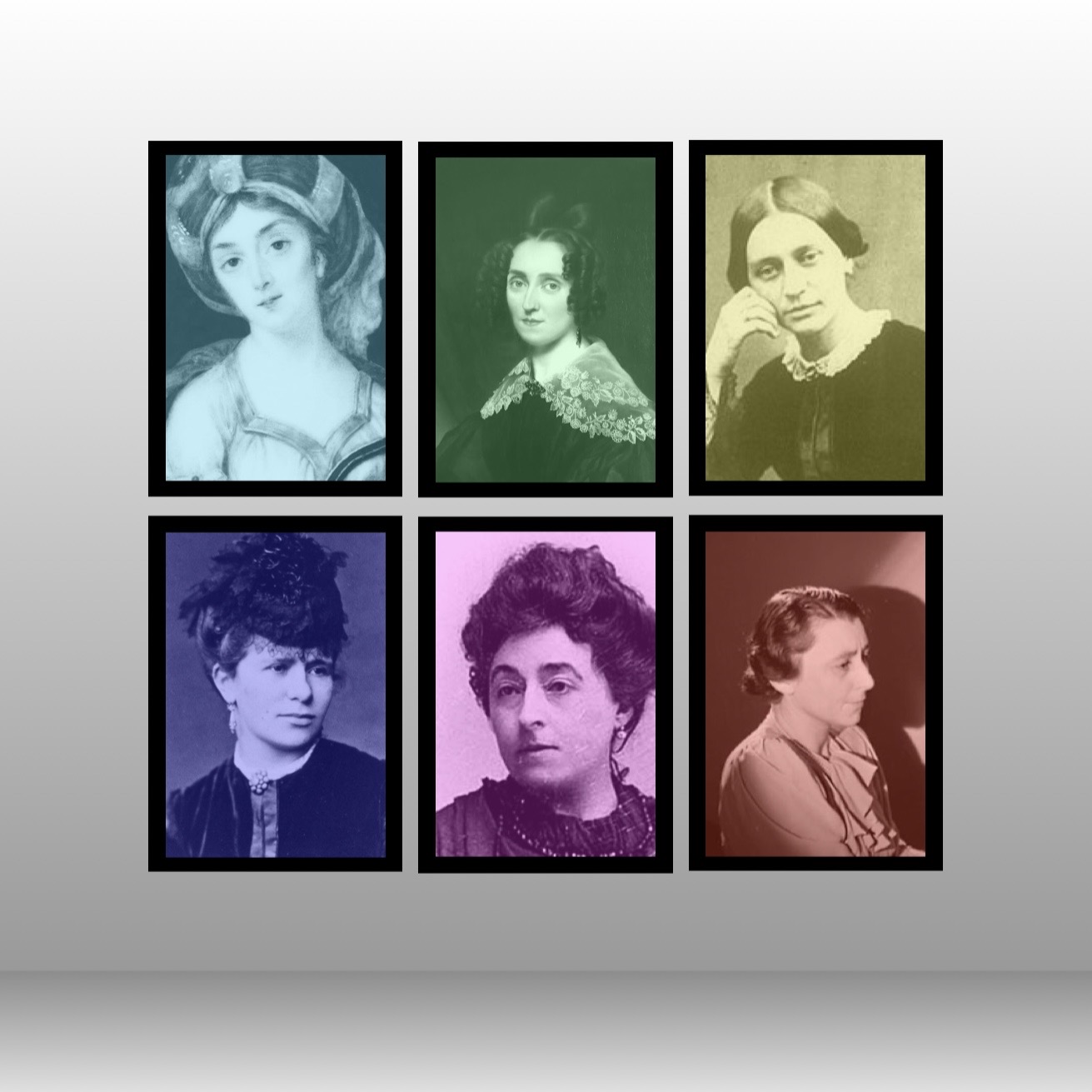
I’d like to invite you to explore seven works by female composers, each of which I’ll recommend alongside a reference recording. This article is therefore as much about discovering new compositions as it is about discussing interpretation.
Hélène de Montgeroult (1764-1836)
Piano Sonata No.9 in F-Sharp Minor, Op.5 No.3
A prominent figure in the salons of the Ancien Régime, whose position was threatened during the Revolution, and eventually a distinguished professor at the Paris Conservatoire — and the first woman in the institution’s history to be appointed as a professor in the boys’ class — Hélène de Montgeroult was above all a pioneer, at the forefront of composition at the turning point between Classicism and Romanticism. Moreover, her works, including her fabulous études, bear witness to a style of writing far ahead of its time — she seems to herald, or indeed truly foreshadow, Schubert, Schumann, and even Chopin. Resolutely pianistic, her approach embraces the full range of pianistic possibilities, with an extraordinary sense of polyphony coupled with a remarkably subtle variation in rhythm — particularly through ornamentation.
The Piano Sonata No. 9 reveals a style of expression that is already fully Romantic, whilst synthesising all the innovations stemming from Classicism. Montgeroult develops a striking sense of theme here, carried by an extraordinary art of variation. Edna Stern, on this fabulous album released in 2017, adds to the expressiveness with plenty of rubato and breathing space, and creates a real contrast by playing on the internal tension of the movements. The rest of the album is devoted to the études, conceived by Montgeroult for learning the piano, and which are just as remarkably musical in their own right.
Louise Farrenc (1804-1875)
Symphony No.2 in D Major, Op.35
Louise Farrenc was an exception. At a time when women’s compositional output was confined to what was known as ‘salon music’, Farrenc composed several symphonies, which enjoyed remarkable success in their day. So much so that, since any praise for a woman at the time could only be measured against the work of men, contemporary reviews noted that she was every bit as good as her male colleagues. She was, however, initially confined to her role as a teacher at the Conservatoire, before falling into a long-lasting obscurity, only to be rediscovered recently. Farrenc’s style perfectly embodies early Romanticism, with its heroic themes and the power of determination. The influence of the Classical period is still present, and the musical discourse seems to take shape in recesses and waves, through sweeping contrasts.
Laurence Equilbey has recorded the complete Symphonies of Louis Farrenc, conducting the Insula Orchestra. The historically informed instrumentation does justice to the contrasts characteristic of the orchestral writing of the period, and lightens the orchestral texture — particularly in the strings — to restore bite to the attacks and weight to the winds and percussion. The metallic timbres serve a musical discourse driven by rhythm, anchored in a frenzied intensity.
Fanny Mendelssohn (Hensel) (1805-1847)
Das Jahr
Fanny Mendelssohn is one of the most famous female composers in history. A prodigy of composition from her teenage years, whilst some of her works were published during her lifetime, many were published posthumously. Furthermore, it appears that she was in fact the author of several works attributed to her brother Felix. Travelling to Italy in 1839, where she met Berlioz and Gounod, among others, Fanny Mendelssohn, now Hensel, maintained numerous connections with the intellectual and artistic circles of the time, including Goethe. Her style, deeply rooted in early Romanticism, is characterised by contrasts, with a very strong melodic foundation. An extraordinary pianist, Fanny Mendelssohn-Hensel did not hesitate to make full use of the dynamic range and to explore the immense range of possibilities offered by the keyboard.
Das Jahr – The Year -, composed in 1841, undoubtedly reflects the year the composer spent in Italy. It is an exceptionally rich work, in which different forms coexist and sometimes contrasting moods follow one another with remarkable coherence. Marie Vermeulin, in a recording released very recently on the Présence Compositrices label, plays extensively on the colours, atmospheres – notably through her use of the pedal – and the various emotional registers present in each piece comprising the cycle. Anxiety is a recurring motif, even during the summer – particularly in « June ». Yet nostalgia seems to haunt every phrase, and a rare elegance is woven into Vermeulin’s phrasing alongside this ever-dual perspective. Each piece possesses a remarkable uniqueness, and many feature distinct themes and wide variations in intensity.
Clara Schumann (Wieck) (1819-1896)
Piano Trio in G Minor, Op.17
Clara Schumann is undoubtedly the most famous composer in this selection. A pianist of genius, she led the career of a true icon, touring extensively throughout Europe. Nevertheless, her Trio, Opus 17, demonstrates her genius at work. Alternating between heroism and nostalgia, each theme is memorable. Composed in 1846, this constant play on variation already foreshadows Brahms, who would write his first Trio in the 1850s — might one detect, among all influences, that of Clara Schumann’s Trio? Quite possibly. And even more so, heroism and nostalgia intertwine and sometimes echo one another within the same phrase, lending a dual hue to a resolutely complex work. The fullness of the chords finds perfect fulfilment in the continuity of the themes’ expression, and this interplay of verticality punctuating the horizontality of the unfolding phrases.
The Nash Ensemble’s interpretation lends an additional layer of depth to the Trio through its refinement, its focus on clarity of expression and the colours of the timbres. At the same time, the richness of the sound lends substance and depth to the dialogue between the instruments, which remains particularly intelligible.
Marie Jaëll (1846-1925)
Piano Quartet in G Minor
Although she was initially recognised as an extraordinary pianist, what truly inspired Marie Jaëll was composition. Camille Saint-Saëns, with whom she had studied, described her style as ‘the bursting forth of a devastating torrent’. She eventually became a composer of her own time, whilst simultaneously conducting research into the psychology of musicians with Dr Charles Féré, which led her to propose a method for teaching the piano — which she supported through the publication of several treatises. Marie Jaëll’s style is rooted in intensity. In this Piano Quartet, there is a dramatic, almost theatrical dimension. The musical gesture is constantly renewed, finding support in music that seems to be perpetually sculpting, through a constant concern for texture. The expressive power is absolutely extraordinary! Jaëll has also composed works for solo piano, as evidenced by her fabulous Pièces pour piano d’après une lecture de Dante, recorded notably by Célia Oneto Bensaid for the Présence Compositrices label.
The extraordinary label La boîte à pépites, a spin-off of the Cité des compositrices association, truly lives up to its name with this volume entitled “Une quête d’inifini” — “A quest of infinity”, a subtle rebuttal to the all-too-common misconception that female composers have never composed anything other than salon music. As always with La boîte à pépites, the ensemble is marvellous: Léa Hennino, Héloïse Luzzati, Manon Galy and Célia Oneto Bensaid bring richness and sonic fullness to the music, whilst emphasising the dramatic and theatrical dimension without ever compromising the vocal line. We thus discover a fully-fledged, (post)Romantic style of remarkable depth.
Rita Strohl (1865-1941)
Grande Fantaisie-Quintette
Rita Strohl is a multifaceted artist. Her work spans almost every musical genre: vocal music, chamber music, solo repertoire and symphonic music. Her style is both a powerful personal statement and, at the same time, seems to symbolise a remarkable synthesis of the compositional forms that preceded her – from Bach’s contrapuntal writing to Wagner’s constant transition. Her Grande Fantaisie-Quintette is indicative of a taste for the — very — large form. The work is ambitious. It is built as much on rupture—particularly between themes that are as singular as they are memorable—as on continuous variation. Coherence is thus ensured by a form of progression within a constantly evolving atmosphere. Everything is in a state of perpetual transformation in Rita Strohl’s music.
Once again, the composer’s rediscovery has been made possible by La boîte à pépites. The label has released a three-volume series, the second of which is devoted to Rita Strohl’s chamber music. It features a superb Septet and a brilliant Piano Quartet, but the most remarkable work is undoubtedly this Grande Fantaisie-Quinette. The volume is entitled ‘Une compositrice de la démesure’ (A Composer of Excess), which once again highlights the composer’s ambition. The performers—Suishi Okada, Alexandre Pascal, Léa Hennino, Héloïse Luzzati and Célia Oneto Bensaid—lend Strohl’s music a true grandeur, in a vision that brings out the orchestral aspects of the work.
Marcelle de Manziarly (1899-1989)
Piano Trio
Deeply influenced by the teachings of Nadia Boulanger, to whom she dedicated a quartet, Marcelle de Manziarly’s work stands at a crossroads. It lies at the intersection of several cultures, particularly Slavic and French, but also of various musical movements, notably atonality. It is a modern work that constantly pushes the boundaries of tonality. Also a conductor, polyphony is a central concept in Manziarly’s style. An eclectic style, shaped by diverse influences. The Piano Trio is certainly a highly narrative work, yet it reveals itself above all as one of immense tension. The atmosphere is deeply anxious, the musical discourse highly disjointed, punctuated by an extraordinary sense of architectural structure.
The performance by Cecilia Zilliacus, Kate Raitinen and Bengt Forsberg is imbued with infinite poetry. Each phrase is crafted with finesse, and the timbres reveal the full impressionistic dimension of the work. Beauty, poetry and anxiety are not antithetical; here, all three are brought together, whilst allowing each instrument to retain its individuality. The timbres are as colourful as they are concrete; they represent and embody not only emotions, but also sensations. Ultimately, this is a work that is not only atmospheric, but above all immersive, or in a certain sense, palpable.
Laisser un commentaire