
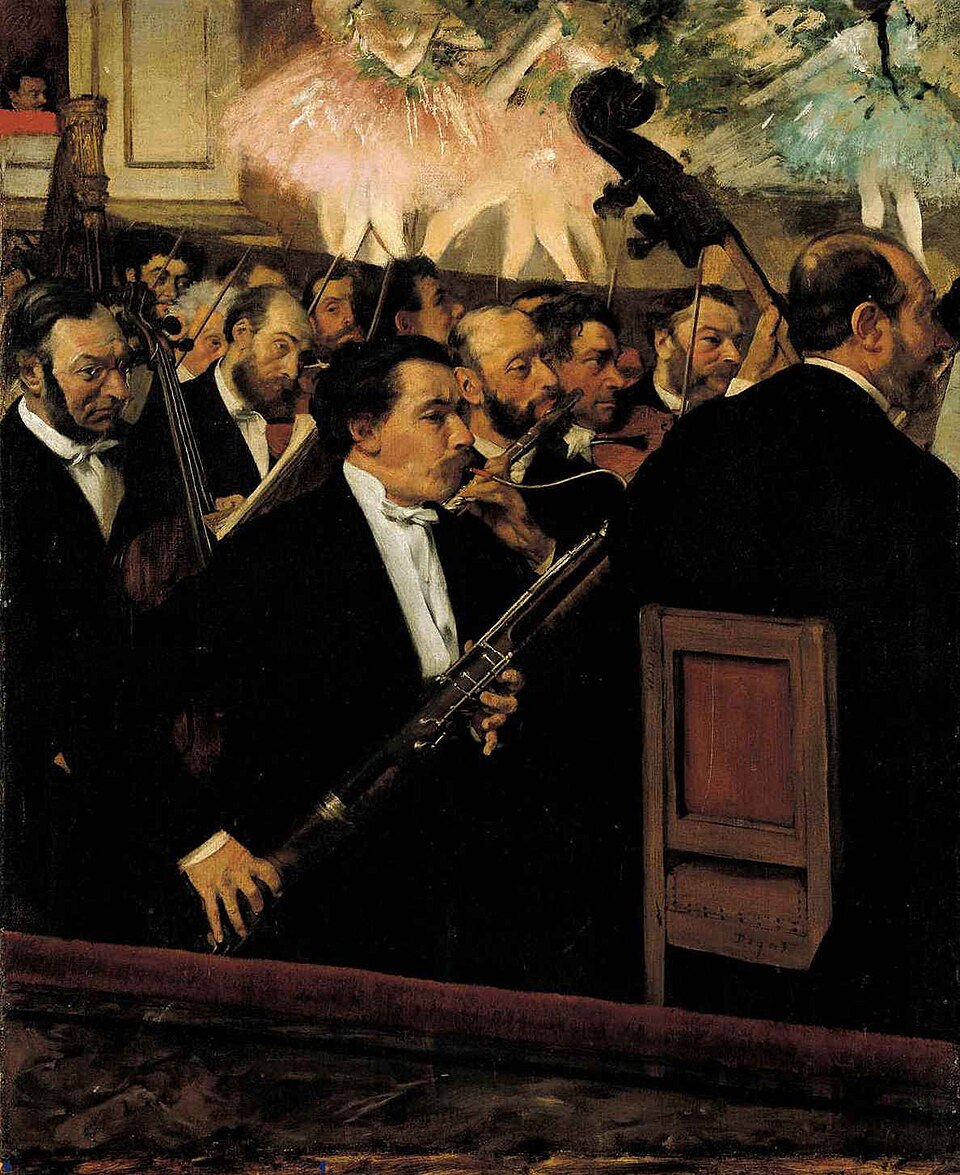
Edgar Degas, L’orchestre de l’opéra (1870), 56,5 x 46 cm, Paris, Musée d’Orsay
Here are some translated excerpts from an interview I gave in French to Hélène Macaire, from the podcast ‘Business as an exciting work of art’. I discuss the possible philosophical implications (I hope) that arise when studying the phenomenon of musical interpretation, and then I return briefly to my own journey.
Hélène Macaire: I wanted to begin this discussion about performance as art with the following question: what does performance as art, as original creation, mean to you, and in what way can a performer be considered an artist?
Guilhem Chameyrat: Well, perhaps the first thing, the first word that comes to mind when talking about interpretation, in this case musical interpretation — and perhaps not only musical, but today we are talking about musical interpretation —, is otherness, as musicologist Joëlle Caullier already stated in a superb article (in French) from 2011 entitled ‘The Art of Interpreting Music: An Essay in Cultural Anthropology’. In other words, we encounter otherness, we encounter subjectivity in performance, and we encounter a subjectivity that expresses itself, even if the scope for this subjectivity to express itself is not always the same, as the basic form is more or less fixed from this point of view (and then, as we shall see, there are contextual conditions that mean that the form is more or less fixed in advance of the interpretation). But interpretation is also an act of creation because it is an act of empathy. I will return to Claudio Arrau, and there is a quote from Arrau that really struck me, in which he says that being an interpreter means being possessed, and above all, making yourself into someone else. And that always puzzled me because I had the idea that musical interpretation is, in a way, using an existing form to express oneself, almost on top of it. And while it’s true, I still think so, that great interpretations make a vision that would not be self-evident seem natural, there’s more to it than that. Being an interpreter means empathising, and it’s not just about sympathising, and that’s where there’s a slight difference. Sympathy would be listening to your first intuition, the expression that has not been filtered through a certain amount of work on yourself, and it would be expressing yourself by effectively using the work as a support, in other words as a means. But the work is also, in a way, an end in itself, and the performer is a kind of medium, subject to a double otherness. On the one hand, they inevitably encounter the composer, and they encounter the composition itself. They often begin by making a so-called naive reading, to immerse themselves in the work, to try to rid themselves of their preconceptions, and to truly encounter the work. But on the other hand, if there is this initial otherness, the interpreter will convey their vision to another otherness, which is that of the audience. And so, they are caught between the two, and they will try to reconcile them, to become not just a conduit, I don’t want to say a vector either because that would be neutral, basically, the performer is what is central here, it seems to me, because they make the work function. So, functioning is a funny concept that comes to us from a fairly contemporary analytical philosopher named Nelson Goodman, who talks about functioning in the implementation of works of art. For Goodman, when a work functions, it is because it is capable not only of changing our view of itself (I am deliberately exaggerating), but also of changing our view of the world in general. And interpretation, in a way, has this task. That is to say, not only is the public not always able to access works in such an ethereal way, even if we never approach works, even when we read music, without presuppositions, without prior concepts, without prejudices too. And so, from this point of view, interpretation has the task of showing us a number of facets, which together form a whole. And from that point of view, the performer, coming back to empathy, it seems to me that this is the meaning of Arrau’s quote, that he must not only have the desire to project what he feels in his flesh onto the work, but he must also be able to shift his perspective in order to change his preconceptions, the patterns through which they reason in order to put themselves ‘in the place’ not only of the composer, but of the work itself, the work already being a totality. The work of an interpreter is so complicated! There is a totality at the base, and then you have to recreate a totality that you deliver to the audience, and it can’t be the work itself in an ethereal way, floating in the sky like that, it’s not possible! And so interpretation… in the end, what we hear is always an interpretation, it is not the work itself, or rather it is the work interpreted, if we want to be more precise. And interpretation is a work because, to use your jargon and the distinction you make between production and creation, it is not just production, it is beyond simple production, it is somewhere where the performer creates something by himself.
H.M.: Thank you very much. To follow up on what you said, something I discovered when I immersed myself in your world is that a score is a series of symbols to be interpreted, that in a way, not everything is written in the score. And what you say leads us to the notion of interpretative choice, which for me is the performer’s own artistic vision, seeing the score in a certain way, with, as you say, the task of resonating with the composer but also with the audience. And I would put it this way: genius sees things that the rest of the world does not see. I really liked the anecdote about Furtwangler, the conductor who said, ‘Everything is in the score.’ And for me, in reality, he heard and saw things that others did not see. It was really his perspective, his structuring, that gave him access to this reading. And I also found the idea that, through their artistic perspective, through their interpretative choices, performers can transcend the music that a composer has created, to be very beautiful and very true. And I really liked the anecdote about Rachmaninoff and Horowitz, which is recounted in one of your podcasts, that Rachmaninoff preferred Horowitz’s interpretation of one of his works, as this performer’s interpretation revealed hidden aspects of his work to the composer himself. So I wanted to know what you thought of my reflection!
G.C.: Let’s go back to the notion of interpretative choice! And in fact, to return to this anecdote about Furtwängler, it’s quite funny, this ‘everything is in the score’! This is all the more remarkable given that, ultimately, there are very few annotations in Furtwängler’s scores. When I spoke of unnatural visions, Furtwängler was often criticised for using works, particularly in a contemporary context in which the form of the works is undoubtedly more fixed than in a post-Romantic setting, but we’ll have time to come back to that. There’s this anecdote where Mitropoulos wanted to see… I don’t remember which of Furtwängler’s scores it was, I think it was Beethoven’s Ninth Symphony, hoping to find what made Furtwängler so brilliant in potential annotations, and what a surprise it was to see that in fact there was not much in the score, because everything was already in Furtwängler’s head! And in terms of interpretative choices, what is essential, it sounds silly when you put it like that, but it’s the idea of choice, i.e. you have to make choices, it’s imperative, and at the same time these choices have to maintain a certain consistency. It often seems to me that there is a certain homogeneity between scientific discourse and the discourse we use to describe the language of musical interpretation. Namely, we will talk a lot about value, but also about the validity of an interpretation. And we will refer to an aesthetic property that we perceive as coherence, which is also a property used in science! There is a fabulous article by Thomas Kuhn, the historian of science, a lecture given in 1973 (if I am not mistaken about the date), which is called ‘Objectivity, Value Judgement and Theory Choice’, in which Kuhn begins by giving what he considers to be the right properties that ensure the validity of a scientific theory. So he talks about coherence, he talks about accuracy, and he talks about fruitfulness. And these are things that we find when we talk about, when we make value judgements about musical interpretations. The first measure of validity of an interpretation is often coherence, meaning that the performer is obliged to make choices (particularly for performers who may have a holistic view of the melody, who conceive of the melody as a whole, because if one conceives of the melody as a whole, especially in an orchestra, then the sound of the orchestra must be unified, which is far from easy for a conductor, for example). So there is consistency, but there is also accuracy, namely whether we are fundamentally respecting the score, and there is this notion, which is perhaps semantically a little more vague, of the spirit of the work. Are we respecting what the work is supposed to mean? The question then becomes: where does meaning come from? Is meaning something that the performer ultimately ensures through the consistency of their interpretative choices in general, or can we take a slightly more realistic approach and say that we need to consider the concept in a somewhat negative light, namely that, of course, we cannot know what the composer had in his little grey cells, that’s not possible, he died a little too long ago in general, but on the other hand we can understand it in a certain negative way because there were undoubtedly things that could not be represented in the composer’s mind, and those are impossible things. And within the concept of the spirit of the work, we can include this kind of thing, namely that an interpretation which consists of a vision of the work that is radically impossible in the composer’s vision, particularly today via a revolution, we will have time to come to that, in the field of interpretation initiated by research into the historicity of works, the manufacture of instruments, period instrumentation, practice in general, and well, we realise that we cannot do everything effectively, and therefore we can take a slightly more realistic approach to accuracy. I will no doubt have time to come back to this, but ultimately, in interpretation, there is a dual challenge of authenticity. Authenticity, an essential value in artistic expression, is questioned twice in the act of musical interpretation, it seems to me. And then, regarding fruitfulness, which I already discussed with Goodman, it is the idea that making a work work for the audience means being able to change the audience’s perception of it. Goodman adds that, in a way, the audience must be able, when perceiving the work through their aesthetic reception of it, to understand the artist’s thought process, to understand what went on in the artist’s mind. And that is also what interpretation allows us to do. It seems simple enough, but we deliver a vision when we interpret.
H.M.: Thank you very much. You’re touching on one of my favourite topics, which is art as an experience of transformation as a creator, as an artist, but also as a beneficiary of the work. And I wanted to explore this further, even though you’ve already given some answers, which in your view form the basis of a great interpretation. And there are two points that I picked up on when I immersed myself in your world. The first is that great interpretations make a vision that is not self-evident seem natural. And the second is that great performers give the impression that the music is being created in the moment, and that is what makes the music real, organic and alive. So I wanted to explore these two points a little more deeply with you.
G.C.: So, to talk about it, and to judge, or at least to try to formulate judgements (I don’t claim that my judgements are necessarily correct, or that I have no preconceptions, etc., I don’t claim that at all). On the other hand, it seems to me that there is a preconception to be acquired somewhere, a concept to be acquired before taking an interest in musical interpretation, if I may say so (or, well, it might come in handy in class!). I was talking about otherness, and basically, otherness means allowing yourself to be available, making yourself available. You said: we resonate with an interpretation. Resonance is a concept that can remind us of (I reason a lot with people, I should point out) Hartmut Rosa, who has written a huge book on the subject, called Resonance, and Hartmut Rosa talks about this relationship that we can have with others, with strangers, with objects (it could be a musician with his or her instrument), or even simply with the world, with the axis of the world, and then to oneself, of course. According to Rosa, resonance certainly cannot be achieved on demand: ‘you cannot obtain resonance on command’, as he puts it. However, it does require allowing oneself to be touched, to be open. And that, to me, is a prerequisite that seems to me to be fundamental to the reception of interpretations. Why? Because it allows us to remain open. I was saying that great interpretations make a vision that is not necessarily self-evident seem natural, and in fact this can destabilise us, so we probably need to be able to appreciate interpretations that go against our usual visions and conceptions of certain works. Of course, this does not mean that we have to accept everything, and that, particularly in the case of criticism, for example, we cannot question certain interpretative choices based on factors that we may consider objective. That’s the first thing. Great performers make a vision that doesn’t come naturally seem natural, and that involves taking a certain amount of risk. The act of performing involves taking a risk in some way, and it also involves taking a risk because, quite simply, performers are delivering a vision that does not come naturally, and they are simply delivering it to an audience, and the audience is not a unified reality either. And on that note, I’m going to move on to the idea of creation in the moment, to this idea of the present of performance. It seems to me, but this is really personal, it’s nothing more than a personal intuition, but one that often follows me (or that I often follow, I don’t know in what order it works!), that great performances actually give me this impression of closing me in. That is to say, I am trapped in the present, like when you watch a great film, whether it is very deconstructed, disjointed, or whether it is a series of scenes that apparently have nothing to do with each other and will be resolved at the end, as some filmmakers do, we are still anchored in the present, we are locked into that present, we cannot escape it, and at the same time there is a certain pleasure in remaining in that present and feeling locked in, at the same time, we touch on what seems to me to be an essential aspect of musical discourse in general, which is tension. The key is that there are several ways to maintain tension, and that a tension that appears to be hollow and wave-like, with the hollows still being perceived as tension, can be just as valid as a very tense vision, which in a way breathes less, or appears to breathe less, because tension still implies an aesthetic experience, and this aesthetic experience is that of the spectator, who needs to breathe, particularly when faced with discourse and even in the presence of a language such as that of music.
H.M.: So, as you mentioned in your introduction, your work is primarily philosophical, and you told me during a conversation that, in music, philosophy tends to focus either on composition or on the reception of a work, but little or nothing on interpretation. I wanted to ask you the following question: in your opinion, how is it disruptive and fruitful to think philosophically about interpretation, to develop a philosophy of interpretation, and in particular of musical interpretation?
G.C.: It seems to me that, in any case, there is a certain relative lack of thought in the philosophy of musical interpretation. That doesn’t mean that nothing has been done, which is not true at all; there have been attempts, but they are actually quite rare. In general, yes, we tend to think of music in two ways: from the perspective of the composer, who is considered the ultimate creator in music, the one who, in a sense, arranges musical forms, so to speak; and then the other perspective is obviously that of aesthetic reception, which has been of great interest to questions of the philosophy of perception, because we perceive something in music that has no visual appearance, but which we often thematise through the visual (we often use visual metaphors to talk about music in general, and this is actually quite fruitful), and so in the history of philosophy, philosophers have been very interested in the reception of music and how we receive this duration, this flow, these protentions and retentions, namely these kinds of preconscious acts in Husserl in particular. But indeed, the interpretative gesture, which is discussed in other fields, obviously the most paradigmatic field when it comes to thinking about an application of interpretation is exegesis, which has been done a lot, but it seems to me that it is all the more interesting to explore these questions because, in the background, the interpretative gesture is nevertheless a creative gesture because, quite simply, I was talking about otherness, and between the two othernesses that the musical performer is confronted with, there is also his own subjectivity, his subjectivity that is expressed, the performer expressing a singular art. Ultimately, it is no coincidence that musical interpretation emerged in the 19th century, during the Romantic period, and in a conceptual context that emphasised self-expression, the affirmation of subjectivity, and, more simply, genius. It is clearly no coincidence either that for a long time, interpretation took place within a post-Romantic framework, because it was directly linked to its very origins, which stemmed from the conceptual breeding ground of Romantic genius.
H.M.: So, as we’ve been discussing, thinking that interpretation consists of reproducing a melody is to misunderstand the nature of interpretation. The same piece can be created and recreated in infinite ways, and I suggest we look at this in a very pragmatic way, with a musical excerpt chosen by you and performed by three different performers. What I suggest is that you listen to each piece and give us your immediate interpretation of the performance, as we will have the opportunity to come back to this later in our conversation. For me, in your genius, you are above all an interpreter of interpreters.
G.C.: A few things to say. First of all, I have chosen three interpretations, but I have chosen three interpretations that I love because I found it much more fruitful to talk about interpretations that I simply like. I remember an interview by Sami Habra, the musicologist who for decades was the voice of the French Furtwangler Society, who always spoke so elegantly and wittily, in which he was asked about the conductors he didn’t particularly like, to which he replied: ‘I prefer to talk about the ones I like’. So, I’m not Sami Habra at all, but I totally agree! And, by the way, a few words about this little comparison. So, this is the exposition of the first movement of the symphony ‘Eroica’, Beethoven’s Third Symphony, which I preferred to choose over the Fifth, because somehow there is something, it seems to me, more complex to grasp in the very construction of this exposition. And then I chose to present these interpretations in chronological order, which is very important to me, and we’ll see why later, because you mentioned composing a melody, but there are several ways to compose a melody, there are several ways to distribute interpretative choices, particularly by section in the case of conducting (since we’re talking about an orchestral work, a symphony).
G.C.: So this first version comes to us from 1952, but it hasn’t aged that much in terms of sound technology; it’s very well recorded. It was conducted by Wilhelm Furtwängler with the Vienna Philharmonic Orchestra as part of a studio recording in November 1952. So here, perhaps we could first say a few words about Furtwängler, who was one of the most representative conductors of a resolutely romantic, or in this case post-romantic, approach to conducting. And so, fundamentally, Furtwängler belongs to a certain paradigm. Yes, because I’m going to return to my metaphor of homogeneity between scientific discourse and musical interpretatio! And I’m going to refer to Kuhn again! Beyond the 1973 article, Kuhn wrote The Structure of Scientific Revolutions, in which he forged this concept of paradigm. It is important to understand that, for Kuhn, within the context of a scientific community, a paradigm is a kind of working basis, a foundation that guides research while setting certain limits on the activity of scientists. And so here, we are dealing with an approach that I propose to call sonnant. Why sonnant? Because the determining principle, particularly for Furtwängler, is how it sounds. It was Celibidache, who claimed to be his pupil (but did Furtwängler have any pupils? That’s a big question), who one day asked him, ‘But Master, how do you choose the tempo?’ Furtwängler looked at him, like this, and then replied: ‘It depends on how it sounds.’ And that is essential. In other words, the determining principle of post-Romantic interpretation is to base interpretative choices on the effects they will have on the listeners’ perception. This is a fundamental principle, and in certain cases, which are not isolated, it can justify modifying the composer’s work, which, as we shall see, in the years to come will be rendered impossible in the practice of interpretation. And so, to speak specifically about Furtwängler, we find, still in line with this post-Romantic approach, a very holistic vision of melody. Melody is taken as a whole. Furtwängler’s idea is that there should be a great unification of the orchestra, with that orchestral sound, the famous ‘Furtwängler sound’, which is a bit like a crackling fire. And then, we could add that with Furtwängler, there is really an organic vision of music, which, unbeknownst to many, is not necessarily self-evident. There is an organic vision of music, and all of this is captured in a form of naturalising metaphor that was very prevalent in the post-Romantic era. Melody is truly seen as an organism, and naturalness is a fundamental value. So, now that I have outlined these preliminary concepts, let us turn our attention to this specific interpretation and read a little, or listen a little, and make ourselves available to listen to this version by Furtwängler! The first thing that strikes me is that there is a lot of tension, despite a great deal of flexibility, a flexibility that is primarily embodied (and, if we are honest, this is often one of the first things we notice in a performance) in the tempo. You simply notice the flexibility in these inflections, i.e. Furtwängler varies the tempo enormously. As an aside, when you’re not used to listening to classical music, this seems all the more surprising given that contemporary music is much more focused on the idea of a more stable rhythm (well, except for certain areas of contemporary avant-garde music), but the fact remains that we notice this tempo that varies all the time, and basically it follows this idea that we find formulated again in his ‘disciple’ (in big quotation marks) Celibidache, who has a brilliant, simple phrase: ‘tempo is a condition’; tempo is not an end in itself, and so tempo is a condition here of this flexibility that maintains tension. And, according to Sami Habra, who, as I said, was the voice of the Furtwangler Society for decades and was undoubtedly the greatest specialist in Furtwangler’s art in his day, it was this tension that made Furtwangler’s chords so beautiful. The chords in question are the two famous chords, the two tutti that open Beethoven’s Third Symphony. Some performers, notably Toscanini, who was Furtwängler’s great rival in the 1930s and 1940s, seem to produce a ‘chak, chak’ sound, whereas with Furtwängler, the chord is much more spread out. Often with Furtwängler, we notice this particularly in the development of this exposition, where the chords are spread out in a way: first the strings come in, then the brass, then the timpani, which anchors the breadth. Except that all this happens in less than half a second! And yet we perceived this kind of shift. And so Sami Habra (incidentally, a metaphor that I find fabulous), on the subject of this ‘Eroica’… so, was that the interpretation? Because it must be remembered that, as Furtwängler had in mind the effects that the interpretation would produce, he adapted his interpretation — no two performances were ever exactly alike with Furtwängler; each performance was linked to a particular context, and no two were really alike. Moreover, I deliberately chose a studio recording because, as soon as he was able to record on tape, which, unlike 78 rpm records with their 4½-minute limit, allowed for long takes, and Furtwängler, who offered this art of flexibility, which also needed to spread out over time, to develop like an organism, and therefore according to a certain totality, Furtwängler’s art in the studio thus changed radically and he was able to find, I wouldn’t necessarily say fulfilment, but at least more fulfilment with tape recording, and so Furtwängler, in this case, to come back to it, adapted to the studio experience, because he was aware that an interpretative choice in public, in the tension of the concert hall, does not have the same scope and effect on the listener as when the listener hears the interpretation in their living room, with that unique experience that is the record… And so I return to the words of Sami Habra, whom I quoted earlier: Sami Habra compares another conductor of the time, Otto Klemperer, to Furtwängler. With Otto Klemperer, he says, one has the impression of seeing the standing stones of Carnac. Except that with Furtwängler, ‘the stone is alive’, and I think that’s brilliant! And so, to conclude on that note, it really is a symbolic interpretation of the romantic vision of the interpretative gesture. It is directly linked to the very birth of the figure of the performer as an artist in his own right, a figure that was largely built around the emergence of other specific figures, such as the conductor, the soloist and, of course, Wagner, because if Furtwängler interpreted Beethoven so well, it was because he had read Wagner’s conception of Beethoven, a conception that was essentially that of music in permanent transition. And this music of permanent transition is typically a marker of this organic metaphor.
G.C.: So in this interpretation, as we can hear right away, the sound of the instruments has changed significantly, and we’ll see why in a moment. This interpretation is conducted by Frans Bruggen, who leads an orchestra called the Orchestra of the Eighteenth Century. This time, we are in 1987, years after 1952. We are in the midst of a paradigm shift, from the sound paradigm, which is directly linked to the birth of the performer in the Romantic era, to post-Romanticism, and this time a new paradigm is emerging, which we could perhaps call the principled approach. Why? Because the principles of interpretation must now be immanent in the text itself. Kuhn says that in the context of scientific activity in general, there is a discovery and this discovery breaks down boundaries, it challenges the very foundations of the paradigm, and so we are forced to move into what Kuhn calls a period of extraordinary science, and so this extraordinary period in musical interpretation comes about through historical research, scientific research. A new scientificity has been grafted onto the artistic practice of performers. This research focuses on the historicity of works in general, and in particular on the craftsmanship of instruments, which is why I said that the instruments sound different. Why? Because these are period instruments, or replicas of period instruments. And so we can hear that the dynamics have changed. Why? Because this time, the composition of the orchestra has changed, simply because we have returned to period instrumentation, and we notice that the strings are less powerful, less homogeneous, and at the same time, because they are less powerful, they are somewhat dominated by the brass, which sound relatively similar to what we heard in Furtwangler’s recording. On the other hand, the woodwinds perhaps have a little more acidity, a little more bite, which amplifies the contrast in dynamics. And then, obviously, the sound is generally dominated by the timpani, because the instruments sound less loud, the timpani, and therefore the percussion is re-evaluated, in Beethoven’s music, which puts it at the centre of the discourse, which is really punctuated by the percussion. And so, the challenge of this principled approach, which Bruggen adopts here in attempting to offer a plausible interpretation of Beethoven’s life (even if, once again, we do not know what Beethoven had in his little grey cells), is essentially not to distort the work, and this can be understood through a certain alliance between a certain scientific approach and its artistic embodiment, through what is known as “historically informed” interpretation. First it happened in Baroque music, then in Classical music, then in Romantic music, and then it spread, with the idea of being able to interpret all the works in the history of art music under the conditions in which they were conceived, the conditions of instrumental construction, and somewhere there is the idea that today musicological research finds artistic expression in the recordings made by performers, who maintain an artistic dimension in their practice. But this new scientific approach has also been grafted onto it, and with it a form of objectivity. However, this obviously does not mean that the sound dimension has been lost. Of course we continue to make sound! Of course there are artistic issues at stake! And earlier, in response to a previous question, I spoke of a dual dimension of fundamental authenticity in the interpretative gesture in music. In fact, authenticity is a central concept in performance, but ultimately, its connotation seems to have changed. That is to say, in the past, authenticity was above all that of the performer who was expressing themselves, the performer as artist, the performer as genius. It was their genius that was being expressed, it was the affirmation of their subjectivity. And to be authentic is to be an authentic performer who affirms his own vision. Nowadays, while it cannot be said that this conception no longer exists, authenticity has taken on a stricter dimension, that of not proposing interpretative choices that are untenable in the context of the time of composition. Authenticity is also the accuracy I was talking about when I referred to the values that make a scientific theory valid, according to Kuhn. So now let’s talk about Bruggen’s interpretation itself! Because I have talked about presuppositions, but obviously there is interpretation, because once we have said that, we must bear in mind that subjectivity is always still expressed in interpretation! Just because there is scientificity, a new form of objectivity, does not mean that there is no artistic expression. And Bruggen was particularly inspired in this respect. It’s funny, I was talking about fertility, through Furtwangler, and through this organic vision of music, which he casually maintains. And this art, one could say of monumentality, almost cathedral-like in Bruggen, this art of architecture, of breathing while having an extremely wide orchestral colour palette, both brilliant and at the same time retaining the necessary sobriety, it is not routine, one could say, basically, there is a kind of brilliant saturation, with shadows that are themselves matt, if I think in terms of colours (I like to think with synesthesia, music). All of this is part of an art of architecture and breathing that leaves room for silence to magnify the naturalness of the discourse.
G.C.: So, I wanted to show you how it’s done today. And so I became interested in this interpretation, which I find absolutely fabulous, by Kristiina Poska in 2021, conducting the Flanders Symphony Orchestra. Here, once again, we are in the presence of a principled contemporary approach. The principled approach has really taken hold today, it seems to me, but this time we are not dealing with period instruments. In other words, we have taken certain results obtained through research using period instruments and transposed them onto modern instruments. So, we are still using modern instruments, and indeed, we can clearly see that the instrumental technique is smoother. But despite this smoother instrumental technique, we have taken into account research on dynamic contrast, which nevertheless allows us to get closer to what was in use at the time of composition. And so, to talk specifically about Kristiina Poska’s interpretation, which I find truly brilliant, and which is not talked about enough, the first thing I want to say is quite simply that there is a crazy energy. There is enormous tension, and at the same time, unobtrusively, there is a certain sonic penitence: listen to the sound of the woodwinds, it’s fabulous, it’s colourful and at the same time there is a certain softness, which is very well balanced by the bite of the attacks in general. But there is also a great deal of flexibility in Poska’s approach, which also means that flexibility has not disappeared with the principled approach! We continue to interpret, we continue to express ourselves! And I’m talking again about the intensity, the beauty of the timbres, formal one might say, but without the glitz or the showmanship. And that’s always a risk. We haven’t talked about it until now, but basically, the risk when you interpret is to say, ‘This is my vision,’ and basically, beyond delivering your vision, to be demonstrative, to want to make a demonstration. However, we are quietly engaged in an artistic practice. In a way, we could say that if the performer demonstrates, they interpret more. And to conclude on this interpretation by Kristiina Poska, I would say that we are very far from the permanent transition found in Furtwangler, which originated with Wagner, because we characterise things differently. You mentioned melody in your question earlier, and we don’t necessarily have to have a holistic view of melody; we can give a certain characterisation, and even a certain individuality, to the sections by playing on the contrasts between themes and on counterpoints. This is obviously what Poska does, and he is extraordinary at magnifying the counterpoints – you can hear everything! There is an art to detail, but, interestingly, as Furtwangler said, details are at the service of unity.
H.M.: Thank you so much, Guilhem, for your interpretations of the performers, which I find extremely rich and which spark a lot of cognitive enjoyment in me. It’s something we have in common: I’m fascinated by paradigms and how, in fact, a paradigm ultimately determines creative possibilities and how, as a result, it opens the door (or not) to certain creations. And also, to pick up on one of the last points you made, I agree with you: when we try to prove something, we are no longer in the realm of art. I would put it this way: when we take a didactic stance, we are no longer in an artistic stance, we are in an ideological stance. And for me, ideology and art do not mix at all! I usually put it this way: art is metaphysics that becomes physical, art is the intimate that becomes the extimate that speaks of our obsessions, our existential questions, to which we viscerally need to give ourselves, to create a response in matter. And so, I wanted to ask you the following question: where does this fascination with interpretation come from on your part?
G.C.: Ah! I saw that one coming! It turns out that yes, undoubtedly, it’s almost certainly linked to my life experience, because due to a certain condition I live with, called autism spectrum disorder, for quite a few years now, that is, since I was born, I’ve been somewhat compelled, and without really meaning to, I try to turn it into a strength, but I am somehow compelled to interpret — interpreting is my whole life! And at the same time, I’m sure that at first, I didn’t necessarily understand very well why interpretations fascinated me, because I actually came to love classical music through interpretation. It was when I realised this strange phenomenon: ‘Oh, when I listen to Furtwangler, and then I listen to another performer, it’s fundamentally different, and it’s almost not the same work!’ And it touched something in me that I couldn’t quite identify, but it touched something very deep from that point of view. And I probably became aware of it by telling myself that, first of all, interpretation, if we want to be rigorous, is a fabrication (and if we want to be a little less rigorous and a little more dreamlike, it’s a creation), and that basically, in the interpretative gesture itself, there is both creation and intertwining with otherness… I was talking about otherness, but fundamentally the interpretative gesture itself implies otherness, and there is no need to express this interpretative gesture through an artistic creation, as is the case in the work of a musical performer, to realise that interpretation implies making oneself available for an encounter, and ultimately having to step outside oneself to demonstrate empathy (I return to this difference between sympathy and empathy). And it seems to me that sympathy can be entirely innate in the sense that from a very early age we can be sympathetic by default, which in fact implies that we feel in our own flesh what we seem to see in others. That is to say, what in everyday language we call an emotional sponge: I see that the other person is sad, and I myself am very sad in my own flesh. Except that sympathy sometimes doesn’t help! It can push us, especially when we have certain introversion syndromes, it can push us into isolation, because somewhere we are so deeply affected that in the end we become overwhelmed, and so we need to shut ourselves away (to put it politely) to recharge our batteries! But on the other hand, empathy, whose interpretative gesture seems to me to be closer to what I was saying with Arrau, and it took me a long time to understand this, empathy is basically stepping outside of one’s own patterns, one’s own conceptual-emotional relationships, if you will, in order to touch upon the way in which the grey cells of the other person are intertwined, those that we cannot see, which is a good thing because when we can see the grey cells of the other person, they are generally no longer very much alive! But, all this to say that yes, in a way, when I look back on it all today, the fact of making podcasts about interpretation, there was something a little obvious about it. There was a calling, and you talked about transformation through art, but actually, it’s funny, I always tell myself that when I make a podcast I have to transform myself, meaning that if I’m making a podcast about a performer, I spend weeks listening to the performer’s discography and public recordings, etc., I listen to them, I write about them, I put the podcast together, etc., and after I’ve done the podcast, I still hear what I listened to while doing it in the same way, which means there’s a problem, that I’ve missed something, that I’ve failed somewhere. There has to be a transformation somewhere, because somewhere, I was going to say that there has to be interpretation! It’s not at all a question of saying: « Ah! I compare my practice of criticism (in a way, it’s a form of criticism, not very contemporary, let’s say a little outdated) to an artistic interpretative gesture », that’s not what it’s about! In any case, in my opinion, we shouldn’t be so pretentious. On the other hand, there must still be transformation, there must be change. Otherwise, it means that I have not succeeded in making myself available and in applying to my own being the interpretations that I was nevertheless seeking to listen to.
H.M.: You know how much I love punchlines? I put it this way: if you haven’t been transformed, it means you haven’t truly created. For me, creation is transformative in its essence. And, you see, when I talk about my artistic and creative practice, I know that I need to become the kind of creator who is capable of bringing forth the work that is waiting to be born. And this process of genesis will also be transformative, just like the reception of my work. I am someone who loves to look at and experiment with my works, if I take my pictorial works, because in fact their reception, even though I am the creator, affects me. I’ll close the parenthesis. I told you at one point that, in my opinion, your genius lies in your ability to interpret interpreters, and your work is very special in that it is, in a way, a mise en abîme. I wanted to know what you enjoy about interpreting interpreters and, ultimately, understanding or attempting to grasp the essence of interpretation.
G.C.: Let’s say that I have a weakness for believing that somewhere, when you study works of art (in this case, I happen to be looking at musical interpretations), you can find meanings that are also a little bit for yourself. There is perhaps a slightly selfish side to making podcasts. In a way, I tell myself that by trying to interpret works of art that are themselves interpretations, it’s funny, I’m also going to learn about myself, while having an experience… I’m going to come back to otherness, in fact. In other words, at the heart of it, there is this kind of double movement of encountering another subjectivity that is being expressed. What’s more, from this point of view, it’s all the more interesting because there is material at the base. There is material, after all, that I am familiar with (when you get into the habit of listening to classical works, you simply begin to know them better), and so you know this material at the base, and in fact this makes it all the more possible to identify what is actually being expressed in the interpretation, and only in the interpretation. That’s also what’s interesting. Basically, the idea behind my podcasts was that I was often disappointed when I listened to podcasts about performers, because I really wanted to find some, I searched high and low, etc., and there are some very good ones out there, but often they still focus a lot on the performers’ biographies and biographical details that don’t necessarily explain why a particular performer made a particular choice. The point is that I thought to myself that if I manage, and I don’t know if I will, but if I manage to glimpse the potential reasons why the performer does what they do, and what constitutes their style, then I will have achieved something. And so, what the performer reveals to us, in a way, not only about himself but also about what we perceive in general.
[…]
H.M.: Thank you, Guilhem. Our conversation, which I have greatly enjoyed, is coming to an end. If you would like to say a few final words, what would you say?
G.C. Make yourself available! No, but really, make yourself available, go to concerts because the world of classical music needs it too, and that’s also how you gain real experience. Concerts are difficult! It’s not a simple experience! Sometimes it’s even a bit of a slog, because, although it’s not usual to say so, I think that deep down we’re taking something full on (a bit like when we do an interview, for that matter), and once again we come back to otherness: it’s exhausting! And in a way, we should not only be moved but also simply tired at the end of a concert. That’s normal. And in a way, if we come out of certain concerts unscathed, we have to ask ourselves some questions. It’s funny, I mentioned Mahler’s Ninth Symphony to you. When you come out of Mahler’s Ninth Symphony in concert and you’re not different, even just a little bit, you have to question yourself a little, or else you have to question the interpretation, which is also valid!
 Sofronichrist
Laisser un commentaire