
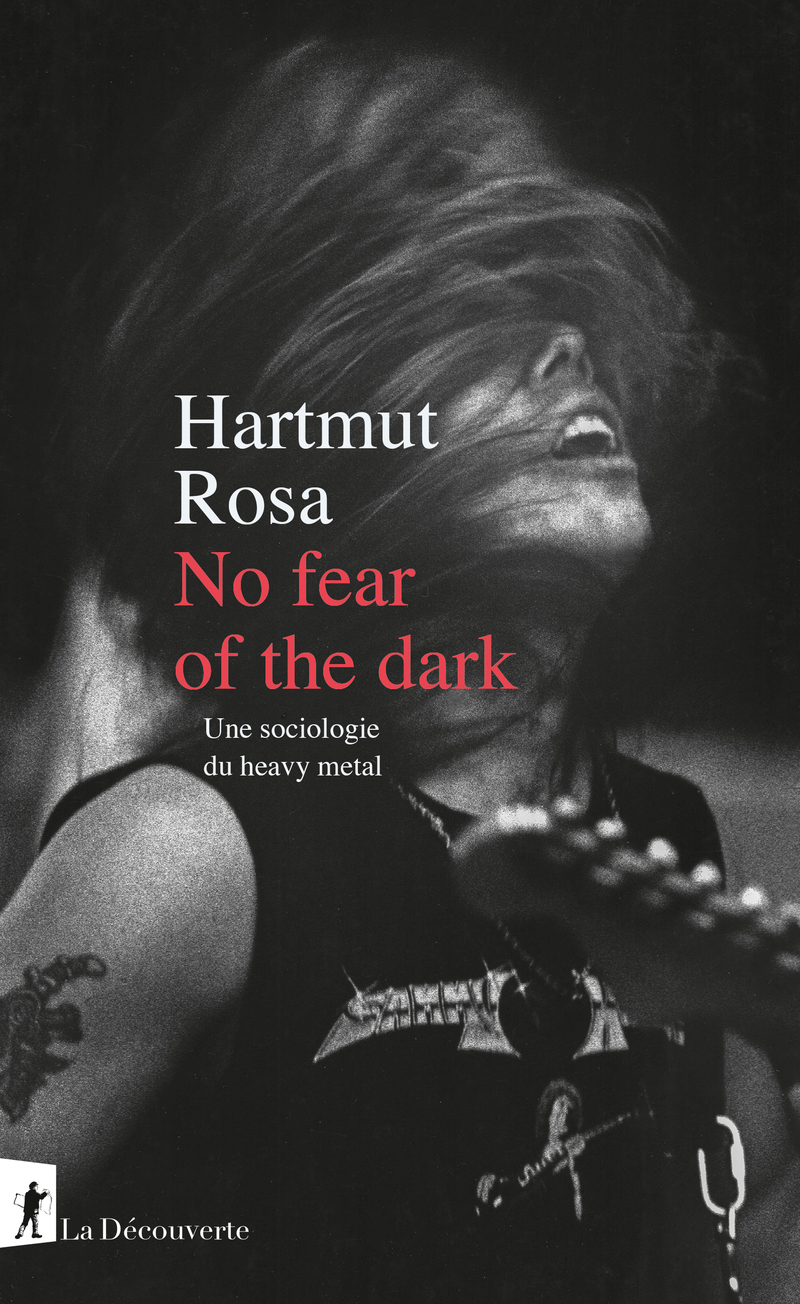
The German sociologist Harmut Rosa, director of the Max-Weber-Kolleg in Erfurt, heir to the prestigious and renowned Frankfurt School – where, at the instigation of Horkheimer and Adorno, critical theory was born, a method aimed at including the discoveries and advances of sociology in contemporary philosophy – recently published No fear of the dark, subtitled A Sociology of Heavy Metal. Being a fervent admirer of Hartmut Rosa and a big « metalhead » – which, it’s true, I’ve never shared on this medium – I rushed out to buy the book. Ever since I discovered heavy metal and the social environments that surround it, I’ve always thought that, although they’re often as much symbols as social groups, metalheads and classical music fans are very similar. In apprehension, commitment, comparison, sound judgement, and of course in the deep faith in music seen not as a means, in other words for ‘use’ – as Rosa puts it – but as an end intrinsically sought for its own sake. Basically, it’s the same kind of enchantment that occurs in both, and the same kind of disappointment that occurs, for example, in the case of a loss of ‘authenticity’. This concept, often used by Rosa, is extremely interesting. Indeed, haven’t we often been disappointed by an artist who, having become well known and won the recognition of both the public and the critics, decides to cross the red line of commercialism? And can we seriously blame artists for wanting to make better and better ends meet? Rationally, probably not, but the fact remains that we are deeply disappointed. Because we expected so much from the new recording, we expected to vibrate to a work that we knew and loved in a new way, thanks to the style, to those essential characteristics that have built this authentic image that we have forged of the artist, and that have linked us to him without us ever having known him.
And to begin with, we need to say a word about the obvious sociological and behavioural links between metal fans and classical music buffs. Hartmut Rosa himself talks about this quite explicitly, as you can see – the extracts I’m reproducing here have been translated into English by myself, albeit imperfectly, as I only have a copy of the book in French – :
It’s something else, as I’ve been able to observe, that really links these two genres: [heavy metal] and [classical music] fans see music as a world apart and attach central importance to it; classical and metal fans don’t just consume music as entertainment, and they use it even less to ‘manage their mood’: what they’re looking for is an authentic and profound musical experience. Of course, there are sportsmen and women, for example, who listen to metal to ‘warm up’ before a competition. But that doesn’t make them metal fans. They’re just metal users.
When you love classical music, not only do you keep a close eye on what’s new, which artists are going into the studio and which works they’re going to perform, but above all you tend, even though the vast majority of us are far from being musicologists, to ‘dissect the music in a quasi-scientific way’. I put inverted commas around it because it’s an exact quote from Rosa about the way metal fans talk about their music. They, too, pay close attention to the reviews and to what’s going on in the scene. Metalheads read Metal Hammer, we read Diapason or Gramophone. Like them, we like to know what’s going on in our musical milieu, which is also a niche one. And Rosa adds a little further on:
It’s hardly surprising, then, that metal fans often reject the ‘playlist’ culture that has now invaded streaming platforms. To put it nastily, many playlist listeners couldn’t care less which artist, album or song they’re listening to, as long as they find the music enjoyable and appropriate to the mood. In contrast, the metal scene remains largely dominated by its attachment to the album as the ‘work’ of a band. That’s why, compared with almost all other genres, sales of metal (and prog rock) CDs are only declining moderately (and vinyl sales are actually rising sharply). In heavy metal, the CD and the LP continue to materialise the ‘work’, which is presented as a total work of art, made up of text, music, typography, image and ‘visual’.
What counts in classical music is the work, and while we sometimes listen to extracts, we are well aware that it is not the work, in the sense that the work is a coherent whole made up most often of several movements that only make sense one after the other and in a certain order. And, to take one example, we sometimes hear the first movement of a work by a performer and find it magnificent, only to find that the second movement is far inferior! And then, while the record is not necessarily completely ruined for our ears, it is nevertheless seriously flawed. For example, I’ve always found Fritz Reiner’s last movement of the ‘Pastorale’ to be a serious detriment to my appreciation of his performance: it drags! Carlos Kleiber, Willem Mengelberg or Wilhelm Furtwangler (except in his 1952 studio recording) play it with a huge organic tension. On the other hand, even if they are rare, conductors who play this movement slowly – even that word is quite restrictive – do exist, such as Evgeny Mravinsky or, closer to us, Jos van Immerseel.
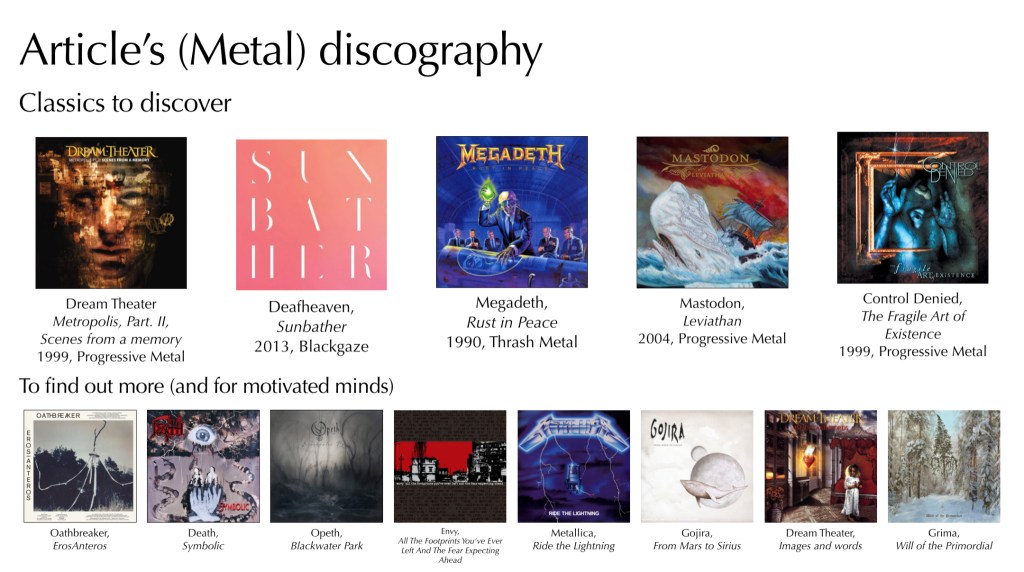
In a way, this is quite analogous to the album culture in metal. A great metal album only makes sense in the order of its tracks, sometimes with purely instrumental interludes, or more electronic transitions. Albums like Metropolis Part.2, Scenes for a memory by Dream Theater, or Deafheaven’s Sunbather – to mention two rather easy-to-access albums – are good examples of this conception of the album as a separate work that needs to be understood in its entirety. And, of course, we shouldn’t forget what heavy metal owes to classical music. Quite a lot, in fact. Metal is a complex, polyphonic and, above all, predominantly – and, above all, originally – acoustic form of music. It’s not uncommon to find instrumental-only tracks on metal albums, and generally speaking, the voices of instruments count for more in this music than the human voice – which often tends, moreover, to move away from clarity and its properly human character, particularly in extreme metal. Many metal bands don’t hesitate to compose complex, polyphonic and – sometimes very – long pieces, in the form of variations on a theme, for example. Progressive metal bands use complex structures, and the instrumental parts are remarkably complex too – this can be listened, for example, in Dream Theater, Mastodon and Opeth, or in a rougher style in Meshuggah, Death (then Control Denied) and Enslaved. Metal is also a music that possesses a certain culture of technicality, in the guitar – with Megadeth, and Marty Friedman’s remarkable soli in Rust in Peace -, in the bass – with the extraordinary Steve di Giorgio in the bands Death and Control Denied – or in the drums – with Morbid Angel, and Pete Sandoval (a band name that Hartmut Rosa points out represents a form of perfect representation of metal, between extraordinary formal beauty and dark ambiences, and sometimes (regularly) it must be said, unhealthy). Metal owes an enormous debt to ‘Western art music’, and it’s not uncommon for musicians in the genre to claim their inspiration in classical music – or jazz, and of course rock, and much else besides.
But the parallels don’t stop there. When we love music, we also love to find little-known artists offering great music. Because it amplifies the bond with them, because we feel privileged, chosen. And the feeling of being close to them forges a sense of authentic commitment. But experiencing music fully and completely is more than just getting closer, and Rosa looks at it through the prism of his fundamental theory: resonance – to which he has devoted an entire book in 2019. Resonance is a ‘mode of relationship’, an ‘experience of entry into the world’. In this way, music touches us in what is deepest within us: our being in the world.
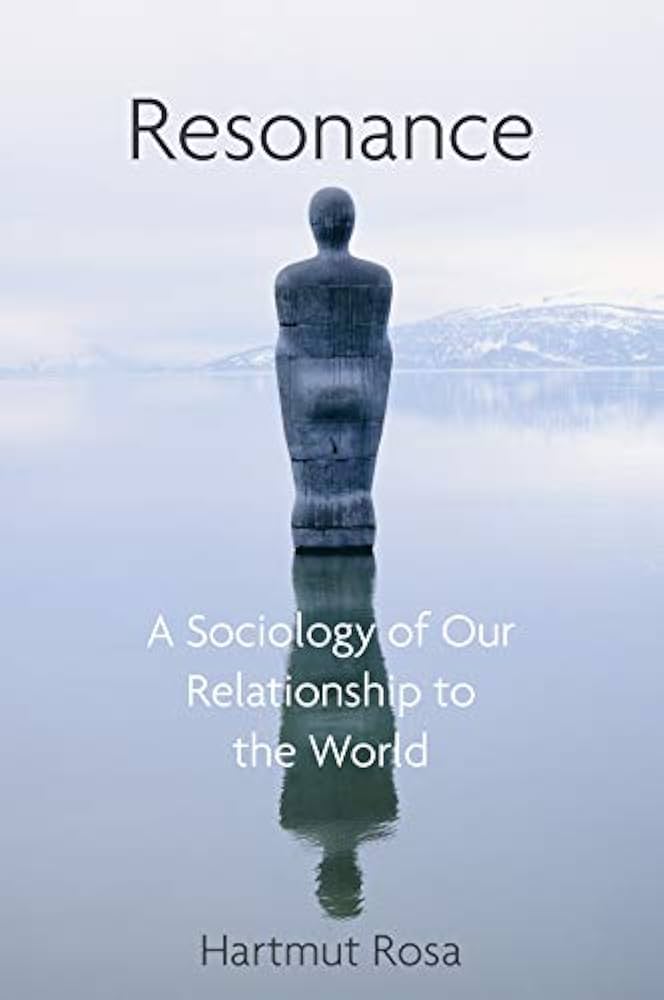
Rosa distinguishes four types of resonance. First, there is the resonance that links us to others, the resonance in which we ‘vibrate with love’: this is the social axis of resonance. Then comes the material resonance, the one that links us as physical beings, as bodies, to fundamental objects with which we interact to enter into a special resonance. Typically, this is what links you to your instrument, which becomes a space of resonance as an extension of your own being, which is not yourself, or even a legal person. Next comes resonance with oneself, which consists of considering oneself as an alter-ego, requiring the engagement of a dialogue, with questions and answers. Finally, and this is where Rosa sees the relationship between metalheads – and I’m thinking of classical music fans too – and their music: the axis of the world and nature. Music is what connects us to the outside world and reminds us of our raison d’être in that outside world. In a world where religions are struggling to provide a response to existential anguish – for Rosa, not least because of their dogmatism, which has distanced them from mutual listening between individuals and from the axis that links the latter to the world, making religions not only apparatuses of injunction and coercion but also apparatuses of knowledge that clash sharply with the discoveries of modern and contemporary science -, In a world where the proclamation of ‘salvation’ clashes violently with the reality of a ‘desert’ existence, with solitude and the experience of emptiness, we have a cultural need for a truly ‘authentic’ response – and it is in authenticity that its credibility is embodied.
But the satisfaction taken in a perfect cadence or the feeling of the fullness of sound of a sequence of major chords cannot be confused with resonance, that is to say with subjective experience – which does not mean individual, but simply that it cannot be studied objectively from an outside point of view, only through empirical observation and the collection of testimonies, which often point in the same direction – of a deep vibration that provides a complex and full link to the music considered for its own sake, to a particularly privileged connection with the musical flow. But it is also the vitality of resonance that resonates with the fluctuating and shifting nature of music. The French philosopher Vladimir Jankélévitch defined music in terms of two essential concepts: the ‘I don’t know what’ and the ‘almost nothing’. For phenomenologists, the musical experience is constituted sensorially by a reconstruction of the melody by the intellect: we are dealing with ‘retentions’, a kind of ‘almost-remembering’ of a moment that has just happened but is still in our immediate mind, in the sense that it has not yet quite passed, and ‘protentions’, anticipations of a future moment, through which we construct resolution, and the principle of dissonance. But while this is a process of consciousness, it is not, strictly speaking, conscious. The truth is, it’s not at all. We have absolutely no control over it.
In fact, Rosa explains it well: resonance is unavailable. That’s its main feature, and it’s also what guarantees its authenticity. Resonance cannot be produced to order. And that’s why an artist can disappoint us. No matter how well he plays our favourite work, with all the elements of his style, if the intention is not fully felt and therefore, in other words, there is no vibration that resonates within us, we will be irremediably disappointed. The music of certain composers particularly reveals the performer’s intentions and approach, and I’m thinking in particular of Schubert and Schumann. There are hundreds of technically perfect and even excellently stylised performances of the Kinderszenen, but how many give us the impression of purity of soul, of innocence, of the painful yet strangely sweet nostalgia of memory? Horowitz regularly played them in tears, and the bond he forged with the audience was one of total purity and intelligibility. He truly resonated with the instrument, with the work and therefore with the composer, with himself, with the audience, and this brought them all together in an abandonment of vertigo, rediscovering the axis of the world.
Music seems to come from within and without, it is within us and we are within it; it is closer to us than our own breath. It touches us to the core and at the same time fills all the space around us. It creates precisely that vibrant connection that we are no longer able to establish intellectually, and which scientific or political explanations of the world deny us. To repeat once again: existential resonance in this sense means an encounter with a non-fixable, with an other that cannot be grasped, forced or controlled theoretically, technically or in any other way. Resonance demands that we accept, on all axes, the unavailability of the other. To put it with Adorno: resonance requires a readiness for a non-identifying encounter; it requires a heart that listens. This, it seems to me, is the very mystery of music: in music we don’t know exactly who we are meeting or what is happening to us.
What listening ultimately means is making ourselves available to an otherness that touches us without our projecting ourselves onto it. To listen to music is to launch out into the unknown, and that requires an extremely strong commitment, since it implies trusting, accepting the otherness that will be unavailable to us out of sympathy, and therefore making oneself available to something that is not subject to any control. The thing about music is that you can’t really describe it in words. This brings us back to Jankélévitch: ‘almost nothing’, ‘I don’t know what’. Music, or the ineffable, is the – French – title of Jankélévitch’s arguably most important work on music.
But because resonance is radically incompatible with any ordering process, with any imperative desire, the encounter with the musical work implies that we fully accept its irremediably incomprehensible dimension – in the sense that we will never be able to fully understand what is going on inside us, beyond the physical processes derived from the senses, such as the mechanism of hearing, the understanding of which obviously in no way accounts for the musical aesthetic experience.
Giving music a central place in our lives means giving up the idea of making the aesthetic experience of music a commodity, and instead making ourselves available in the hope that the work will resonate within us – and sometimes, even with all the will in the world, it doesn’t work, it fails, and we’re disappointed, because our favourite work doesn’t give us any emotion, we’re somewhere else, we’re not available in spite of ourselves. Hartmut Rosa has written a fascinating book about heavy metal, of course, but also about music itself, the extraordinary powers it bestows on those who make themselves available to it, the irreducibility of the musical experience, and of course about what it is that makes music touch us so deeply.
 Sofronichrist
Laisser un commentaire