
The name ‘Sofronichrist’ is a pun on Vladimir Sofronitsky’s name, one of the greatest Russian pianists of the 20th century.
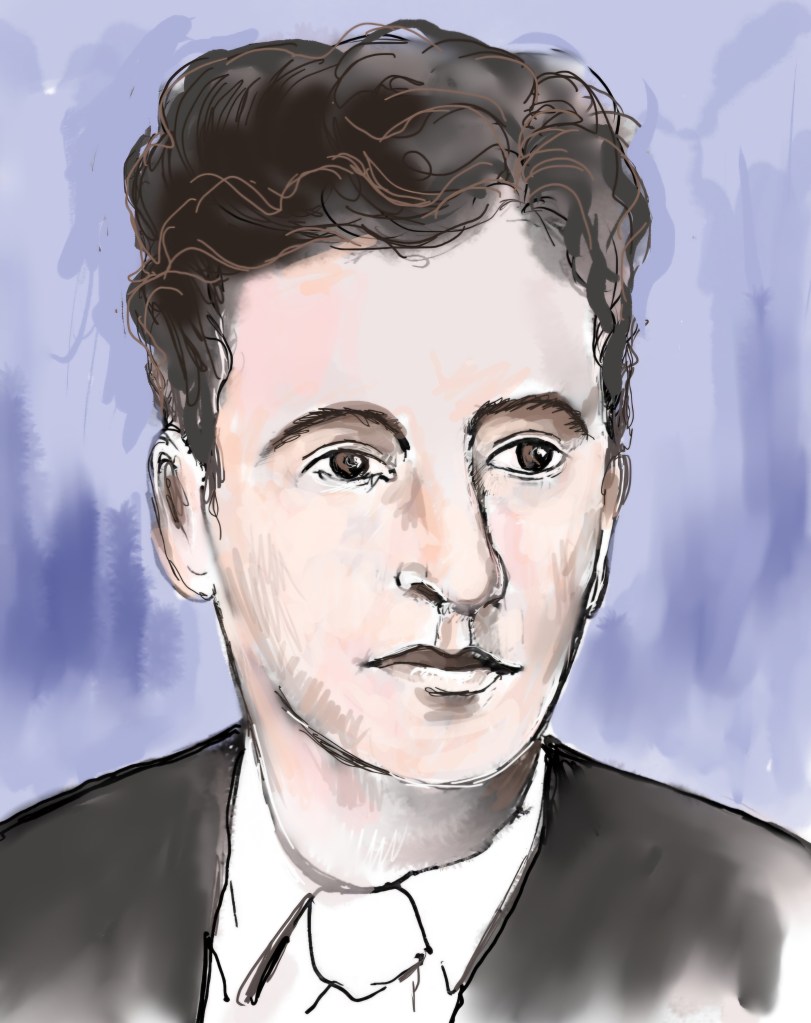
Vladimir Sofronitsky, at the heart of balance
By Guilhem Chameyrat, illustrations by Adès (2025)
‘My corpses’. This is how Vladimir Sofronitsky liked to describe his commercial recordings. And yet it was these recordings that first made it possible to pass on a unique musical legacy, hallucinatory and fervent readings of the works of Scriabin and Rachmaninoff. Vladimir Sofronitsky was a Russian – or should we say Soviet – pianist born in 1901 who died prematurely in 1961. He was a pupil of two illustrious teachers. The first of them, a Pole, was the immense Aleksander Michalowski. The young Sofronitsky was introduced to him by a certain Alexander Glazunov, when he was still only nine years old. Sofronitsky continued to receive regular lessons from Michalowski right up until the First World War, albeit a little more sporadically. Sofronitsky met his second Russian teacher, Leonid Nikolayev, years later at the St Petersburg Conservatoire. One anecdote – or more accurately, one set of facts – speaks louder than any other if we are to attempt to give an account of the intellectual and musical emulation that was then taking off at the Conservatoire. Sofronitsky was in the class of two other famous musicians who also had a lasting impact on their era, Dmitri Shostakovich and Maria Yudina! It was also at the Conservatoire in 1917 that Sofronitsky met Elena Scriabin, daughter of the composer – who never had the chance to hear Sofronitsky perform his works, but whose wife said she had never found a better ambassador for her husband’s music than Vladimir Sofronitsky. Even today, Sofronitsky’s image remains very strongly associated with that of Scriabin, to whom, moreover, he is – too often – reduced. Yet it is true that the pianist had a very special affinity with this music throughout his life. Indeed, he ended his career by spending the last years of his life giving regular recitals in Scriabin’s house, which had already been converted into a museum, playing the composer’s piano – deliberately out of tune.
In 1928, Sofronitsky undertook a major trip outside the USSR, first to Warsaw, before arriving in Paris, where he met Prokofiev, among others. But, speaking of France and Vladimir Sofronitsky, I’d like to suggest a parallel. In fact, I think it’s quite relevant to see two similar approaches, in many respects, between Sofronitsky’s art and that of Alfred Cortot. Basically, we find the same two absolutely structuring features in both of them: a constant concern for balance, combined with an absolutely phenomenal imagination. However, in conflict with the Soviet authorities, Sofronitsky was no longer allowed to leave the country in the 1930s. A few years later, at the height of the Second World War, he found himself trapped in the siege of Leningrad, from which he had to be airlifted out in an extremely precarious state of health. Although he was subsequently appointed to the Moscow Conservatoire in 1943, Sofronitsky hated teaching – which did not prevent him from marrying a student, Valentina Doushinova. Vladimir Sofronitsky, in frail health, died in 1961, shortly after being diagnosed with cancer, after a final concert in the small hall of the Moscow Conservatory.
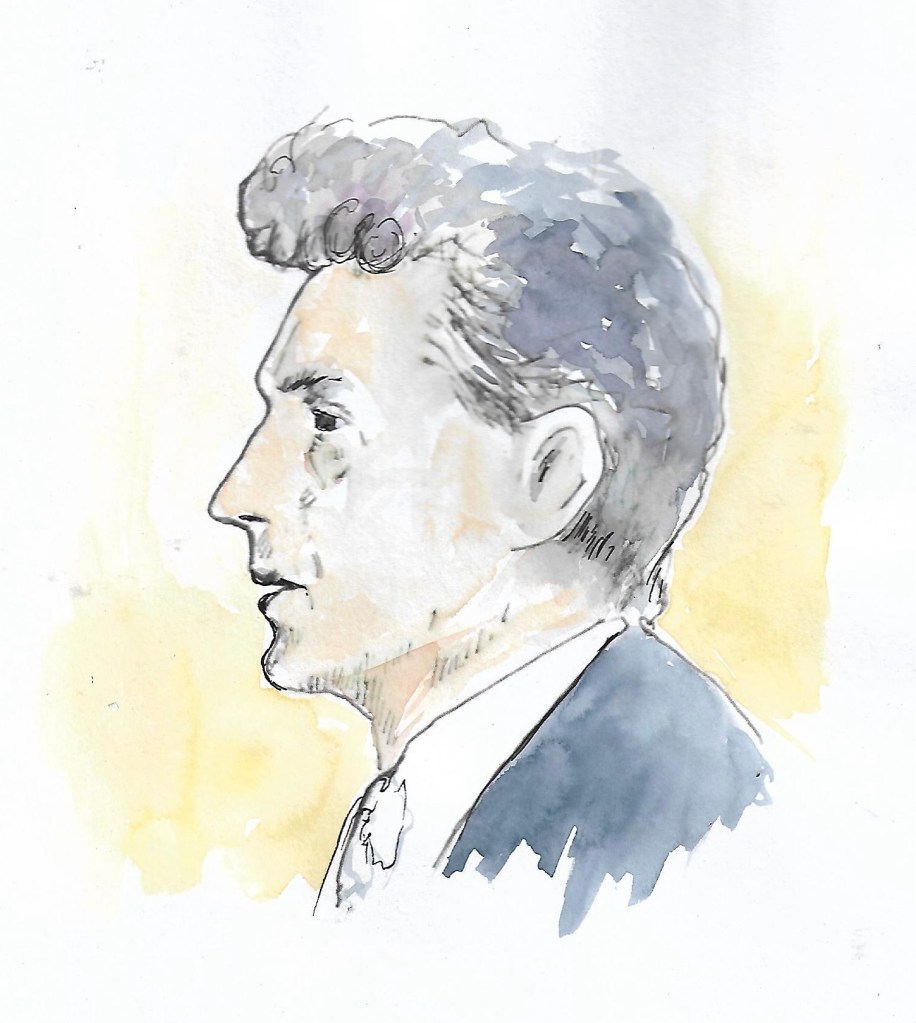
There is a document that is absolutely essential for anyone interested in the art of Vladimir Sofronitsky. It is an interview that the pianist gave to Alexander Vitsinsky in October 1945. Vitsinsky had planned to compile a collection of interviews with a number of Soviet pianists of his time – Sofronitsky, but also Yakov Flier and Emil Gilels. Sofronitsky was what one might truly call a passionate pianist. What animated his playing was, in a way, inversely proportional to his outward reserve and the solitude he cultivated – for example, he spoke as little as possible to his colleagues at the Conservatory. His interpretations seem to be animated by an inner fire, carried by a great attention to balance and clarity of expression, while preserving a great singularity – and what must be called an extraordinary capacity for imagination, and even, often, beyond imagination itself, such a capacity for expression and characterisation that one could almost speak of figuration. It is often difficult to grasp the true colours of Sofronitsky’s playing, and no doubt, beyond the often disastrous sound recordings – and, worse still, editions – this reluctance to use the studio did not help matters. But this passion was also evident in the pianist’s artistic ambition itself. In Sofronitsky’s interview with Vitsinky, starting with the preface written by the latter, it is possible to perceive this absolute perfectionism and demand, through a search that is certainly aesthetic, but even more intrinsically musical. Vitsinky speaks in particular of the profound disturbance caused to Sofronitsky by his own mistakes – even though he praised passion and naturalness, as in the example of Van Cliburn. Speaking of willpower and research, we are led to a statement made by Sofronitsky himself: ‘First of all, a performance requires a will.’. Let’s understand this in the sense that willpower is understood as ‘meaning to want a lot, to want more than you have now, more than you can give’. The challenge of this form of projection that Sofronitsky was looking for, of this form of augmentation, we could say, by the idea of a full investment, a whole, supposing always to mobilise a stronger energy, was to really give life to the piece. However, this raises an aesthetic question of the first order: what does it mean to give life to music, or more precisely, to interpretation? Every great performer has a different way of breathing life into works, with their own particular means. But in this case, it’s because Sofronitsky, like many great performers, has an organic vision of music. The piece must be considered holistically, as a whole, which gains momentum to emancipate itself in its unity. It is not a question of the work giving meaning through distinct moments, but in its entirety. Sofronitsky summed it up as follows: « The whole piece should live, breathe, move as protoplasm. I play—and one part is alive, full of breath, and another part nearby may be dead because the live rhythmic flow is broken. » What is absolutely fundamental here, then, is that this whole somehow functions on its own. Sofronitsky thus comes to talk about Rachmaninoff, since he played the composer’s works – and was perhaps the greatest interpreter of the 20th century – and had a deep admiration for the pianist: « Rachmaninoff, for instance, could create a rhythmic pulse that was unfailingly alive. He had the enormous artistic will of a genius. He had a greater will than any of the modern pianists. »
But, returning to this balance, could we speak of sobriety in Sofronitsky’s case? If we do get this impression, could it also be due to the studio work? What seems to stand out in all of Sofronitsky’s interpretations is undoubtedly, above all else, the combination of naturalness and fluidity. Even though there is this significant difference in dynamics, with the hands being extremely identifiable, and the chords often arpeggiated, Sofronitsky’s playing was never strictly analytical. The challenge was to bring the piece to life, in the original sense of the term, to give it a soul. Sofronitsky had a remarkable ability to characterise works, which was particularly noticeable in his Rachmaninoff. Admittedly, he is no Horowitz, in the sense that he is not extravagant – or pyrotechnical, depending on your point of view. And although Rachmaninoff loved Horowitz’s interpretation – we remember the composer rising from his seat and exclaiming, « This is how my concerto should be played! » – one is struck, when hearing him play his own works, by the astonishing restraint and supreme mastery that Rachmaninoff displays – not only in his own works, but in general. And, just as when Rachmaninoff interprets his own compositions, Sofronitsky displays the same concern for relief and depth, the same way of delving into each phrase. Sofronitsky said he worked from what he called the heart of each piece, and this can be perceived intuitively. Everything is brought back to what could be called the emotional climax of each piece, which, however, only makes sense in the context of what has been played before – as is undoubtedly the case with all great performers. There is a certain vertigo in allowing oneself to be touched by this striking, physical approach, which has a real physical impact on the listener because it is so deeply rooted – I believe this is the term that best captures the specificity of Sofronitsky’s Rachmaninoff – while preserving the polyphony of this music and, with it, its harmonic complexity. Everything is very vertical, but nothing is ever brutal; it is, in fact, extremely clear. But these are mainly studio recordings. Nevertheless, it must be said that Sofronitsky’s style has probably never been as embodied, as paroxysmal and, quite simply, as alive as it was during his concerts. Today, we have a large number – at least for the time in the USSR – of recordings of concerts given by Sofronitsky, although most of the time we are only able to hear remnants, more or less well preserved, of the musicality that filled the entire hall at the time. Sofronitsky always played passionately. Each of his recitals was a spiritual event for the audience. A true ‘living legend’ in the USSR, he showed constant and ever-renewed inspiration in a repertoire that was far from being limited to Scriabin alone – to which we too often tend to reduce him. Each of Sofronitsky’s interpretations was infinitely different, even within the same work. This difference between the calm, and sometimes tranquillity, of the studio and the feverishness of the concert hall is a typical feature of Sofronitsky’s playing. One way of illustrating this is by comparing the studio and concert recordings of Beethoven’s Sonata, Opus 111. For example, between the 1956 recording and the 1952 concert. While the timing immediately reveals two radically different approaches – twenty-seven minutes in the studio for the entire work, compared to twenty-three minutes in public – listening to the fifth variation proves this even more clearly. Although we are not witnessing a radical paradigm shift here, major differences are immediately apparent. The first that strikes us is undoubtedly that of commitment. Sofronitsky throws himself wholeheartedly into a heavenly, unique conception – to the extreme – in front of his audience – taking a great risk, which must also be emphasised – while the studio leaves the field open to the expression of great refinement – a refinement that is certainly also found in the concert version, but which is not the main issue underlying the vision, because in public it is subsumed by commitment. In short, one could almost say that Sofronitsky’s playing in the studio is reflective, introspective – which is, incidentally, very rarely the case with Sofronitsky – whereas in front of an audience, the pianist is almost possessed.
Although Sofronitsky’s concert performances always seemed extraordinarily natural, they were nevertheless the result of careful reflection on the part of the artist. Sofronitsky himself spoke of the work that went into his performances in these terms: « My work may continue without the instrument, I may be talking to people, listening to them, answering quite reasonably, but work continues unceasingly inside. I was considered lazy when I was a boy—they did not understand that after playing a little on the piano and lying on the sofa afterward, I continued to work intensively inside, listening to the music, looking for the necessity and finding it. » The work of reflection, and indeed of reflexivity, specific to the performer was a particularly intense experience for Sofronitsky. Even more interestingly, it was not through experimentation that he managed to find the ‘necessity’ required by the piece itself. In contrast, for example, to the work of Vladimir Horowitz, Harold Schonberg, former chief music critic for The New York Times, wrote about Horowitz’s interpretation of Chopin’s First Ballade that « Every time he played this piece, he had new ideas. He never managed to decide exactly what he wanted to do with it, but he showed as much determination in his quest as Lancelot did in his search for the Holy Grail.‘ Horowitz did not find this ’necessity » by reflecting and interacting internally, but by playing directly, in the experimental and empirical practice of embodied musical flow. This rhythmic flow remained, nevertheless, extremely important in Sofronitsky’s case. To explain this, let us take the climax of the Molto moderato of Schubert’s Sonata, D.960. Sofronitsky does not vary the tempo, and yet it seems faster than before. The expressiveness here is at its peak, and yet we notice that Sofronitsky lets the piece breathe, like an organism that lives and moves before our eyes. Sofronitsky creates a unique ambient balance, as heavenly – though less intrinsically religious – as that of his former Conservatory classmate Maria Yudina, who declared that ‘Sofronitsky was exactly a pure romantic; he is all yearning to the infinite and totally indifferent to the sea of life and is completely helpless in such.’
But let’s return to what we were discussing earlier with the example of Rachmaninoff’s interpretation, that famous ‘heart’ unique to each piece. During the interview with Alexander Vitsinksy, Vladimir Sofronitsky’s second wife, Valentina Doushinova, spoke about her husband’s memorisation process in these terms: ‘Vladimir Vladimirovich usually takes a fragment of the work, typically just from the beginning of the piece, and learns this episode, works on it until it comes out exactly as he wants it. Then he takes the next, learns it, and so on. Mainly, it seems to me that he works from the beginning to the end on each segment until he achieves the result.’ Sofronitsky himself added that « But most crucial is to find the heart of each piece or each sonata movement, feel its basic essence, culmination, and then—the same in each construction, every phrase. I played badly before, only in recent years have I come to understand—better and better—how to play. And if I am alive in several years then I will really start to play. » Here we see an absolutely fundamental aspect of Sofronitsky’s personality, namely this very particular form of critical distance. Musically, this distance can be expressed – in words, of course – in a fairly simple way: you have to learn to hear yourself play. The fundamental essence found in the emotional climax of the piece must therefore be taken into account in the interpretation of each of the phrases that compose it. Here, we are far removed from the effect that some performers may seek in order to better convey a particular feeling, or even, more prosaically, a particular climax – or lack thereof – in the piece. « I always find something new in the composition. My critics rebuke me that I have nothing determined and fixed, nothing stable in performing even the same piece. They do not understand that I have to justify the performance internally for myself, must hear and feel something new, different from the past. What is wrong with that? They say that I may play well by chance, or badly—also by chance. One cannot play well by chance, one can only play badly by chance., » said Vladimir Sofronitsky. You can’t play well by chance. The musicality of Sofronitsky’s concerts – but also of his studio recordings – is a unique legacy in the history of music because of its true power, that of evidence, of simplicity; in other words, of necessity.
 Sofronichrist