
The original podcast (narration in French, English and German subtitles)
When people talk about Furtwängler, a certain cliché springs to mind for far too many music lovers. Furtwängler is supposedly a ponderous, slow conductor, embodying the Germanic tradition and a sweeping, extreme expressiveness. He is thus often compared to Otto Klemperer and contrasted with Toscanini. Yet, if there is one composer in whose music Furtwängler’s conducting most thoroughly dispels this cliché, it is Wagner. Yes, Wagner is indeed the composer whose music embodies par excellence organicity, breath, monumentality, but just as much intimacy and sensitivity in all its dimensions – at times raw, always on edge – yet, more profoundly, he is perhaps the greatest composer of flexibility. Wagner always modulates in the space between lightness and heaviness, reconciling these dualities. Wagner’s music does not lend itself well to a rigid baton. Whilst it demands rigour, it calls for the introduction of organicity through flexibility. Lyricism is, in fact, an essential condition of it, and that is why Bruno Walter was such a great Wagnerian, for example – if you’ve never done so, go and listen straight away to his first Act of Die Walküre, recorded in 1935, with Lotte Lehmann and Loritz Melchior!
But when we think of Wagner, we also think of a seminal school of conducting: the Dresden School. One thinks of this Romantic and then post-Romantic legacy, embodied in the 20th century by conductors such as Max Fiedler, Willem Mengelberg, Hermann Abendroth, Arthur Nikisch no doubt, Wilhelm Furtwängler of course, but also Nikolai Golovanov, for example, who was, incidentally, a remarkable Wagnerian. Moreover, whilst Wagner enjoyed great success throughout his career as a conductor, thanks to his constant concern to adapt the musical language and delivery to the audience’s perception, he considered himself first and foremost a composer who conducted. And we know how keen Furtwängler was to make this approach his own, with a success that is not attributed to him – and for good reason, in my view.
I therefore invite you, following Brahms and Beethoven, to delve into Furtwängler’s understanding of the Bayreuth master’s music – an understanding that was at once so natural, almost innate, and yet so unique. I must also extend my warmest thanks to Chris Walton, who assisted me in the production of this video. Chris Walton is a musicologist; he has notably directed the renowned Zurich Central Library and is currently Professor of Music History at the Basel Academy of Music. He recently edited issue 19 of the Wagner Journal, a leading British publication, which in this instance is devoted to Wagner’s relationship with the Lied.
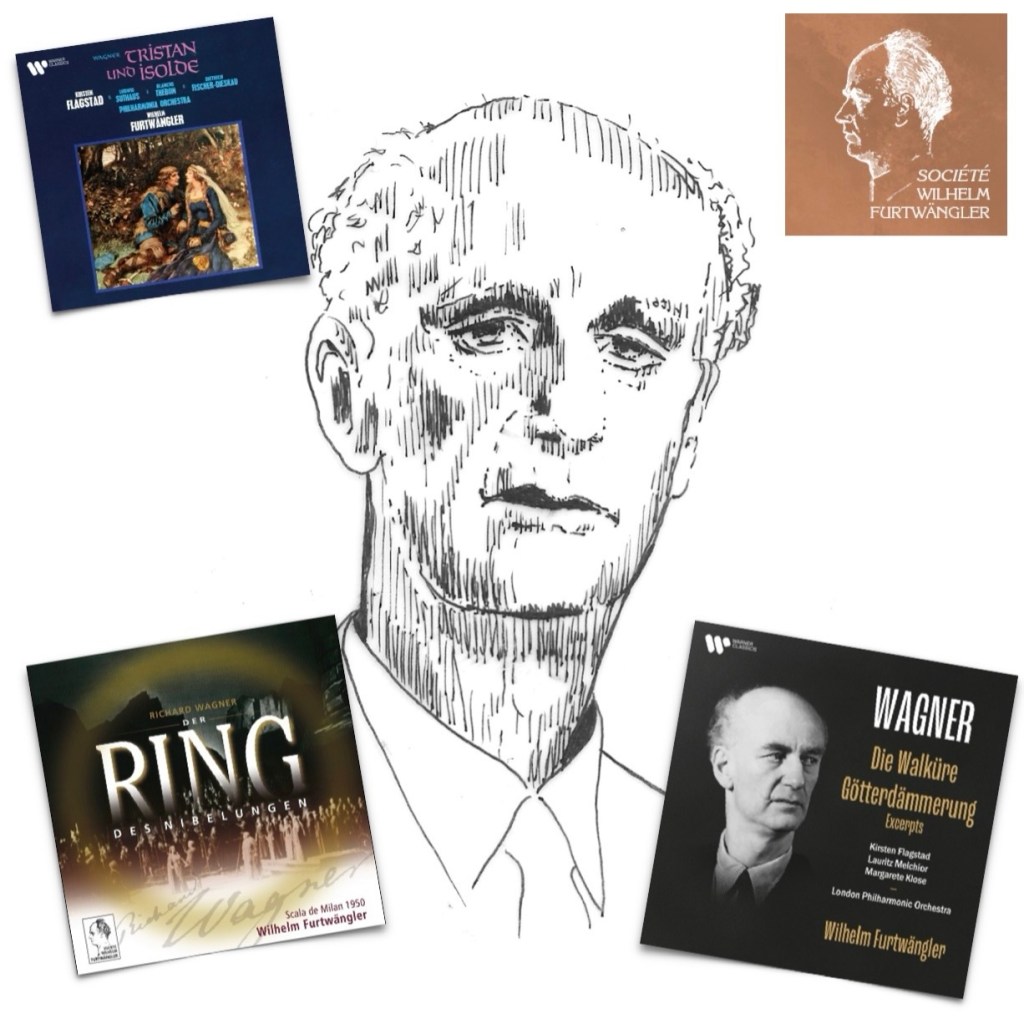
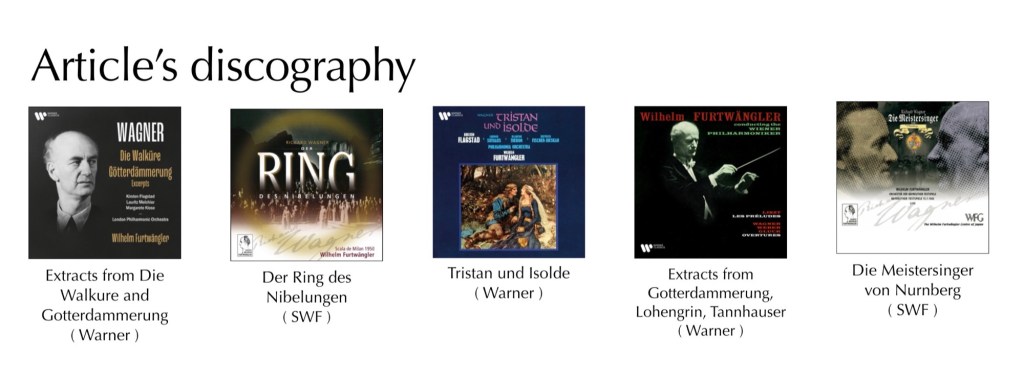
But, returning to Furtwängler, let’s begin with a brief overview of his discography. First of all, the operas that have survived in their entirety. Firstly, we have two complete tetralogies. One from La Scala in Milan in 1950, the other recorded at RAI in Rome in 1953. This may surprise you, but I would recommend the RAI recording more highly. Admittedly, the cast is better in 1950, because Kirsten Flagstad is still at the height of her vocal powers, and Max Lorenz’s portrayal – though his voice was already in decline – is nonetheless reminiscent of a Greek tragedy, with heart-rending intensity and passion. Yes, but Furtwängler, by his own admission, managed to convey his own vision more effectively in 1953, accompanied in particular by a Martha Moddl in a state of grace. Perhaps there is less urgency at the RAI, but the unfolding of the dynamics is unparalleled, and the colours, paradoxically, far more nuanced – even if less sombre, and less archetypically romantic than in Milan. Having discussed these two versions, a word must also be said about the 1937 excerpts. We have Act III of Die Walküre and a few excerpts from Götterdämmerung. These are undoubtedly Furtwängler’s greatest Wagnerian recordings. This Ride of the Valkyries alone embodies Furtwängler’s genius. A genius who dared to be bold, and who made himself inimitable.
As for the Immolation, it is quite simply breathtaking, but we’ll come back to that later. First, however, I’d like you to listen to an excerpt from the Ride. Listen to how Furtwängler does not give the melody to the brass, by separating the sections, and thus emphasising the ethereal quality by bringing the strings to the fore, with cascades of immense suppleness, each accent different and even more intense than the last. This Wagner is full of vitality, dazzling, joyful!
And now, let’s move on to the other masterpiece: Tristan. A few recordings exist from before the 1950s, but in extremely poor sound quality – 1942, 1947 – yet they cannot go unmentioned. But it is above all the 1952 studio recording that interests me. Conducting the Philharmonia Orchestra, this was the first time Furtwängler was truly satisfied with a studio recording. A richness of sound fills every chord, including the vocal parts. Flagstad’s performance is enough to bring tears to your eyes, and even though Elizabeth Schwarzkopf dubbed her for two notes, I know! Just listen to that ‘Lust’ at the end of Liebestod – if it weren’t for that ‘T’ at the end, you’d have mistaken it for an oboe!
On the orchestral side this time, it is indeed the full sensuality of Wagnerian opera that blends here with a flow of sound that is both supple and sombre, capable of singing with unrivalled lyricism – the Prelude to Act I, the whole of Act II – whilst evoking the abyss, suffering, the Prelude to Act III advancing with such psychological violence that it even comes to embody courage. Everything in this performance highlights the humanity of the characters and amplifies the unfolding drama without any exaggeration, even if the singers and the orchestra’s instruments do at times truly merge – as with Tristan and Kurwenal, who respond to one another as much as the woodwinds of the orchestra. The power of Furtwängler’s orchestra, whether stemming from the strings’ impetus or the woodwinds’ insistence, is never considered in isolation from the overall vision: the opera is conceived from beginning to end as a whole, and nothing strays from the path the tragedy has charted from the outset – and, in a sense, everything is foreshadowed by Furtwängler right from the Prelude.
Finally, there is Die Meistersinger, recorded in Bayreuth in 1943, at the height of the Festival’s darkest period – although there are a few excerpts from a rather lacklustre 1938 performance, in Nuremberg no less, featuring notably Rudolf Bockelmann, a magnificent interpreter of Sachs whose career in the SS did not prevent him from becoming a singing teacher after the war – I’m just saying. As for this 1943 version, the cast is more than adequate: Jaro Prohaska does a more than fine job as Hans Sachs, Max Lorenz is as virtuosic as ever, and Maria Muller is absolutely fabulous as Eva. Furtwängler’s conducting, meanwhile, is more sombre, fully rooted in that almost demiurgic intensity characteristic of the art of war. Unfortunately, the Quintet is missing, which is rather disappointing!
To conclude, I’d like to mention a few particularly memorable excerpts and recordings. First, the third act of Lohengrin at Bayreuth in 1936 – a masterpiece available from the SWF shop! The cast is undoubtedly the finest ever recorded! And then there is the Overture to Tannhäuser, recorded twice by Furtwängler: once in 1949, in a vision brimming with tension where the musical momentum is constantly renewed, and once in 1954, a version which this time stretches the narrative horizontally, giving it breadth and revealing a richness and even a mad orchestral fullness, thanks to the full range of colours of the Vienna Philharmonic. In the 1930s, for Polydor, with recordings again distributed by the SWF, Furtwängler made several great Wagnerian recordings, most of which I consider to be underrated, including a fabulous Funeral March, but also the only surviving trace of his interpretation of Parsifal. The Preludes from Tristan – as well as the Liebestod – and from Die Meistersinger were recorded on several occasions, both during and after the war – and even before, in the case of Die Meistersinger.
If we consider the various aesthetic characteristics of Furtwängler’s interpretation of Wagner’s music, it seems to me that any analysis must first be grounded in a distinctly Wagnerian legacy that is evident in Furtwängler’s work. This involves a clarity in the exposition of themes, a sine qua non of this constant transition, of this perpetually evolving movement within Furtwängler’s organic orchestra. This is embodied in his interpretation of Wagner through a certain lightness and liveliness. For Furtwängler was a staunch advocate of brisk, even very brisk, tempos in Wagner. And this remained the case even after the war, despite the upheaval it had caused. Of course, the embodiment of this lively and alert lightness lies in these excerpts from the 1937 Covent Garden Ring Cycle, recently reissued by Warner. In the Guide to Wagner’s Operas published by Fayard, we read the following regarding these excerpts: ‘If one were to know only a single Furtwängler recording, this is the one to choose: […] one is left spellbound by the texture of the orchestral fabric, constantly surging and swelling, with a bewildering overall energy, a massive impetus and a sense of arc: the Ride, rough-edged yet joyful, surges forth, whilst the moments of Farewell radiate.” However, right at the end of the review, we read the following, which is of fundamental importance: ‘Let us be clear: we shall never hear this again, not even from the same performers, in future versions, whether complete or not: a war will have taken place in the meantime, breaking their spirit, somewhere. ’ For, despite everything, the political co-opting of Wagner’s work by Nazism came to disrupt the interpretation. The orchestra took on a heavier sound, and a more sombre tone as well. Walter would never again conduct a Wagner opera after the Anschluss, when Bayreuth was forced to undergo a radical overhaul with a modernist orientation and new performers upon its reopening in 1951. It is quite possible that Furtwängler’s vision was deeply marked by a sense of guilt, for in any case, in the subsequent performances of the Ring Cycle—whether complete or in excerpts—Furtwängler’s approach was no longer the same. In the guide to Wagner’s operas, discussing the 1954 Die Walküre —Furtwängler’s very last recording—we read that a form of disembodied abstraction permeated the performance.
But then, why this liveliness and lightness, even if they were ultimately overshadowed by abstraction? Paradoxically, although we retain this cliché of Furtwängler as a conductor who favoured slow tempos – which we might thus contrast with the vitality of Toscanini’s art – the two actually differed on this point in that Furtwängler conducted Wagner quickly, and Toscanini very, very slowly – incidentally, Toscanini conducted the slowest Parsifal in history, whereas Furtwängler conducted it in under four hours. How can this be explained? By the harmonic and, above all, melodic complexity of Wagner’s writing. In fact, Toscanini sought an analytical rendering of the score; he sought to make every note audible whilst allowing a melodic continuity to be perceived. Moreover, making every note audible in this way requires, in Wagner’s case, slowing down the tempo. However, Furtwängler prioritises the aesthetic reception and the emotional impact of the musical discourse on the listener’s perception over a strict rendering of the text. And so, he modulates the tempo, and above all does not hesitate to accelerate sharply, to strip back and then re-enrich the musical discourse, which he does by allowing the orchestral texture to breathe through lightening it.
In fact, Furtwängler takes Wagner at his word, as Wagner sought to prioritise the continuity of the singing in the performance. Furtwängler thus emphasises the distinctly operatic or dramatic dimension – I think Wagner would have preferred it! – through a force that comes from deep within. There is so much physicality, such embodied substance that seems to spring from nowhere to surpass what came before in intensity, that one feels overwhelmed, almost crushed, yet without ever ceasing to breathe. This physicality is embodied in that extraordinary force, which stems from a crackling, from that famous ‘Furtwängler sound’. Thus, the strings seem to stretch horizontally in arpeggiated chords, whose intensity is growing, always seeming to amplify. This is obviously also made possible by the rubato, subtle yet constantly present, which anchors the musical discourse in an organic dimension, so dear to Wagner, and to post-Romanticism in general. Thus, through these constant modulations and adaptations, the conductor seems to be improvising. And this is how the tension becomes diegetic, closely linked to the narrative stakes of the musical drama unfolding.
So, I suggest you listen to the prelude to the third act of Tristan, from the fabulous 1952 recording. As an aside, this was the first recording with which Furtwängler was satisfied. Listen first to this monumental entry by the low strings, which truly probe the abyss, inducing vertigo, and where the resolution is not an answer, but an embodiment of anguish, and even despair. And when the orchestral fabric hangs by a thread, that is precisely where the tension reaches its peak.
In fact, the main point is that Furtwängler is a direct heir to Richard Wagner. His artistry lies in the culmination of this conception of conducting based on perceptive adaptation, which is embodied in a certain flexibility. When writing this programme, I mentioned that I had received assistance from Chris Walton, a musicologist specialising in the Germanic repertoire and, in particular, the Romantic period. Chris Walton has researched the connection between Wagner and Furtwängler, and indeed presented the findings of his research at a lecture given at the Cercle National Richard Wagner. He also points out that a decisive influence on Furtwängler’s musical personality was Arthur Nikisch, his predecessor at the helm of the Berlin Philharmonic, who had conducted under Wagner himself on more than one occasion. If Furtwängler thus represents the culmination of Wagner’s principles of conducting, it is because he prioritises fluidity. In On Orchestral Conducting, his major essay on the subject, Wagner explained that any change in the continuum of musical duration must be gradual, both in terms of dynamics and tempo. Indeed, Wagner had ceased to use metronome markings in the 1840s, because he considered them contrary to what he regarded as the spirit of music.In his view, the challenge was therefore to strike a chord with the audience—on an emotional level—not by ensuring that interpretative choices corresponded as closely as possible to the content written on the composer’s score, but by ensuring that those choices were perceived within the flow of the concert through the subjectivity of the audience. Indeed, for Wagner, musical interpretation was not to be a mere performance, but a living creation, bringing about something new and unique, specific to each performance.
Right, well, it’s time for the usual comparison! Once again, I therefore invite you to a comparative listening session to highlight the differences in approach, method and meaning between Furtwängler and other conductors. And so I suggest we compare them using a cult piece – I can’t think of any other way to put it – from the Ring Cycle: the Funeral March from Siegfried. It is a difficult passage to interpret for a semantic reason. Generally, conductors find themselves forced to choose between two interpretations: either to emphasise the epic dimension – the most commonly adopted approach – by lending a heroic quality to the brass and providing dynamic support from the strings; or to emphasise the tragic dimension by accentuating the gravity of the brass, slightly reducing their range, and placing the emphasis on the almost static power of the strings.
I have chosen lyrical versions that give pride of place to the singing. I did so for purely subjective reasons, because I thought it would be more interesting to present versions that are in keeping with Wagner’s original intentions for the orchestra. These versions are, moreover, of a rather light nature, apart from the very first one I’m going to play for you, as I wanted to talk to you about versions I personally enjoy – and even if this is arbitrary, I stand by it! I should add that they aren’t necessarily the most famous, which is a great pity – perhaps also because they aren’t always the best recorded…
So let’s begin by listening to this first version, conducted by Arturo Toscanini, leading the BBC Symphony Orchestra in 1935.
Indeed, it is not the lightest of visions. Toscanini always displayed a certain slowness when conducting Wagner. I offered my theory to explain this: by seeking an analytical rendering of the score that was as detailed and clear as possible, he ended up isolating each chord. And this then creates a sort of upward movement, which Wagner valued highly in the construction of musical discourse, caught up in a constant transition that Furtwängler would later adopt as his own. I had already analysed this Funeral March by Toscanini in an episode of my series ‘Portraits in Music’ that I had dedicated to the Italian maestro. If we examine this 1935 performance in detail, we notice, on the one hand, the weight of each chord, because each marks a pause, a crushing sensation in almost spectral colours. Thus, Toscanini fully embraces the tragic and funereal nature of the work. But where Toscanini proves all the more brilliant is that he constantly increases the dynamics; with every additional chord, he thickens the orchestral texture, thereby giving each chord enormous breadth, so as not to let the tension dissolve in the slowness.
And now, let us look at a vision that is the very opposite of Toscanini’s, with Leopold Stokowski conducting the London Symphony Orchestra:
Yes, it’s Wagner at his most spectacular, but how brilliantly executed it is! Because it’s done with such natural ease. Stokowski embraces a resolutely epic vision. To emphasise the heroism and capture the spirit of the March, Stokowski employs the legendary fluidity of his swaying chords, of such wild elegance, and of course his inimitable legato. If the conductor can thus push the boundaries so far, including those of bad taste, it is also thanks to his mastery of the orchestra, and his conception – like Wagner himself, and of course Furtwängler – of the orchestra as a single, unified instrument. It is a very natural interpretation, because it is highly intuitive whilst gaining charm through the refinement of the musical language. And then, of course, it is very natural thanks to the speed and momentum, which restore theatricality and continuity to the singing, particularly, of course, in that wild acceleration to launch the crescendo.
So, let us linger for a moment on the epic side, listening to a more academic interpretation – or at least one closer to the Wagnerian interpretative canon – with Dimitri Mitropoulos, in New York in the early 1950s:
As with Stokowski, the emphasis on the epic or heroic dimension is achieved through a unification of the sound textures. With Mitropoulos, it is as though the power comes from deep within, amplified by a great deal of rubato. The counterpoint is very pronounced, which brings the music to life. The main factor ensuring coherence here is the rhythm, with an absolutely organic irregularity.
And now, let us return to the tragic side, yet one that is more alive, almost in fusion, compared to Toscanini, embodied in a legendary performance by Erich Kleiber at the Teatro Colón in 1947:
Well, within its own genre, it’s perfect. The melodic flow is astonishingly natural, but above all, the lyricism is ever-present, carrying every phrase with incredible fervour! There’s a spring in the step, and subtle inflections that bring life to the surface. There’s legato where it’s needed, applied with restraint. In fact, rather than tragedy, it is a matter of gravity, linked to the urgency of the moment. It is extremely operatic – and yet, the acoustics are very dry! Kleiber plays on constant shifts between weight and lightness, whilst maintaining the unity of each phrase and constantly renewing the musical gesture. In this way, he provides continuity by unifying the sound layers, in contrast to the vision presented by Furtwängler. Setting Furtwängler aside, in a different interpretation, we have here, it seems to me – and this is purely a matter of personal taste – something approaching perfection. And, incidentally, it is a scandal that we were unable to hear Kleiber at the new Bayreuth, he who, moreover, had not compromised himself in any way with Nazism by fleeing Europe as early as 1935. He would have been perfect in 1955, when Decca set up its microphones to record the Ring Cycle conducted by Joseph Keilberth, in an extraordinary performance now available on Testament.
And on that note, let us return to Furtwängler:
So here we are in 1950, at La Scala in Milan. What is interesting about Furtwängler is that he is, in a way, the only one to reconcile these two visions – that is to say, the tragic and the heroic – and to turn them into a march that is as mournful as it is epic. Furtwängler begins in a tragic, even mournful, register, and then shifts into the epic register with a crescendo that seems to come straight out of nowhere! The phrases possess an absolutely mind-blowing expressive power! And this stems from the flexibility. One senses it in the overall lightness, and in the emergence of certain key details, such as the prominent role given to the snare drum, or the counterpoints of the lower strings. Once again, one perceives a cornerstone of Furtwängler’s Wagner: the disunity of the sections. Why? To restore a sense of organic unity and urgency. It throbs, it always trembles a little; we’re on the brink of breaking point, always teetering on the edge, and the slight timing difference is intuitively perceptible without us consciously realising the arpeggios – particularly with that timing difference in the timpani strikes! Ultimately, even if the microphone isn’t overloaded, the ensemble creates a perceived saturation from the listener’s perspective, from our point of view as listeners!
To conclude, I’d like to talk to you about a lesson that Furtwängler’s Wagner seems to teach us – it sounds rather religious put like that! Furtwängler, like many conductors of the golden age, conducted Wagner in the same way he conducted Mozart. That is to say, as lively, pulsating music, both organic and lyrical. Wagner placed singing at the heart of his approach, and Bayreuth was built with this ambition in mind. However, since the Second World War, and the appropriation of Wagner and Bayreuth by Nazism, that brilliance, that laughing, light-hearted Wagner has disappeared, replaced by a certain heaviness. Even Furtwängler’s style suffered as a result. Yet Furtwängler also teaches us that Wagner’s music is above all physical, grounded in physical sensation. And if Furtwängler was such a great Wagnerian, it was also because of the distinctly carnal dimension of his style. It seems to me that Wagner’s work is not an intellectual one, and indeed that it can be dangerous to go down that path, the Nazis notably emphasising his anti-Semitism by placing it at the service of a supposed superiority of the Germanic spirit; in short, we know all that. The Wagner of the golden age, and all the more so that of Furtwängler, is music of the moment, rooted in the sensory, and that is also why it is a constant transition, a ‘descent into the maelström’ to borrow the title of a short story by Edgar Allan Poe. In a way, Furtwängler’s Wagner is, paradoxically, not for me music of monumentality – and indeed, it might well be ethically problematic to emphasise the monumentality of Wagner – but rather a form, if not of intimacy, then of sensation. And we must not lose sight of this along the way, by seeking metaphysical meanings where there is perhaps only the beauty of life in motion, which is already quite enough.
 Sofronichrist
Laisser un commentaire