
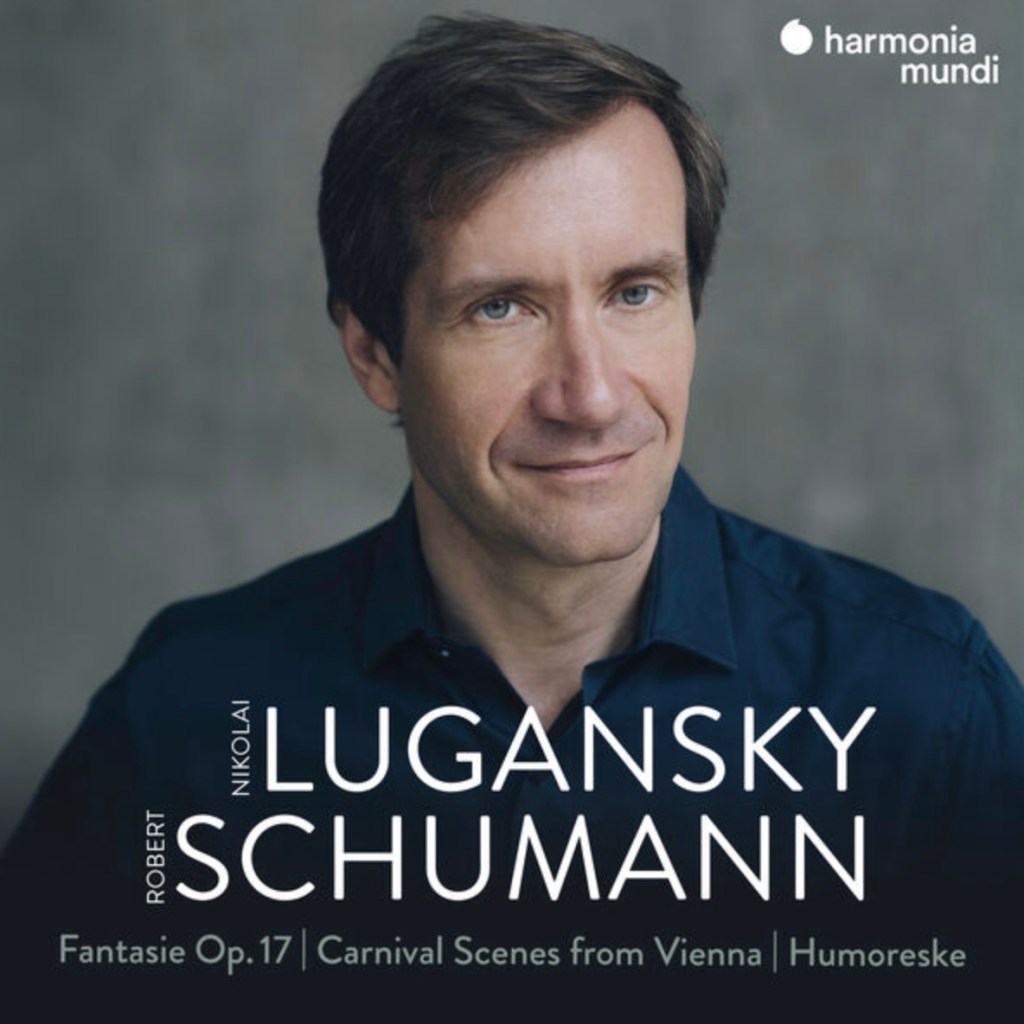
Recently, Nikolai Lugansky has had a knack for getting people talking about him. Musically speaking, in a good way. A very good way, in fact. A compelling album devoted to Beethoven’s late works, followed by a Wagner album featuring his own transcriptions of selected excerpts. A marvellous album, constantly alert, where the fantastic rubs shoulders with the period. This Siegfried Funeral March is magnificent! Poetry, but also tension. And this was already the case in his great previous recordings, with Rachmaninov among others. This time, Lugansky returns to Schumann, still with Harmonia Mundi. In addition to the Humoreske and the Carnival Scenes from Vienna, I obviously want to talk to you about the Fantasy Op.17, which opens the album.
The first word that comes to mind to describe Lugansky’s approach is naturalness. Not that it is a single vision, but the narrative is indeed formally one. Carried by remarkable continuity, each counterpoint serves the melodic line. It is also through this continuity that the pianist marks the contrasts. For the second watchword is intensity. An intensity worthy of the great works of Eastern European performers, in the direct lineage of Sofronitsky or Virsaladze. But each chord has weight, even if it means separating them greatly, as in the development of the first movement. But the rubato, while subtle, is fundamental to the incredible power of the expression. Fortunately, continuity prevents any mannerism, as in the crescendi of the initial exposition theme, which are wildly expressive! The breadth of the sound is matched only by the breadth of the colour palette, which is fantastically rich and profuse! For these are bold, almost saturated colours. The gesture does not hold back, it affirms itself fully, and as it is constantly renewed, it gives even more depth with each repetition. It is not necessarily an embodiment of Apollonian light, as in Sergio Fiorentino’s work, for example. However, the weight given by the breadth of the sound and the colours amplify the depth that comes from naturalness.
A breadth that swells the piano fabric and restores anchorage to what must nevertheless be expressed through transcendence. For all the motifs of the Fantasia are embodied in a transcendence, or almost an excess, through the gesture of exceeding, of pushing expression to the limit. And this breadth is not only perceptible in the counterpoints of the first movement, or even the slight nostalgia of the second, but it also carries the elevation and the humanity of the Finale, which is as trying as it is ideal. Lugansky constantly plays with the tempo, while maintaining the fundamental continuity of the melodic line. The interpretation thus takes on a remarkable coherence, as the work reveals itself in its unity. The emotional tone is the same, but it takes on even greater intensity and touches us ever more deeply each time.
Essentially, it is an extraordinarily romantic vision, which has become rare today. A constant appeal, as heart-rending as it is rooted in the human dimension of the Fantasia. It is an interpretation of an immoderate passion, but one that is lived, experienced and trying. And, as in all the great, great versions of the Fantasia, this one once again becomes that miracle: Schumann’s gesture of pure love. Nikolai Lugansky delivers a benchmark version here, and, even more than that, a truly great moment in music.
 Sofronichrist
Laisser un commentaire