
French version, following by the english one
L’identité d’une œuvre chorégraphique à l’épreuve de la technique française et de la méthode Vaganova.
Par Mihn Mabut
« Alors que je ne cherche qu’à offrir le meilleur spectacle possible […] il m’arrive souvent d’introduire quelques nouvelles combinaisons de pirouettes ou des sauts que je juge plus impressionnants que ceux chorégraphiés initialement dans l’œuvre », déclare le danseur français François Alu dans Le prix de l’étoile. Là où de telles modifications des chorégraphies sont tolérées dans d’autres pays, ces désobéissances auront valu à François Alu de nombreuses remontrances de la part de ses supérieurs et ce manque de liberté à l’Opéra de Paris fera partie de ses motivations le poussant à quitter l’institution en 2022. Il semblerait alors que les institutions, et plus précisément les écoles de danse divergent dans leur vision de l’identité d’une œuvre chorégraphique. C’est ce que l’on observe dans le cas de la technique française et de la technique russe d’Agrippa Vaganova : si la technique française est attachée à la reproduction exacte des chorégraphies, l’école Vaganova accepte beaucoup plus aisément des modifications pour s’adapter aux particularités de chaque danseur. Ces observations peuvent nous interroger : si la chorégraphie change entre deux représentations d’un même ballet, peut-on encore considérer que ces deux performances appartiennent à la même œuvre ? Quels critères permettent d’établir une identité chorégraphique ? Le cas des modifications de chorégraphies dans la technique Vaganova interroge aussi sur le degré de liberté accordé à un artiste : à quel moment considère-t-on que la modification d’une œuvre outrepasse la marge d’interprétation accordée à un danseur, et se transforme en une nouvelle chorégraphie ? À l’inverse, dans le cas de la technique française, le respect scrupuleux de la chorégraphie comporte ses propres limites : si l’interprétation du danseur devient scrupuleusement encadrée, ces derniers peuvent-ils encore être considérés comme des artistes ou de simples exécutants ? Ne risque-t-on pas de sacrifier l’aspect artistique de la danse au profit de la préservation de l’œuvre ?
Des auteurs philosophiques de tradition analytique se sont penchés sur la performance et sur les critères d’identités d’une œuvre chorégraphique. On pense notamment à Nelson Goodman qui a travaillé sur la notation en danse, ou aux travaux de Margolis qui a élaboré la thèse du type/token, examinée par la suite par Graham MacFee. Frédéric Pouillaude s’est quant à lui intéressé à l’histoire de la danse et aux problèmes liés à la notation et la transmission d’une œuvre. Le désoeuvrement chorégraphique, dans lequel il expose ses thèses, sera longuement étudié au cours de notre travail. Cependant, à notre connaissance, aucun auteur n’a relié ces thèses philosophiques aux pratiques des différentes écoles de danse, en soulignant la manière dont un style influait sur la conception de l’identité chorégraphique. Ces interrogations nous mèneront à établir des critères pour différencier une interprétation valide d’une interprétation invalide, et nous éclaireront sur le rôle des danseurs – compris comme artistes ou simples exécutants. Il s’agira ainsi, pour reprendre les termes de Graham MacFee, d’éclaircir notre compréhension de l’œuvre chorégraphique dans son unité, et plus largement la vision portée sur la danse qui en découlera.
Pour ce faire, nous comparerons la compréhension de l’identité chorégraphique entre la technique française et Vaganova en nous appuyant sur des exemples concrets émanant des deux institutions incarnant ces écoles : l’Opéra National de Paris et le théâtre du Mariinsky. Nous choisirons de partir des artistes eux-mêmes en utilisant par exemple des captations de performance, afin que notre analyse philosophique soit au plus proche de la réalité étudiée. Les sources seront donc de nature variable : nous mobiliserons des écrits d’artistes, des captations de transmissions de variations, des documentaires ou des écrits théoriques sur la danse, que nous chercherons à éclairer à l’aune de texte philosophique. Notre travail aura une portée descriptive et non axiologique : nous chercherons à montrer en quoi différentes techniques de danse peuvent aboutir à différentes compréhensions de l’identité chorégraphique, sans chercher à établir de hiérarchie entre ces deux approches.
Afin de rendre notre travail accessible à tous, il nous a paru essentiel de repartir de l’opposition entre la technique française et Vaganova, en s’intéressant au style en danse classique. À la suite d’une première tentative de définition de l’identité chorégraphique commune aux deux écoles, nous étudierons par la suite le cas de la technique française et russe séparément, en raison de divergences trop importantes pour être réconciliables. Dans chacun des cas, il s’agira d’examiner la conception de l’identité chorégraphique qui découle de ces écoles grâce à des textes philosophiques, et de soulever les éventuels problèmes que posent ces critères d’identité.
I. Analyse comparative de la technique française et Vaganova : premières pistes pour l’élaboration d’une identité chorégraphique
1. Les techniques de danse : retour sur l’opposition entre le style française et l’école Vaganova
Avant de s’intéresser aux différences de conception de l’identité chorégraphique entre la technique française et Vaganova, il nous apparaît important de revenir brièvement sur l’histoire de ces deux styles pour comprendre la pertinence d’une telle opposition.
En effet, bien que la danse classique soit un art codifié dont la structure globale demeure identique dans toutes les traditions (les pas restent les mêmes, les principes fondamentaux structurels tels que l’en-dehors ou la recherche d’une silhouette gracieuse et éthérée sont toujours respectés), elle est parcourue par différentes méthodes d’enseignement. On distingue différents styles : l’école française, la technique russe du Bolchoï, la méthode Vaganova, le style Balanchine, … Comme le rappelle V. Chistyakova dans son introduction aux Basic Principles of classical ballet, un style de danse produit une « homogénéité artistique » au sein d’une troupe, quelque chose d’identifiable par un spectateur, et que tous les danseurs d’une même école « ont en commun dans leur exécution » d’un pas. Cette homogénéité ne réside donc pas seulement dans des facteurs historiques ou dans un répertoire de gestes communs : le style touche à la manière de se mouvoir. Ainsi, l’école française, largement influencée par Auguste Bournonville puis par Rudolf Noureev, met l’accent sur un bas de jambe très rapide, précis et dynamique, et un haut du corps élégant et épuré. La technique française valorise ainsi la retenue et la sobriété dans l’expression des émotions. La technique Vaganova, à l’inverse, prône une grande expressivité dans les bras et un lyrisme presque théâtral. Par sa valorisation de l’expressivité des danseurs, elle accorde peut-être plus d’importance à la spécificité des corps et à la personnalité de chaque artiste.
Il semblerait alors compréhensible qu’une variation puisse être modifiée dans la méthode Vaganova si elle permet une plus grande expressivité, ce qui n’est absolument pas envisageable dans la méthode française. En cela, notre excursus sur les différentes écoles de danse semble central, puisqu’il nous permet de comprendre qu’un style n’influe pas seulement sur la manière de bouger des danseurs, mais témoigne indirectement d’une certaine compréhension de l’identité d’une chorégraphie. Il est alors pertinent de s’intéresser à des cas concrets de modifications d’une chorégraphie, pour comprendre comment ces différences de conceptions de l’identité chorégraphique se matérialisent sur scène.
2. La danse comme art performatif : transformations chorégraphiques dans le cas de la variation de Raymonda de l’acte III.
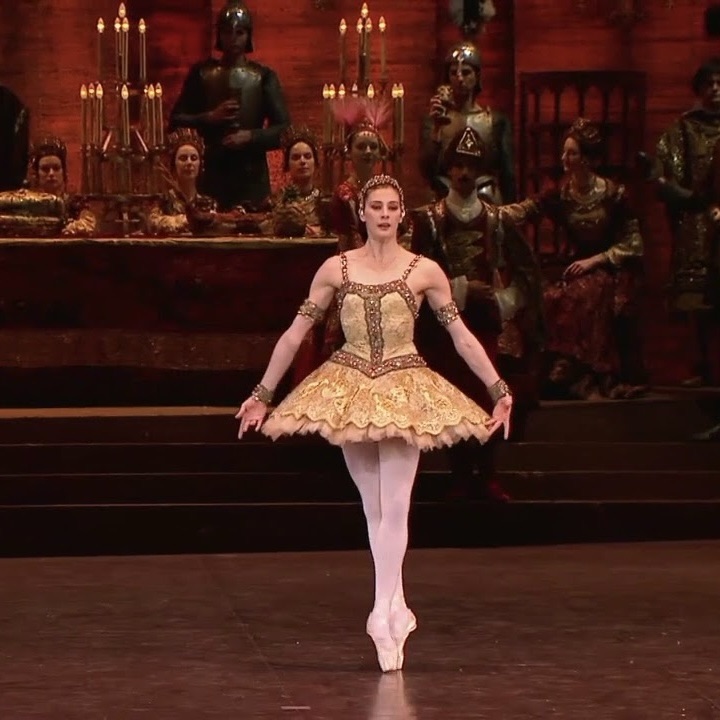
Ces différences de liberté prises sur une chorégraphie originale sont particulièrement manifestes dans des variations peu exigeantes techniquement et requérant une réelle interprétation des danseurs. Pour examiner ces différences, nous nous proposons de comparer la variation de l’acte III de Raymonda, respectivement à l’Opéra de Paris (dans la chorégraphie de Rudolf Noureev) et au théâtre du Mariinsky (dans la chorégraphie révisée par Konstantin Sergueïev). En comparant les interprétations de plusieurs danseuses d’une même compagnie, il ne s’agira pas bien sûr de comparer les différences de chorégraphies entre des versions différentes, mais d’étudier les écarts entre des performances issues d’une même chorégraphie. Pour cette étude, nous avons choisi des captations de Sylvie Guilhem, Marie-Agnès Gillot, Maria Iliushkina et Viktoria Tereshkina. Nous avons volontairement choisi des danseuses ayant le même grade dans leurs compagnies respectives (pour que les modifications des chorégraphies ne s’expliquent pas par des problèmes d’exécution purement techniques) et d’époques relativement proches.
Dans les deux performances de l’Opéra de Paris, les différences remarquées sont faibles et anecdotiques. Les comptes, les pas, les directions, les inclinaisons de la tête et les ports de bras sont identiques sur les deux captations, bien que les deux danseuses n’appartiennent pas à la même génération (Sylvie Guilhem a dansé à l’Opéra entre 1984 et 1989, alors que la captation de Marie-Agnès Gillot a été prise entre 1990 et 2018). On pourra noter quelques petites différences dans le nombre de tours en menés sur pointe ou dans l’inclinaison du buste dans la pose de fin. Cependant, ces différences restent minimes et demeurent probablement invisibles aux yeux d’un spectateur. À l’inverse, les points de passage importants de la chorégraphie sont conservés, comme les claques sonores qui ponctuent la variation, ou la précision dans les pieds dans les petits battements de la diagonale sur pointe. La même interprétation se dégage des deux danseuses, qui incarnent une femme grave et puissante. Plus qu’une différence entre ces deux performances, c’est plutôt la proximité entre les deux versions qui nous frappe : en lançant en parallèle ces deux captations, on a parfois l’impression d’observer des doubles, qui se figent aux mêmes moments dans les mêmes positions.
C’est une impression toute différente que nous laissent les captations du Mariinsky. Si la fin des variations sont identiques, leurs débuts laissent place à de grandes différences de chorégraphie. Les ports de bras, les inclinaisons du buste et les ports de tête ne sont pas les mêmes sur une grande partie de la variation. Non seulement le haut du corps est plus libre, mais on observe également une différence dans les pas, qui se poursuivra sur deux fois huit comptes. On pourrait penser que ces différences de bras et de tête sont insignifiantes, mais prises dans l’ensemble de la chorégraphie, elles aboutissent à deux choix d’interprétations distincts. Là où Viktoria Tereshkina incarne une femme forte au visage grave, Maria Iliushkina arbore un air triomphant et joyeux, si bien que l’on peut se demander si les deux danseuses interprètent le même personnage et racontent la même histoire. Plus largement, ces études de cas illustrent bien la difficulté à établir des critères d’identité chorégraphique : est-ce que ce sont les pas qui comptent le plus, ou faut-il également prendre en compte d’autres facteurs comme les placements dans l’espace ou les ports de tête ? Si tel est le cas, jusqu’à quel degré de précision faut-il descendre ? Est-ce sinon l’émotion transmise par l’artiste et l’incarnation du personnage qui permet d’identifier une interprétation conforme à la chorégraphie ?
Ce comparatif illustre un paradoxe que soulignait MacFee dans « Was That Swan Lake I Saw You at Last Night ? : Dance-Identity and Understanding » : dans un paradigme dualiste séparant les arts visuels des arts performatifs, la danse est indéterminée par nature en ce qu’elle nécessite une actualisation de l’œuvre dans le temps. Il sera donc impossible d’assister à l’œuvre première pensée par le chorégraphe et dénuée de toute interprétation : dans le cas des arts performatifs, « lorsque l’on assiste à une œuvre dans le domaine des arts du spectacle, il s’agit déjà de l’interprétation d’un artiste ». Il y aura donc toujours des différences entre des performances, et comme le rappelle MacFee : « Les différences perceptibles sont tout à fait acceptables : […] elles sont à prévoir dans les arts du spectacle ».
Cependant, si la performance dansée est intrinsèquement éphémère en tant qu’art performatif, elle doit pourtant être réitérable et rester suffisamment fidèle à l’œuvre originelle pour être identifiable. Il semble d’ailleurs que l’attribution d’un nom à une chorégraphie contribue à la fixer dans le temps. Il s’agira alors de trouver les caractéristiques objectives qui permettent d’associer une performance particulière à une chorégraphie.
3. La notation : un critère d’identité chorégraphique en danse classique ?
Une première hypothèse pour distinguer une interprétation correcte d’une interprétation incorrecte serait de se référer à une partition initiale. C’est ce que propose MacFee dans « Was That Swan Lake I Saw You at Last Night? : Dance-Identity and Understanding », en s’intéressant à la relation reliant un type (l’œuvre originelle pensée par le chorégraphe, mais en partie indéterminée car non actualisée) vers un token (l’œuvre chorégraphique actualisée par la performance d’un danseur). MacFee propose le critère d’identification suivant : « La performance A et la performance B sont des performances d’une même œuvre d’art (dans n’importe quel art du spectacle) dans la mesure où elles satisfont ou incarnent toutes deux un « texte » particulier dans une notation considérée par les experts de cette forme d’art comme une notation adéquate pour cette forme ». En effet, la thèse de la notionnalité offre des avantages conséquents : la notation serait comme une « recette », qui permettrait de transmettre les volontés du chorégraphe, de distinguer les éléments constitutifs d’une chorégraphie des détails contingents, et de préciser quels degrés de modifications sont permis dans l’interprétation des artistes.
Cependant, au-delà des problèmes intrinsèques à cette thèse philosophique, cette dernière se heurte à un problème empirique. Il est d’ailleurs intéressant de noter que là où MacFee ponctuait son texte d’exemples d’œuvres chorégraphiques issues aussi bien de la danse classique que de la danse contemporaine, il cesse de mobiliser des exemples de ballets dans sa section 6.0 consacrée à la notionnalité, signe peut-être que cette thèse est plus adaptée à la danse contemporaine qui a un rapport différent à la partition. Il existe bien une notation de la Raymonda de Noureev, comme en témoigne le Benesh Movement Notation Score Catalogue, et il semblerait qu’il existe également une trace écrite de la Raymonda de Konstantin Sergueïev dans la Collection Sergueïev (la chorégraphie de Petipa dont Sergueïev s’est largement inspirée est, quoi qu’il en soit, répertoriée dans le Benesh Movement Notation Score Catalogue). Ces notations sont cependant rares, difficiles à se procurer, et tout le monde (même parmi les danseurs) n’est pas capable de les lire puisque la danse ne possède « pas de notation traditionnelle » : il serait donc impossible pour un spectateur de se reposer sur ces notations pour établir une identité entre un type et un token. Or, comment concevoir un critère d’identification qui exclue l’appréciation du spectateur, si la danse classique est un spectacle vivant destiné non pas seulement à des historiens de la danse, mais à un plus vaste public ? La notation est également un outil d’une utilité limitée pour le danseur ou les répétiteurs, puisqu’une chorégraphie ne s’apprend pas à partir de la lecture d’une partition, comme cela peut être le cas en musique. Une certaine fidélité du token par rapport au type serait une « condition nécessaire à l’identité de la danse », mais non suffisante. Quels critères permettraient donc d’établir l’identité d’une chorégraphie ?
2. La technique française : fidélité à la chorégraphie originelle et aux volontés du chorégraphe
1. La captation, un outil structurant la relation entre un token et son type ?
Il semble donc qu’une œuvre ne soit pas créé à partir d’une partition : la notation ne servirait pas de support premier à partir duquel serait créée une première performance, mais un type serait plutôt constitué à partir d’une première représentation de l’œuvre qui deviendrait par la suite un outil de référence. C’est alors seulement que la notation interviendrait, afin de consigner cette performance de manière durable, et de la rendre itérable. Si l’identité chorégraphique réside dans la fidélité entre un type et un token, et que cette fidélité ne peut être établie uniquement grâce à l’utilisation de la notation, il convient donc de s’intéresser aux mécanismes qui rendent la transmission de l’œuvre possible.
Une première hypothèse pourrait être qu’une telle identité se mesurerait grâce au support audiovisuel : il s’agirait de redéfinir le type comme la première performance en date connue de l’œuvre, acquérant le statut de performance de référence, et le token correspondrait aux différentes performances postérieures au type. Un token appartiendrait donc à un type si une ressemblance suffisante est observée entre les deux performances, et cette ressemblance pourrait se mesurer grâce à l’utilisation de captations. Il s’agirait d’une hypothèse d’autant plus intéressante que le support vidéo est couramment utilisé dans la danse classique, contrairement à la notation : la captation peut servir de référence aux jeunes danseurs, aussi bien dans l’apprentissage des pas que dans leur exécution. L’utilisation d’enregistrements dans le processus de reproduction d’œuvres était ainsi évoquée par Gérard Genette dans l’Œuvre de l’art. Il s’agirait cependant d’un support limité, comme le souligne Frédéric Pouillaude dans le Désœuvrement chorégraphique : contrairement à la musique dans laquelle l’enregistrement est extrêmement proche de l’expérience vécue par le spectateur, la captation de la danse fonctionne différemment. Cette dernière ne correspond jamais à l’expérience perceptive du public, puisqu’elle peut impliquer des gros plans sur les pieds ou les visages des danseurs, qui donnent accès à des détails invisibles pour un spectateur. De plus, il serait faux de penser que la captation puisse devenir un référentiel offrant un point de vue objectif, puisque la disposition de la caméra dans l’espace est déjà un parti-pris qui n’est pas neutre. La captation ne serait donc pas suffisante à elle seule pour remonter d’un token vers un type, puisque comme le rappelle Frédéric Pouillaude, le nombre de captations d’un même spectacle est très limité et ne permet pas d’effectuer de nombreuses comparaisons entre performances. Se baser uniquement sur la captation pour s’assurer de la fidélité du token vis-à-vis du type revient à se soumettre aux aléas d’une performance singulière, et d’accepter de prendre pour référentiel de potentielles erreurs ou de mauvaises interprétations. Enfin, contrairement à la notation, le support vidéo ne permet pas de véhiculer les intentions d’un chorégraphe. La technique française se sert donc du support vidéo pour assurer une homogénéité entre les performances, mais elle se repose aussi sur la transmission orale, qui permet justement de véhiculer les souhaits du chorégraphe.
2. La transmission orale et le respect de la volonté d’un chorégraphe.
En cela, la transmission orale semble très spécifique à la technique française, dont l’identité se cristallise en partie autour des chorégraphies de Rudolf Noureev. Cet attachement aux volontés du chorégraphe se ressent en particulier dans les captations de répétitions et de transmissions des œuvres : « Il [Rudolf Noureev] veut du bruit […], il veut que ce mouvement-là soit sonore, il voulait que ça passe au-delà de la scène », rappelle Elisabeth Platel en enseignant la variation de Raymonda du troisième acte. Ce sont d’ailleurs des consignes qui ont été respectées dans les deux performances de cette variation que nous avions analysées plus haut, signe que cette transmission des volontés du chorégraphe est bien parvenue jusqu’aux interprètes malgré le décès de Rudolf Noureev. Il semblerait donc que l’identité d’une chorégraphie dans la technique française se comprenne de la manière suivante : une performance correspond à l’œuvre originale si les souhaits du chorégraphe sont respectés – le respect de ces souhaits étant encadré à la fois par le support audiovisuel, mais également par une transmission orale des danseurs ayant participé à la création.
En ce sens, l’exemple mobilisé par Frédéric Pouillaude dans le Désœuvrement chorégraphique sur le remontage des « Carnets Bagouet » à la mort du chorégraphe semble particulièrement pertinent pour comprendre la conception de l’identité chorégraphique dans la technique française. En effet, bien que Dominic Bagouet soit un chorégraphe de danse contemporaine, les procédés utilisés pour assurer les liens entre type et token sont très similaires à ceux utilisés par l’Opéra de Paris. Le remontage de l’œuvre reposait sur trois critères : « 1) la présence de deux chefs de projets […] 2) l’intervention dans le temps d’apprentissage du plus grand nombre possible d’interprète d’origine […] 3) […] le recours supplémentaire au plus grand nombre possible de traces documentaires et vidéos ». Bien que ces critères soient peut-être moins stricts dans le cas de l’école française, la présence de répétiteurs ayant connu le chorégraphe est obligatoire dans le remontage d’une œuvre de Rudolf Noureev, comme l’indique la Fondation Noureev (fondation qui détient les droits sur les chorégraphies, et autorise ou non le remontage de ses ballets). Ainsi, ces ballets peuvent être remontés « sous réserve d’un strict contrôle artistique qui inclut la collaboration d’un répétiteur agréé par la Fondation pour les répétitions […] du ballet ».
Cette notion de « strict contrôle artistique » peut pourtant questionner : le respect de la volonté d’un chorégraphe n’est-il pas un critère d’identité chorégraphique trop contraignant, aussi bien pour les danseurs que pour les institutions ? Et n’est-il pas vain de chercher une telle similitude entre chaque performance, si l’on considère qu’une chorégraphie possède toujours en elle des propriétés contingentes ?
3. Danseurs, artistes ou interprètes ? Les limites de la conception d’identité chorégraphiques par l’école française
Cette omniprésence d’un chorégraphe fantôme, qui continuerait à dicter la conduite des interprètes d’aujourd’hui malgré son décès, se ressent particulièrement dans le témoignage de François Alu : « Je ne suis qu’un exécutant qui prête son corps […] pour exécuter la vision d’autrui ». Il nous semble que cette formulation ne doit pas être prise à la légère : n’indique-t-elle pas que la technique française risque de sacrifier l’interprétation des artistes au profit d’une vaine recherche d’identité entre une performance et l’œuvre originale, au risque de dépouiller la danse de ce qui faisait d’elle un art ? Notre position peut paraître dure, mais elle repose sur la considération suivante : n’est-ce pas l’interprétation d’un rôle, qui permet de différencier la danse d’un sport, et le mouvement dansé d’un simple geste ? Il s’agit d’ailleurs des mêmes reproches que formulaient Frédéric Pouillaude à l’égard du remontage des « Carnets Bagouet », dans lequel danseurs et remonteurs s’inclinent devant la mémoire d’un chorégraphe défunt. La performance ressemble alors non plus à un spectacle vivant, capable de laisser place à l’imprévu, mais à « une simple répétition à l’identique » d’une œuvre préexistante, à un hommage perpétuel, voire à une reconstitution historique. Si la perpétuation de l’œuvre est mise en péril à cause d’un décalage historique trop important entre le type et ses tokens (l’œuvre originale étant incapable de s’adapter au monde dans lequel elle est actualisée), y a-t-il encore un sens à vouloir conserver des critères d’identités chorégraphiques aussi contraignants ?
Cette conception de l’identité chorégraphique pose également problème pour les institutions : si le remontage des « Carnets de Bagouets » était particulièrement lent et complexe, il en va de même pour les chorégraphies de Rudolf Noureev, qui requièrent selon la Fondation Noureev l’utilisation du même décor et du même nombre de danseurs que dans la production originale, ce qui limite très fortement le nombre de compagnies capables de danser ces ballets. La même question revient alors : à quoi bon chercher une telle proximité entre un type et ses tokens, s’il devient presque impossible de diffuser cette œuvre ? De plus, une démarche autobiographique reposant sur la mémoire de l’œuvre comporte également ses propres limites, comme le soulignait Frédéric Pouillaude en reprenant ironiquement l’exemple de l’Opéra de Paris (qui insiste pourtant sur l’importance de la transmission orale et le respect des souhaits des chorégraphes) : « En 1950, l’Opéra a oublié l’essentiel de son propre répertoire romantique », car la transmission par la mémoire repose aussi sur la survie des chorégraphes et des danseurs ayant participé à la création de l’œuvre.
Il semble donc que la conception de l’identité chorégraphique de l’œuvre française contribue à expliquer son attention portée aux détails, et sa sobriété dans l’expression des danseurs. Le respect des souhaits du chorégraphe et la recherche de la plus grande fidélité possible entre l’œuvre originale et la performance expliquent donc le peu de variations dans les chorégraphies qui nous avaient frappées lors de notre étude comparative. C’est pourtant tout l’inverse que nous avions observé dans l’école Vaganova, nous laissant à penser que cette technique charrie une tout autre conception de l’identité chorégraphique.
3. La technique Vaganova ou la quête d’expressivité chez l’artiste.
1. Un espace de liberté dans l’interprétation du danseur : l’expressivité individuelle au cœur de la performance
À l’inverse de la technique française extrêmement attachée au respect de la tradition et offrant une faible marge d’interprétation à ses danseurs, la technique Vaganova semble prendre un parti complètement différent. Si ces écarts de visions étaient ostensibles dans notre étude comparative de performances issues d’un même ballet, la liberté accordée aux danseurs dans la technique Vaganova se retrouve dans le processus de transmission même. C’est ce que l’on observe dans le cas de l’apprentissage de la variation de Médora du Corsaire du troisième acte, par Maria Khoreva, première danseuse au Mariinsky : il existe deux versions différentes pour la seconde moitié de la variation (soit 4 fois 8 temps). Certains changements n’impactent « que » les bras, tandis que d’autres affectent l’intégralité des pas effectués. Il est alors intéressant de constater que la danseuse a changé plusieurs fois de versions entre les spectacles, et que ces choix étaient le fruit de décisions conjointes entre la danseuse et sa répétitrice, en fonction de ce qui convenait le mieux à l’artiste. On est donc bien loin du processus de transmission vertical de l’école française, que dénonçait François Alu. L’approche des artistes, détachés de cette recherche de fidélité envers l’œuvre originale qui caractérisait l’école française, peut paraître déroutante : « Vous pouvez faire deux pas, ou un chassé, peu importe. Enfin, si, c’est important, mais c’est votre choix ». Il ne s’agit pas d’affirmer que la technique française ne laissait aucune liberté à ses interprètes : il existe différentes versions d’une même variation, et toutes ces versions sont enseignées aux danseurs qui effectuent ensuite leurs choix. C’est un phénomène que l’on observe par exemple dans la variation de Raymonda du troisième acte, que nous avions longuement étudiée. Cependant, les différences de versions touchaient à une minuscule portion de la variation, et ne portaient que sur des détails minimes de coordination et de contact du pied avec le sol: ces versions étaient annexées à la narration de l’histoire et non à des critères esthétiques, il était donc impossible de croiser les deux versions entre elles (ce qui est possible dans la technique russe).
Ce parti-pris de l’école Vaganova peut rappeler la thèse de Noverre sur la « danse en action », opposée à une « danse mécanique » : selon lui, la danse en tant qu’art doit permettre de raconter une histoire, et cette narration ne peut se faire qu’à travers l’expressivité des danseurs. Noverre utilise une analogie pour souligner l’importance qu’il accorde à l’expressivité : le danseur qui se contenterait d’exécuter un mouvement serait semblable à l’érudit qui maîtriserait l’écriture, mais serait incapable d’utiliser le langage pour communiquer. Le véhicule de cette expressivité résiderait dans les bras des danseurs et non plus dans leurs pieds, ce qui rappelle l’importance accordée aux ports de bras qui est au cœur de la technique Vaganova. L’identité d’une chorégraphie serait donc à trouver dans l’unité de l’histoire qui est racontée, et reposerait sur une notation qu’elle finirait toujours par dépasser. Des modifications dans l’interprétation des danseurs et dans les pas exécutés sont dès lors tolérées puisqu’elles sont la condition nécessaire à une narration efficace et sincère. Le respect vis-à-vis d’une notation préexistante ou d’un souhait du chorégraphe perd donc peut-être son sens, si l’on considère comme Noverre que l’expressivité ne saurait être codifiée au sein d’une partition préalable, ou à travers les indications verbales d’un chorégraphe.
Cependant, un critère d’identité aussi large ne pose-t-il pas lui aussi problème ? Comment permet-il de rendre compte de l’identité d’œuvres non narratives ? N’y a-t-il pas un risque que la priorité accordée à l’artiste plutôt qu’à la chorégraphie nuise à la conservation d’une chorégraphie ? Aussi bien au Mariinsky qu’à l’Opéra de Paris, les danseurs sont des professionnels, dont le métier est de pouvoir répondre aux exigences d’une chorégraphie sans avoir à la modifier, et de transmettre leur intériorité à travers des gestes fixés à l’avance. Ne peut-on pas craindre que la technique Vaganova finisse par tendre vers une confusion entre l’interprète et l’œuvre, au point que l’œuvre ne soit plus réitérable (aussi bien parce que la chorégraphie serait perdue, que parce que les différences d’interprétation entre artistes seraient telles que le spectateur n’irait plus regarder un ballet en particulier, mais un artiste) ? À modifier une chorégraphie, la performance ne finit-elle pas par devenir une nouvelle œuvre, indépendante du type dont elle émane pourtant ?
2. Une approche pragmatique : la performance confrontée au monde de la danse et à son contexte d’exposition
L’aspect narratif d’une œuvre chorégraphique comme critère d’identité n’est peut-être pas tant à rejeter qu’à nuancer et à compléter. En effet, il semble impossible de se contenter de ce premier critère, qui finirait par faire de la danse un art éphémère échappant à toute identification.
Une approche pragmatique pourrait peut-être nous permettre de saisir la compréhension de l’identité d’une œuvre chorégraphique au sein de la technique Vaganova : contrairement à une pensée essentialiste, elle nous préviendrait de critères d’identité abstraits qui ne correspondent pas à la manière dont l’identité d’une chorégraphie est comprise par les danseurs ou le public. La démarche de Julie Van Camp nous semble en ce sens particulièrement pertinente : en s’intéressant aux lois américaines sur les droits d’auteurs dans « Identity in Dance: What Happened? », cette dernière fonde l’identité d’une chorégraphie dans la réalité du « monde de la danse ». Il ne s’agit donc pas de nier l’utilité d’une notation, mais de reconnaître ses limites et de l’utiliser comme un support facilitant l’identification d’une performance, sans pour autant en faire un critère d’identité nécessaire et suffisant. Cette thèse, approfondie dans « A Pragmatic Approach to the Identity of Works of Art », fonderait l’identité chorégraphique sur une « manière d’agir » et une « manière de parler », une double approche assez large et réaliste pour inclure les diverses performances autorisées dans la technique Vaganova. Le rôle qu’occupe le dialogue entre danseurs et répétiteurs, et qui permettrait d’établir un degré acceptable de modification de la chorégraphie semble refléter la réalité décrite par Maria Khoreva. Le fait que ce dialogue soit continu permet également d’éviter un décalage entre l’œuvre originale et le monde dans lequel elle est actualisée, et que nous avions pu analyser dans le cas de l’école française. La multiplicité des acteurs constituant ce monde de la danse permettrait de façonner un critère d’identité qui puisse s’adapter à la fois à la réalité des danseurs et du public, aussi novice soit-il (ce qui n’était pas le cas lorsque le respect des volontés du chorégraphe était au cœur de l’identité d’une œuvre). Ainsi, non seulement les danseurs et les répétiteurs, mais aussi le public, les critiques et les historiens de l’art participent à l’identification de l’œuvre dans leur manière de parler de la performance. Enfin, les institutions jouent un rôle par leurs actions : le nom sous lequel est vendu un ticket, ou les répétiteurs extérieurs invités dans une compagnie participent de l’identification d’une performance.
Cette thèse pose évidemment ses propres difficultés : quel sens conférer à une identité émanant d’un monde de la danse si large, qui semblerait mettre sur le même plan des spectateurs pour la plupart novices, des historiens de la danse et des danseurs qui n’ont pas toujours un regard objectif sur leur propre pratique artistique ? Bien que ces interrogations soient légitimes, notre démarche ici n’est pas axiologique, et ne cherche pas tant à trouver un critère absolu d’identification d’une œuvre que de comprendre la manière dont une école de danse envisage une identité chorégraphique. En ce sens, il semble bien que les thèses de Noverre et l’approche pragmatique de Julie Van Camp permettent d’éclairer la pratique artistique en vigueur au théâtre du Mariinsky.
Conclusion
Si les écoles de danse sont généralement abordées d’un point de vue historique ou technique, notre étude a permis de réaliser comment un style de danse charrie avec elle sa propre conception de l’identité d’une chorégraphie, et véhicule plus largement un regard rétrospectif sur sa propre pratique.
Ainsi, les caractéristiques de la technique française semblaient se retrouver dans sa compréhension de l’identité chorégraphique : la précision du bas de jambe qu’elle enseigne était une précision qui paraît se retrouver dans son attache au respect de la chorégraphie originale, et plus encore, aux respects des vœux du chorégraphe. Il ne s’agit pas alors de rejeter la notation d’une œuvre chorégraphique, mais de venir nourrir le travail de transmission d’autres supports, tels que les captations ou les témoignages oraux, pour s’assurer de la fidélité de la performance à l’œuvre originale. Le rejet d’une expressivité excessive, jugée superflue par l’école française s’explique peut-être aussi par le rôle accordé au danseur : dans la performance, ce n’est pas l’individualité qui est mise en avant, mais bien l’œuvre du chorégraphe. Le danseur se rapproche alors plus d’un exécutant que d’un artiste, et doit se mettre au service de l’œuvre. Si certaines libertés sont accordées au danseur dans cette conception de l’identité chorégraphique, ces différences restent marginales et sont soigneusement encadrées : dans l’œuvre chorégraphique comprise comme œuvre d’art, c’est bien davantage la notion d’œuvre qui l’emporte sur l’aspect artistique. Une telle identité chorégraphique, en raison des contraintes très lourdes qu’elle implique, ne peut s’adresser à un public amateur : seul un expert de la danse semblerait en mesure d’attribuer une identité à une performance.
À l’inverse, la recherche d’expressivité dans la technique Vaganova impliquait une mise en avant de l’artiste au centre de la performance, tendant à éclipser l’œuvre originale. De nombreuses modifications de la chorégraphie ont pu être acceptées, afin d’adapter l’œuvre aux préférences individuelles des danseurs et de l’époque dans laquelle elle est produite. Cependant, au risque de tomber dans un relativisme (l’identité entre un type et un token dépendant d’une simple opinion, indépendamment de tout critère objectif), ou de rendre une œuvre chorégraphique non réitérable à cause d’un trop grand nombre de modifications non légitimes, deux hypothèses ont été étudiées pour parvenir à fonder une identité chorégraphique. La trame narrative pourrait constituer un premier critère à l’unicité d’une œuvre : un token appartiendrait à un type si tous deux racontent la même histoire, en se basant sur une même notation et un ensemble de gestes communs servant de langage au danseur. Une approche pragmatique, qui ferait résider l’identité de l’œuvre dans le jugement d’acteurs appartenant au monde de la danse, permettait également de s’adapter aux réalités de l’attribution d’une identité, tout en incluant le public visé par cette performance.
Bibliographie
Textes de philosophie :
Genette Gérard, L’œuvre de l’art (1994), t.1, Seuil, Paris
Goodman Nelson (1968), Languages of Art. An Approch to a Theory of Symbols, Indianapolis, Hackett, 1976, trad. fr., Languages de l’art, Nîmes, Chambon, 1990
MacFee Graham (1994), « Was That Swan Lake I Saw You at Last Night?: Dance-Identity and Understanding», Dance Research: The Journal of the Society for Dance Research, Vol. 12, No. 1, Edinburgh University Press
Noverre (1760), Lettre sur la danse et les ballets, réédition Divoire, Lieutier, 1952
Pouillaude Frédéric (2009), Le désœuvrement chorégraphique, étude sur la notion d’œuvre en danse, Vrin, essais d’art et de philosophie, Paris
Van Camp Julie C (2006), « A Pragmatic Approach to the Identity of Works of Art », Journal of Speculative Philosophy, 20.1, pp. 42–55.
Van Camp Julie C (2019), « Identity in Dance: What Happened? », Midwest Studies in Philosophy
Ecrits non philosophiques sur la danse :
Alu François (2024), Le prix de l’étoile, éditions Robert Laffont, Paris
Vaganova Agrippa (1953), Basic Principles of classical ballet: Russian Ballet Technique, Dover Publication, INC, New-York, trad.angl., Chujoy, 1969
Autres ressources :
ARTE France, 2018 « Danser classique », Graines d’étoiles, saison 2 – ép. 1, réalisation Françoise Marie, https://play.operadeparis.fr/p/graines-detoiles-saison-2-ep-1
Cat Cat, 18 janv. 2018, YouTube, Marie-Agnes Gillot – Paris Opera Ballet Raymonda, https://www.youtube.com/watch?v=EDIaW_t6IYE
Braga144 b, 17 mars 2020, YouTube, Sylvie Guillem Raymonda, Francesco Libetta piano, https://www.youtube.com/watch?v=PHZTTYmuCNk
Gilmer Lopez Aguilar, 21 juin 2020, YouTube, Viktoria Tereshkina, Variation de Raymonde act III, https://www.youtube.com/watch?v=yGcCEWTDDDE
Khoreva Maria (ballet dancer public), 30 juillet 2020, YouTube, Ballet LE CORSAIRE – Medora solo – LEARN TOGETHER with Maria Khoreva, https://www.youtube.com/watch?v=Yg6R5Ka0RY4&t=549s
Paris Opera Play, 2024, Raymonda en répétitions avec… Élisabeth Platel, la variation de Raymonda (Acte III), Masterclass, Opéra national de Paris, réalisation OV Studio, https://play.operadeparis.fr/p/raymonda-en-repetitions-avec-elisabeth-platel
TheBalletGallery, 22 février 2024, YouTube, Maria Ilyushkina (Mariinsky Ballet) Raymonda, Hungarian variation (Act 3), https://www.youtube.com/watch?v=_6L8Dro5QgM
English version
The identity of a choreographic work put to the test by French technique and the Vaganova method.
By Mihn Mabut (English translation by Guilhem Chameyrat)
Table of content
Introduction
I. Comparative analysis of French and Vaganova technique: initial avenues for developing a choreographic identity
A) Dance techniques: a look back at the opposition between the French style and the Vaganova school
B) Dance as a performing art: choreographic transformations in the case of the variation in Raymonda in Act III.
C) Notation: a criterion for choreographic identity in classical dance?
II. The French technique: fidelity to the original choreography and the choreographer’s intentions
A) Capture: a tool for structuring the relationship between a token and its type?
B) Oral transmission and respect for the choreographer’s wishes.
C) Dancers, artists or performers? The limits of the French school’s conception of choreographic identity
III. The Vaganova technique or the quest for expressiveness in the artist.
A) A space for freedom in the dancer’s interpretation: individual expressiveness at the heart of performance
B) A pragmatic approach: performance confronted with the world of dance and its exhibition context
Conclusion
« While I only seek to offer the best possible performance (…] I often introduce some new combinations of pirouettes or jumps that I consider more as impressive as those originally choreographed in the work », says French dancer François Alu in Le prix de l’étoile. Whereas such changes to choreography are tolerated in other countries, this disobedience earned François Alu numerous reprimands from his superiors at the Paris Opera Ballet, and this lack of freedom at the Paris Opera was one of the reasons that prompted him to leave the institution in 2022. It would therefore seem that institutions, and more specifically dance schools, differ in their vision of the identity of a choreographic work. This can be seen in the case of the French technique and Agrippa Vaganova’s Russian technique: while the French technique is committed to the exact reproduction of choreography, the Vaganova school is much more open to modifications to adapt to the particularities of each dancer. These observations raise questions: if the choreography changes between two performances of the same ballet, can we still consider these two performances to belong to the same work? What criteria can be used to establish a choreographic identity? The case of choreographic modifications in the Vaganova technique also raises questions about the degree of freedom granted to an artist: at what point do we consider that the modification of a work exceeds the margin of interpretation granted to a dancer and becomes a new choreography? Conversely, in the case of French technique, scrupulous adherence to the choreography has its own limitations: if the dancer’s interpretation becomes strictly regulated, can they still be considered artists or simply performers? Is there not a risk of sacrificing the artistic aspect of dance in favour of preserving the work?
Philosophical authors from the analytical tradition have examined performance and the criteria for identifying a choreographic work. Notable examples include Nelson Goodman, who worked on dance notation, and Margolis, who developed the type/token thesis, which was subsequently examined by Graham MacFee. Frédéric Pouillaude, meanwhile, has focused on the history of dance and the problems associated with the notation and transmission of a work. Le désœuvrement chorégraphique, in which he expounds his theories will be studied at length in the course of our work. However, to our knowledge, no author has linked these philosophical theories to the practices of different dance schools, highlighting the way in which style influences the conception of choreographic identity. These questions will lead us to establish criteria for differentiating between a valid interpretation and an invalid one, and will shed light on the role of dancers – understood as artists or mere performers. In the words of Graham MacFe e 6. this will involve clarifying our understanding of the choreographic work as a whole and, more broadly, the resulting vision of dance.
To do this, we will compare the understanding of choreographic identity between the French technique and Vaganova, drawing on concrete examples from the two institutions that embody these schools: the Paris Opera and the Mariinsky Theatre. We will choose to start with the artists themselves, using, for example, performance recordings, so that our philosophical analysis is as close as possible to the reality being studied. The sources will therefore be varied in nature: we will draw on artists’ writings, recordings of variations, documentaries and theoretical writings on dance, which we will seek to illuminate in the light of philosophical texts. Our work will be descriptive rather than axiological in scope: we will seek to show how different dance techniques can lead to different understandings of choreographic identity, without seeking to establish a hierarchy between these two approaches.
In order to make our work accessible to all, we felt it was essential to start with the contrast between the French and Vaganova techniques, focusing on style in classical dance. Following ar initial attempt to define the choreographic identity common to both schools, we will then study the French and Russian techniques separately, as the differences between them are too great to be reconciled. In each case, we will examine the concept of choreographic identity that emerges from these schools through philosophical texts, and raise any issues that these identity criteria may pose.
I. Comparative analysis of French and Vaganova technique: initial avenues for developing a choreographic identity
A) Dance techniques: a look back at the opposition between the French style and the Vaganova school
Before looking at the differences in the conception of choreographic identity between the French technique and the Vaganova technique, we believe it is important to briefly review the history of these two styles in order to understand the relevance of such an opposition.
Indeed, although classical dance is a codified art form whose overall structure remains identica nal scarintor estered in the a se, the funare alwal structural principles such as en-dehors or the search for a graceful and ethereal silhouette are always respected), it is taught using different methods. There are different styles: the French school, the Russian Bolshoi technique, the Vaganova method, the Balanchine style, etc. As V. Chistyakova points out in her introduction to Basic Principles of Classical Ballet, a dance style produces « artistic homogenety » within a troupe, something identifiable by a spectator, and that all dancers from the same school « something they have in common in their manner of excuting » of a step. This homogeneity is therefore not only due to historical factors or a repertoire of common movements: style also relates to the way one moves. Thus, the French school, largely influenced by Auguste Bournonville and then Rudolf Nureyev, emphasises very fast, precise and dynamic lower body movements and an elegant and refined upper body. French technique thus values restraint and sobriety in the expression of emotions. Vaganova technique, on the other hand, advocates great expressiveness in the arms and an almost theatrical lyricism. By emphasising the expressiveness of dancers, it perhaps places greater importance on the specificity of each artist’s body and personality. It would therefore seem understandable that a variation could be modified in the Vaganova method if it allows for greater expressiveness, which is absolutely unthinkable in the French method. In this respect, our excursus on the different schools of dance seems central, as it allows us to understand that a style not only influences the way dancers move, but also indirectly reflects a certain understanding of the identity of a choreography. It is therefore relevant to look at specific cases of choreographic modifications in order to understand how these differences in conceptions of choreographic identity materialise on stage.
B) Dance as a performing art: choreographic transformations in the case of the variation in Raymonda in Act III.
These differences in freedom taken from an original choreography are particularly evident in variations that are not technically demanding and require real interpretation from the dancers. To examine these differences, we propose to compare the variation in Act Ill of Raymonda, respectively at the Paris Opera (in Rudolf Nureyev’s choreography) and at the Mariinsky Theatre (in the choreography revised by Konstantin Sergeyev). By comparing the interpretations of several dancers from the same company, we will not, of course, be comparing the differences in choreography between different versions, but rather studying the differences between performances based on the same choreography. For this study, we have chosen recordings of Sylvie Guilhem, Marie-Agnès Gillot, Maria Iliushkina and Viktoria Tereshkin. We have Dancers were deliberately chosen who hold the same rank in their respective companies (so that changes in choreography cannot be explained by purely technical performance issues) and who are from relatively similar periods.
In both performances at the Paris Opera, the differences noted are minor and anecdotal. The counts, steps, directions, head inclinations and arm movements are identical in both recordings, even though the two dancers do not belong to the same generation (Sylvie Guilhem danced at the Opera between 1984 and 1989, while Marie-Agnès Gillot’s recording was made between 1990 and 2018). There are a few minor differences in the number of turns performed on point el and in the angle of the torso in the final pose. However, these differences are minimal and probably invisible to the audience. Conversely, the important points of the choreography are preserved, such as the loud claps that punctuate the variation, or the precision of the feet in the small battemen sis of the diagonal on pointe. The same interpretation emerges from both dancers, who embody a serious and powerful woman. Rather than a difference between these two performances, it is the similarity between the two versions that strikes us: when watching these two recordings side by side, we sometimes have the impression of observing doubles, who freeze at the same moments in the same positions.
The Mariinsky recordings leave us with a very different impression. While the endings of the variations are identical, their beginnings reveal significant differences in the choreography. The arm movements, the inclinations of the torso and the head positions are not the same for much of the variation. Not only is the upper body freer, but there is also a difference in the steps, which continues for two sets of eight counts. One might think that these differences in arm and head movements are insignificant, but taken within the whole choreography, they result in two distinct interpretations. Where Viktoria Tereshkina embodies a strong woman with a serious expression, Maria Iliushkina has a triumphant and joyful air, so much so that one might wonder whether the two dancers are interpreting the same character and telling the same story. More broadly, these case studies illustrate the difficulty of establishing criteria for choreographic identity: are the steps what matter most, or should other factors such as spatial placement and head position also be taken into account? If so, how precise does one need to be? Or is it the emotion conveyed by the artist and the embodiment of the character that allows us to identify a performance that is consistent with the choreography?
This comparison illustrates a paradox highlighted by MacFee in « Was That Swan Lake I Saw You at Last Night? : Dance-Identity and Understanding »: in a dualistic paradigm separating the visual arts from the performing arts, dance is indeterminate by nature in that it requires the work to be actualised over time. It is therefore impossible to witness the work as originally conceived by the choreographer, devoid of any interpretation: in the case of the performing arts, « when one witnesses a work in the performing arts, it is already a performer’s interpret », there will therefore always be differences between performances, and as MacFee points out: « Variety of perceptible differences are quite acceptable : indeed, such are to be expected in performing arts ». However, although dance performance is intrinsically ephemeral as a performing art, it must nevertheless be repeatable and remain sufficiently faithful to the original work to be identifiable. It also seems that giving a name to a choreography helps to fix it in time. The challenge then is to find characteristics that allow a particular performance to be associated with a choregraphy.
C) Notation: a criterion for choreographic identity in classical dance?
A first hypothesis for distinguishing between a correct interpretation and an incorrect one would be to refer to an initial score. This is what MacFee proposes in « Was That Swan Lake I Saw You at Last Night? : Dance-Identity and Understanding, » focusing on the relationship between a type (the original work conceived by the choreographer, but partly indeterminate because it has not been actualised) and a token (the choreographic work actualised by a dancer’s performance). MacFee proposes the following identification criterion: « Performance A and performance B are performances of the same work of art (in any performing art) just in case both satisfy or instantiate some particular ‘text’ in a notation agreed by the knowledgeable in the art form to be an adequate notation for that form » Indeed, the thesis of notionality offers significant advantages: notation would be like a « recipe », which would make it possible to convey the choreographer’s intentions, to distinguish the constituent elements of a choreography from contingent details, and to specify what degrees of modification are permitted in the artists’ interpretation.
However, beyond the problems intrinsic to this philosophical thesis, it also faces an empirical problem. It is interesting to note that while Macfee punctuated his text with examples of choreographic works from both classical and contemporary dance, he stops using examples from ballet in section 6.0, which is devoted to notionality. This may be a sign that this thesis is more suited to contemporary dance, which has a different relationship to the score. There is indeed a notation of Nureyev’s Raymonda, as evidenced by the Benesh Movement Notation Score Catalogue, and it would appear that there is also a written record of Konstantin Sergeyev’s Raymonda in the Sergeyev Collection (the choreography of Petipa, who greatly inspired Sergeyev, is, in any case, listed in the Benesh Movement Notation Score Catalogue). However, these notations are rare, difficult to obtain, and not everyone (even among dancers) is able to read them, since dance does not have « no traditional notation »: it would therefore be impossible for a spectator to rely on these notations to establish an identity between a type and a token. But how can we devise an identification criterion that excludes the spectator’s appreciation, if classical dance is a live performance intended not only for dance historians but for a wider audience? Notation is also a tool of limited use for dancers or rehearsal directors, since choreography cannot be learned by reading a score, as is the case with music. A certain fidelity of the token to the type would be a « necessary condition for dance identity », but it is not sufficient. What criteria would therefore establish the identity of a choregraphy?
II. The French technique: fidelity to the original choreography and the choreographer’s intentions
A) Capture: a tool for structuring the relationship between a token and its type?
It therefore seems that a work is not created from a score: notation would not serve as the primary medium from which an initial performance would be created, but rather a type would be constituted from an initial representation of the work, which would subsequently become a reference tool. Only then would notation come into play, in order to record this performance in a lasting manner and make it repeatable. If choreographic identity resides in the fidelity between a type and a token, and if this fidelity cannot be established solely through the use of notation, it is therefore necessary to examine the mechanisms that make the transmission of the work possible.
A first hypothesis could be that such an identity could be measured using audiovisual media: the type would be redefined as the first known performance of the work, acquiring the status of a reference performance, and the token would correspond to the various performances subsequent to the type. A token would therefore belong to a type if there is sufficient similarity between the two performances, and this similarity could be measured using recordings. This hypothesis is all the more interesting given that video recordings are commonly used in classical dance, unlike notation recordings can serve as a reference for young dancers, both in learning the steps and in their execution. The use of recordings in the process of reproducing works was thus evoked by Gérard Genette in L’Œuvre de l’art. However, this would be a limited medium , as the points out Frédéric Pouillaude in Le désœuvrement chorégraphique : unlike music, where recordings are extremely close to the audience’s experience, dance recordings work differently, they never correspond to the audience’s perceptual experience, as they may involve close-ups of the dancers’ feet or faces, revealing details that are invisible to the audience.
Furthermore, it would be wrong to think that recordings can become a reference point offering an objective point of view, since the positioning of the camera in space is already a biased choice that is not neutral. Recording alone would therefore not be sufficient to map a token to a type, since, as Frédéric Pouillaude points out, the number of recordings of the same performance is very limited and does not allow for many comparisons between performances. Relying solely on recordings to ensure the fidelity of the token to the type means submitting to the vagaries of a single performance and accepting potential errors or misinterpretations as a reference point. Finally, unlike notation, video does not convey the intentions of a choreographer. The French technique therefore uses video to ensure consistency between performances, but it also relies on oral transmission, which allows the choreographer’s wishes to be conveyed.
B) Oral transmission and respect for the choreographer’s wishes.
In this respect, oral transmission seems to be very specific to the French technique, whose identity is partly crystallised around Rudolf Nureyev’s choreographies. This attachment to the choreographer’s wishes is particularly evident in recordings of rehearsals and transmissions of works: « He [Rudolf Nureyev] wants noise […], he wants that movement to be loud, he wanted that it goes beyond the stage » recalls Elisabeth Platel when teaching the variation from Raymonda from the third act. These instructions were followed in both performances of this variation that we analysed above, a sign that the choreographer’s wishes have been successfully conveyed to the performers despite Rudolf Nureyev’s death. It would therefore seem that the identity of a choreography in French technique can be understood as follows: a performance corresponds to the original work if the choreographer’s wishes are respected – the respect for these wishes being framed both by the audiovisual medium and by the oral transmission of the dancers who participated in the creation.
In this sense, the example used by Frédéric Pouillaude in Le désœuvrement chorégraphique on the re-staging of the « Carnets Bagouet » after the choreographer’s death seems particularly relevant to understanding the conception of choreographic identity in French technique. Indeed, although Dominic Bagouet was a contemporary dance choreographer, the processes used to ensure the links between type and token are very similar to those used by the Paris Opera. The The restaging of the work was based on three criteria: « 1) the presence of two project leaders […] 2) the involvement of as many original performers as possible in the learning process […] 3) […] the additional use of as many documentary and video records as possible ». Although these criteria may be less strict in the case of the French school, the presence of rehearsal directors who knew the choreographer is mandatory when restaging a work by Rudolf Nureyev, as indicated by the Nureyev Foundation (the foundation that holds the rights to the choreographies and authorises or denies the restaging of his ballets). Thus, these ballets may be restaged « subject to strict artistic control, which includes the collaboration of a rehearsal director approved by the Foundation for rehearsals [.] of the bates ».
However, this notion of « strict artistic control » may raise questions: is respect for the choreographer’s wishes not too restrictive a criterion of choreographic identity, both for dancers and for institutions? And is it not futile to seek such similarity between each performance, considering that a choreography always has contingent properties?
C) Dancers, artists or performers? The limits of the French school’s conception of choreographic identity
The omnipresence of a ghost choreographer, who continues to dictate the conduct of today’s performers despite his death, is particularly evident in François Alu’s testimony: « I am merely a performer who lends his body […] to execute the vision of others ». We believe that this statement should not be taken lightly: does it not suggest that French technique risks sacrificing the artists interpretation in favour of a vain search for identity between a performance and the original work, at the risk of stripping dance of what made it an art form? Our position may seem harsh, but it is based on the following consideration: is it not the interpretation of a role that distinguishes dance from sport, and danced movement from a simple gesture? These are the same criticisms that Frédéric Pouillaude levelled at the remounting of the « Carnets Bagouet », in which dancers and remounters bow to the memory of a deceased choreographer. The performance then no longer resembles a live show, capable of leaving room for the unexpected, but « a simple and identical rehearsal » of a pre-existing work, a perpetual tribute, or even a historic reconstruction. If the perpetuation of the work is jeopardised because of too great a historical gap between the type and its tokens (the original work being unable to adapt to the world in which it is updated), is there still any point in wanting to preserve such restrictive choreographic identity criteria?
This conception of choreographic identity also poses a problem for institutions: while the estaging of « Carnets de Bagouets » was particularly slow and complex, the same is true of Rudol Nureyev’s choreographies, which, according to the Nureyev Foundation, require the use of same set and the same number of dancers as in the original production, which greatly limits the number of companies capable of dancing these ballets. The same question then arises: what is the point of seeking such proximity between a type and its tokens if it becomes almost impossible to disseminate the work? Furthermore, an autobiographical approach based on the memory of the work also has its own limitations, as Frédéric Pouillaude pointed out, ironically citing the example of the Paris Opera (which nevertheless insists on the importance of oral transmission and respect for the wishes of choreographers): « In 1950, the Opera forgot most of its own romantic repertoire » because transmission through memory also depends on the survival of the choreographers and dancers who participated in the creation of the work.
It therefore seems that the choreographic identity of the French work helps explain its attention to detail and the dancers’ restrained expression. Respect for the choreographer’s wishes and the quest for the greatest possible fidelity between the original work and the performance therefore explain the lack of variation in the choreography that struck us during our comparative study. However, we observed the exact opposite in the Vaganova school, leading us to believe that this technique conveys a completely different conception of choreographic identity.
III. The Vaganova technique or the quest for expressiveness in the artist.
A) A space for freedom in the dancer’s interpretation: individual expressiveness at the heart of performance
Unlike the French technique, which is extremely attached to tradition and offers its dancers little room for interpretation, the Vaganova technique seems to take a completely different approach. While these differences in vision were evident in our comparative study of performances from the same ballet, the freedom granted to dancers in the Vaganova technique is also reflected in the teaching process itself. This can be seen in the case of the teaching of the Medora variation from Le Corsaire in the third act by Maria Khoreva, principal dancer at the Marlinsky: there are two different versions for the second half of the variation (i.e. 4 times 8 beats). Some changes affect « only » the arms, while others affect all the steps performed. It is interesting to note that the dancer changed versions several times between performances, and that these choices were the result of joint decisions between the dancer and her rehearsal coach, based on what suited the artist best. This is a far cry from the vertical transmission process of the French school, which François Alu denounced. The approach of the artists, detached from the French school’s characteristic quest for fidelity to the original work, may seem confusing: « you can go step step or chassé, doesn’t really matter. I mean, it does matter, but it’s your choice ». This is not to say that the French technique left no freedom to its performers: there are different versions of the same variation, and all these versions are taught to the dancers, who then make their own choices. This phenomenon can be observed, for example, in the Raymonda variation in the third act, which we studied at length. However, the differences between the versions affected only a tiny portion of the variation and concerned only minor details of coordination and foot contact with the floor: these versions were linked to the narrative of the story and not to aesthetic criteria, so it was impossible to combine the two versions (which is possible in Russian technique).
This approach taken by the Vaganova school is reminiscent of Noverre’s thesis on « dance in action », as opposed to « mechanical dance »: according to him, dance as an art form should tell a story, and this storytelling can only be achieved through the expressiveness of the dancers. Noverre uses an analogy to emphasise the importance he attaches to expressiveness: a dancer who merely executes a movement is like a scholar who has mastered writing but is incapable of using language to communicate. The vehicle for this expressiveness would lie in the dancers’ arms rather than their feet, which recalls the importance given to arm movements, which is at the heart of the Vaganova technique. The identity of a choreography would therefore be found in the unity of the story being told, and would be based on a notation that it would always end up transcending. Changes in the dancers’ interpretation and in the steps performed are therefore tolerated, as they are a necessary condition for effective and sincere storytelling. Respect for pre-existing notation or the choreographer’s wishes may therefore lose its meaning if, like Noverre, we consider that expressiveness cannot be codified in a pre-existing score or through the verbal instructions of a choreographer.
However, isn’t such a broad criterion of identity also problematic? How does it account for the identity of non-narrative works? Isn’t there a risk that giving priority to the artist rather than the choreography will undermine the preservation of a choreography? At both the Mariinsky and the Paris Opera, the dancers are professionals whose job is to meet the demands of a choreography without having to modify it, and to convey their inner feelings through pre-determined movements.
Is there not a risk that the Vaganova technique will ultimately blur the distinction between the performer and the work, to the point where the work can no longer be repeated (both because the choreography would be lost and because the differences in interpretation between artists would be such that the audience would no longer be watching a particular ballet, but an artist)? By modifying a choreography, does the performance not end up becoming a new work, independent of the type from which it originated?
B) A pragmatic approach: performance confronted with the world of dance and its exhibition context
The narrative aspect of a choreographic work as a criterion of identity should perhaps not be rejected so much as nuanced and supplemented. Indeed, it seems impossible to be satisfied with this first criterion alone, which would ultimately render dance an ephemeral art form that defies identification.
A pragmatic approach might enable us to grasp the understanding of the identity of a choreographic work within the Vaganova technique: contrary to essentialist thinking, it would warn us against abstract identity criteria that do not correspond to the way in which the identity of a choreography is understood by dancers or audiences. Julie Van Camp’s approach seems particularly relevant in this regard: by focusing on American copyright laws in « Identity in Dance: What Happened? », she bases the identity of a choreography on the reality of the « dance world ». It is therefore not a question of denying the usefulness of notation, but of recognising its limitations and using it as a support to facilitate the identification of a performance, without making it a necessary and sufficient criterion of identity. This thesis, explored in greater depth in « A Pragmatic Approach to the Identity of Works of Art », bases choreographic identity on « ways of talking and acting », a dual approach broad and realistic enough to include diverse performances authorised in the Vaganova technique. The role played by dialogue between dancers and rehearsal directors, which allows for an acceptable degree of modification to the choreography, seems to reflect the reality described by Maria Khoreva. The fact that this dialogue is ongoing also helps to avoid a disconnect between the original work and the world in which it is performed, which we were able to analyse in the case of the French school. The multiplicity of actors constituting this world of dance would make it possible to shape a criterion of identity that could be adapted to both the reality of the dancers and the audience, however novice they may be (which was not the case when respect for the choreographer’s wishes was at the heart of a work’s identity). Thus, not only dancers and rehearsal directors, but also audiences, critics and art historians participate in the identification of the work through the way they talk about the performance. Finally, institutions play a role through their actions: the name under which a ticket is sold, or the external rehearsal directors invited to a company, contribute to the identification of a performance.
This thesis obviously poses its own difficulties: what meaning should be given to an identity emanating from such a broad world of dance, which seems to place mostly novice spectators, dance historians and dancers who do not always have an objective view of their own artistic practice on the same level? Although these questions are legitimate, our approach here is not axiological, and does not seek so much to find an absolute criterion for identifying a work as to understand how a dance ichool envisages a choreographic identity. In this sense, it seems that Noverre’s theories and Julie Van Camp’s pragmatic approach shed light on the artistic practice in force at the Mariinsky Theatre.
Conclusion
While dance schools are generally approached from a historical or technical perspective, our study has shown how a dance style carries with it its own conception of the identity of a choreography and, more broadly, conveys a retrospective view of its own practice.
Thus, the characteristics of French technique seemed to be reflected in her understanding of choreographic identity: the precision of the lower leg that she teaches was a precision that seemed to be reflected in her attachment to respecting the original choreography and, even more so, to respecting the wishes of the choreographer. It is not a question of rejecting the notation of a choreographic work, but of enriching the work of transmission with other media, such as recordings or oral testimonies, to ensure that the performance remains faithful to the original work. The rejection of excessive expressiveness, considered superfluous by the French school, can perhaps also be explained by the role given to the dancer: in performance, it is not individuality that is emphasised, but the choreographer’s work. The dancer is therefore closer to a performer than an artist, and must put themselves at the service of the work. While dancers are granted certain freedoms in this conception of choreographic identity, these differences remain marginal and are carefully controlled: in choreographic work understood as a work of art, it is the notion of the work that prevails over the artistic aspect. Such a choreographic identity, due to the very heavy constraints it implies, cannot be addressed to an amateur audience: only a dance expert would seem capable of attributing an identity to a performance.
Conversely, the search for expressiveness in the Vaganova technique involved placing the artist at the centre of the performance, tending to overshadow the original work. Numerous changes to the choreography were accepted in order to adapt the work to the individual preferences of the dancers and the era in which it was produced. However, at the risk of falling into relativism (the identity between a type and a token depending on a simple opinion, regardless of any objective criteria), or of rendering a choreographic work unrepeatable due to too many illegitimate modifications, two hypotheses were studied in order to establish a choreographic identity. The narrative framework could constitute a first criterion for the uniqueness of a work: a token would belong to a type if both tell the same story, based on the same notation and a set of common gestures serving as the dancer’s language. A pragmatic approach, which would base the identity of the work on the judgement of actors belonging to the world of dance, also made it possible to adapt to the realities of attributing an identity, while including the audience targeted by this performance.
 Sofronichrist
Laisser un commentaire