
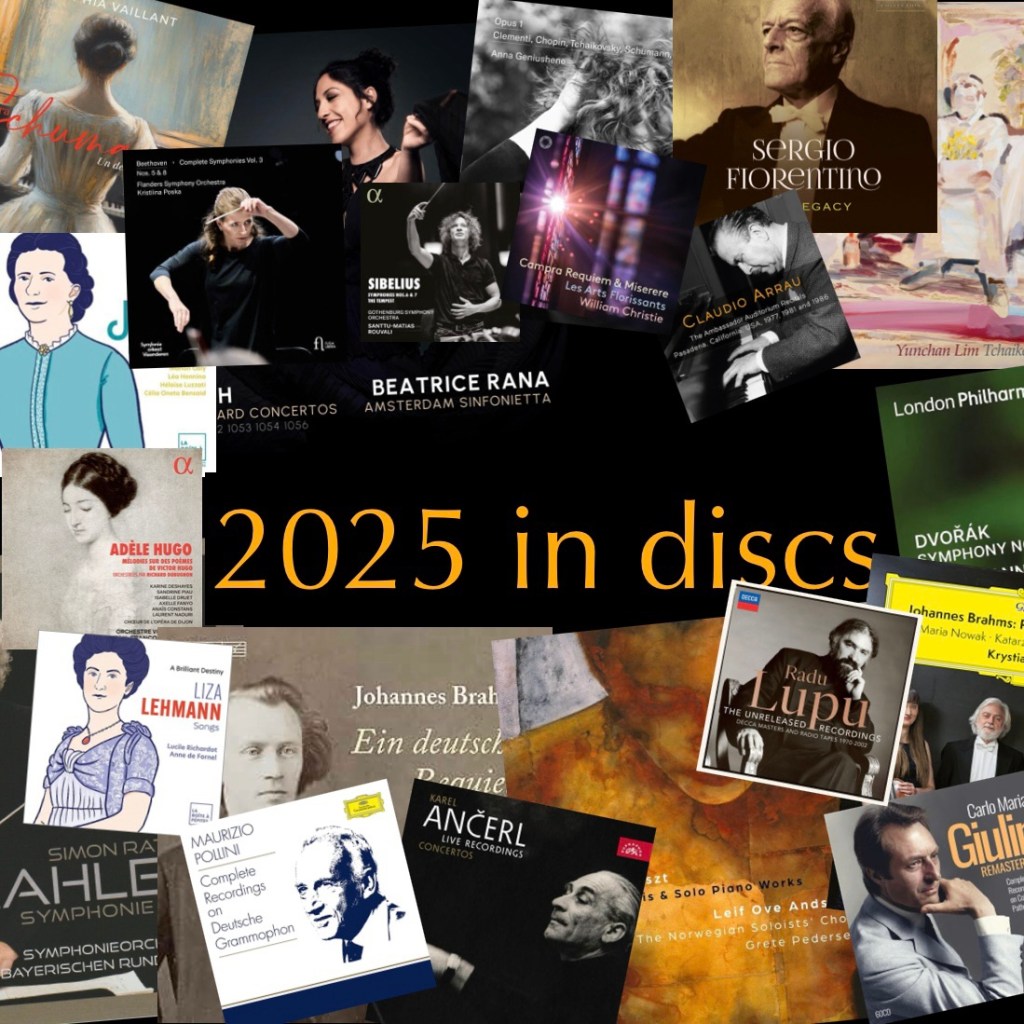
What records will you remember from 2025? Which ones made a particular impression on me, and which ones will go down in history? Here’s a brief overview of the recording year that’s just gone by, backed up by reviews and personal opinions – all subjective, of course!
Let’s start with the piano. Yunchan Lim has treated us to two albums this year. While Rachmaninoff’s Third, recorded on the occasion of his dazzling victory in the Van Cliburn Competition, dazzles with its formal perfection, perhaps we are entitled to expect more, given how speechless Chopin’s Etudes left us last year – but would that be too harsh on such a young artist? The most striking of the two discs remains Tchaikovsky’s Seasons, with its total clarity, luminosity, polyphony and remarkable refinement.
In terms of discoveries, we must mention Sophie Vaillant’s formidable work on the works of Clara Schumann, and we should also note Yuliana Avdeeva’s foray this year into Shostakovich’s splendid Preludes and Fugues, choosing the path of light while playing on the influences that the composer inherited from the previous century, and Benjamin Grosvenor’s interesting, albeit somewhat formal, Chopin Sonatas.
Anna Geniushene offered an innovative journey through the romantic ‘Opus 1’ works (but not only): Chopin, Tchaikovsky, but above all Schumann, and the Abegg Variations, and then of course Berg and Brahms, and their first Sonata together. Geniushene offers nuanced, colourful interpretations with remarkable sonic richness, combining arpeggios and breadth while magnifying the contrasts.
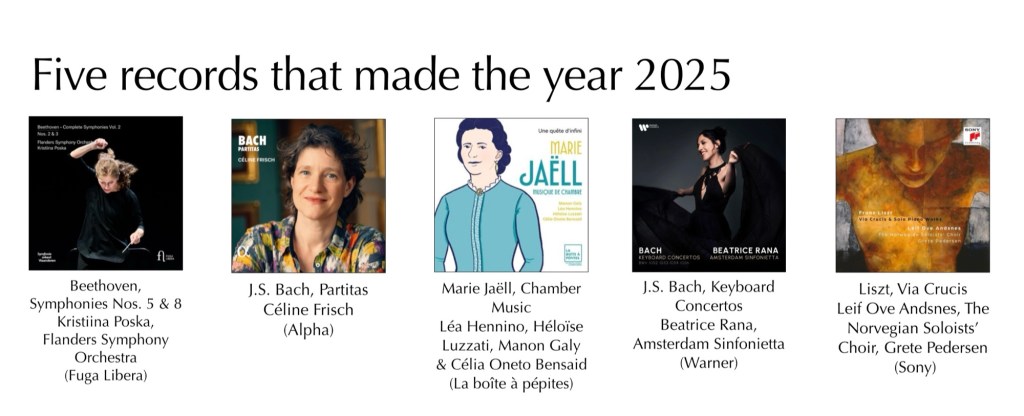
But without a doubt, the piano album of the year in my opinion is by Beatrice Rana. The Italian pianist puts her imaginative phrasing and raw power of sound to work in a number of fabulous Bach concertos. Her expressiveness is thoroughly romantic, while maintaining the lightness required for these Baroque works, particularly in the orchestra, which provides support while asserting itself sufficiently. It is in a rhythmic flow of phenomenal intensity that the cadences become hurricanes and each note of the slow movements implodes.
In chamber music, a major recording has brought a major composer to the fore: Marie Jaëll. Once again, the extraordinary label La boîte à pépites shows its flair for titles: entitled ‘Une quête d’infini’ (A quest of infinity) – a subtle counterpoint to the widely held and still all too common idea that women composers have only ever composed salon music – it allows us to hear this superb Piano Quartet, remarkable for its finesse of writing, but also for its extraordinary intensity and expressive power, written in 1880, and resolutely modern. Once again, the performers are wonderful: Léa Hennino, Héloïse Luzzati, Manon Galy and Célia Oneto Bensaid give the music breadth and fullness of sound, while accentuating its dramatic and theatrical dimension without ever sacrificing its songfulness. A great album by a wonderful composer, just as the label introduced us to the incredible Rita Strohl – and so many others – last year. This is undoubtedly a work of public interest, not only from a musicological and historical point of view, but also simply in artistic terms! What a joy to discover such a confident, (post-)Romantic style, rich and profound, served by such performers!
Speaking of a more institutional composer, we must also mention the wonderful recording of Brahms’ Piano Quartets Nos. 2 and 3 by Maria Nowak, Katarzyna Budnik, Yuya Okapoto and the indefatigable Krystian Zimerman on piano. Such finesse and elegance of touch, supple yet offering a tense discourse.
In terms of orchestral recordings, the major digital release of the year is undoubtedly the continuation of Kristiina Poska’s complete Beethoven symphonies. I have already offered a more complete review, but to summarise this recording, I will briefly repeat what I said here. The sound of the orchestra is truly fabulous. Without being brilliant, it reveals itself to be of breathtaking formal beauty, starting with woodwinds that are as supple as they are distinct. Each attack is sharp, without detracting from the natural relief. The two symphonies are served by fabulous energy, while revealing an incredible amount of detail. Another remarkable recording is the conclusion of Santtu Matias Rouvali’s Sibelius cycle, conducting the Gothenburg Symphony Orchestra, with the Symphonies Nos. 6 and 7. As always with Rouvali, lightness and tension serve to heighten the intensity of the music, presented with great clarity. The liveliness and, even more so, the precision of the conducting are truly brilliant, allowing us to gain an even finer understanding of the polyphony of Sibelius’s writing.
We should also applaud Simon Rattle’s excellent Seventh Symphony by Mahler, conducting the Bavarian Radio Symphony Orchestra, full of nuance – although sometimes lacking a little unity, unlike his extraordinary Ninth and fabulous Sixth, both previously recorded by the same performers. Klaus Mäkelä, for his part, offered a refined performance of Berlioz’s Symphonie Fantastique, notably in his dialogue between the different sound layers, particularly in the strings, which proved absolutely exhilarating, but still somewhat detached, formal and almost smooth at times, despite his brilliant orchestral skills. Finally, a word must be said about Edward Gardner’s beautiful concert, released by the London Symphony Orchestra label, which features a superb Second Symphony by Schumann, combined with a beautifully crafted Seventh Symphony by Dvorak.
For me, the major release of this baroque year on period instruments is Céline Frisch’s Bach Partitas. Sunny, clear and lyrical, while retaining the clarity that carried her through her two sumptuous discs devoted to the Well-Tempered Clavier, Céline Frisch makes these dances so natural and so essential at the same time! The Prelude to the first Partita is a true miracle! Frisch magnifies each chord with iridescent colours and plays on an incredible complexity of registrations. These registrations are also exploited to marvellous effect, but this time on the organ, by Masaaki Suzuki, with his sumptuous Leipzig Chorales. Rubato is omnipresent, and there is always that swaying, highly arpeggiated sound so characteristic of the Japanese master. Finally, a word must be said about the beautiful disc of Concertos for several keyboards by Bertrand Cuiller and his friends, which is remarkably clear, highlighting every detail – although one might perhaps ask for a little more verve, and therefore naturalness.
Some albums marked the year in song. On the one hand, the melodies of Adèle Hugo, released by the Alpha label, with the Victor Hugo Orchestra, the Dijon Opera Choir, and Karine Dehayes, Sandrine Piau, Isabelle Druet, Axelle Fanyo, Anaïs Constans, and Laurent Naouri, all conducted by Jean-François Verdier. The anthology showcases remarkable finesse of writing and great expressiveness. And then, on the other hand, we must also mention Liza Lehmann’s Songs by Lucile Richardot and Anne de Fornel, once again released by La boîte à pépites, which never ceases to reveal remarkable composers! On the operatic side, let us remember the brilliant Judgement of Paris by Weldon, performed by Julian Perkins and his sense of polyphony, at the head of the Academy of Ancient Music and the Cambridge Handel Opera. And then, of course, lightness guides Mathias Vidal in a new version of Rameau’s Platée, at the head of La Chapelle Harmonique.
In terms of sacred music, several recordings have captivated us this year. First, Brahms’ Requiem by Masaaki Suzuki, reviewed here. It is a splendid interpretation! The crescendos carried by the singing brass in the background to increase the tension created by the strings are absolutely magnificent. It may sound a little like Fauré, but what a balance of contrasts! The amplitude of the gesture gives a vigorous brilliance to the attacks, which seem to rise endlessly, again and again! This is undoubtedly a new benchmark in an already extensive discography. Of course, we cannot fail to mention Campra’s brilliant Requiem, recorded by William Christie for Pentatone. Christie tackles a work that suits him perfectly, thanks to all the light it carries. And then, of course, one can only regret hearing Simon Rattle’s absolutely brilliant conducting in Haydn’s The Creation, one of the most beautiful ever heard alongside Frans Bruggen or, in a different style, Herbert von Karajan, because the cast is unfortunately not up to scratch. Finally, Leif Ove Andsnes, together with The Norwegian Soloists’ Choir and Grete Pedersen, offers us a truly exceptional recording: Liszt’s Via Crucis. Admittedly, it may seem austere, but what elevation! Here we are at a height that is as spiritual as it is obvious, radiating grace. It is, in a way, music reduced to its essence, almost otherworldly, but nevertheless particularly natural – to which this sublime interpretation contributes greatly.
And now let’s talk about reissues and historical performers. The most beautiful reissue this year is undoubtedly the complete recordings of Carlo Maria Giulini on Warner. A truly striking remastering by Art et Son Studio magnifies the timbres and restores the bite to the attacks. Giulini gave pride of place to sonic expressiveness, to the breadth of gesture, to depth and to the construction of grand arcs. He was an elegant performer, precise and simple in his profound, expansive gestures, which swept broadly and gave meaning to each phrase while emphasising continuity. His elegance was also that of a very singular poise and tension. In short, one of the most beautiful syntheses ever achieved of the art of one of the giants of conducting of the last century. And then, of course, the other huge reissue is the one offered by Brillant Classics to the art of Sergio Fiorentino, to which I have devoted a review, available right here. ‘He is the only other pianist,’ Arturo Benedetti Michelangeli said of him. Having devoted most of his career to teaching, Sergio Fiorentino was mainly recorded at the beginning and end of his career – the box set thus includes several recordings made in the 1950s, up to the late 1990s in Berlin. A discreet pianist with a remarkably refined style, profound interiority and great delicacy and colour, Fiorentino is an unjustly underrated artist. His playing, of rare elegance, often seemed introspective, probing his own conscience. With remarkable clarity, his approach gave pride of place to flexibility and fluidity. Next, let us mention the reissues dedicated to Joseph Krips, Walter Weller and Jochum’s interesting Brahms symphonies in London.
We must of course applaud Decca’s extraordinary retrospective of Radu Lupu’s previously unreleased recordings, including Mozart’s sumptuous Piano Quartet, K.478, and of course Schubert’s Sonata D.850, Mozart’s fantastic ‘Sonate facile’, and so many other treasures that are just waiting to be discovered! Finally, of course, Deutsche Grammophon publishes all of Maurizio Pollini’s official recordings for the yellow label. A discography of extraordinary consistency, full of precision, intensity and meaning – almost analytical at times. A tribute to a giant of the piano, who has left his mark on and influenced entire generations of musicians.
On the orchestral side, Warner Classics offers a remastered reissue of some of Herbert von Karajan’s greatest recordings, in particular the superb Beethoven symphonies recorded with the Philharmonia Orchestra. The sound is clearer than ever, the attacks sharper, the sound crisper. Listen to this ‘Eroica’, perhaps Karajan’s greatest, with, of course, the fabulous 1982 concert for the centenary of the Berlin Philharmonic!
And now let’s move on to the unreleased recordings. First, let’s talk about Claudio Arrau’s recitals at the Ambassador Auditorium. The box set includes key works from Arrau’s repertoire – Beethoven, Brahms, Liszt, etc. – with the spontaneity of a live concert and perfectly acceptable sound quality. Some interpretations, such as Beethoven’s ‘Waldstein’ or Brahms’ Third Sonata, are nothing short of miraculous. Deutsche Grammophon is reissuing a few Beethoven sonatas by Sviatoslav Richter, which are highly expressive but perhaps still lack both clarity and nuance. On the orchestral side, two box sets released by Supraphon are worthy of praise. The first is devoted to new live recordings by Karel Ancerl conducting the Czech Philharmonic, this time with soloists. And what a find! These include a sublime Second Concerto by Chopin with Wilhelm Kempff, a brilliant Third by Beethoven with Sviatoslav Richter, a superb Cello Concerto by Dvorak with Mstislav Rostropovich, and a few other rarities! Finally, we should also mention the concerts brought together by Lovro von Matačić’s Czech label, in particular a human-scale Ninth Symphony by Bruckner, with its fragility and its questions, carried by the light sound of the Czech Philharmonic.
 Sofronichrist
Laisser un commentaire