
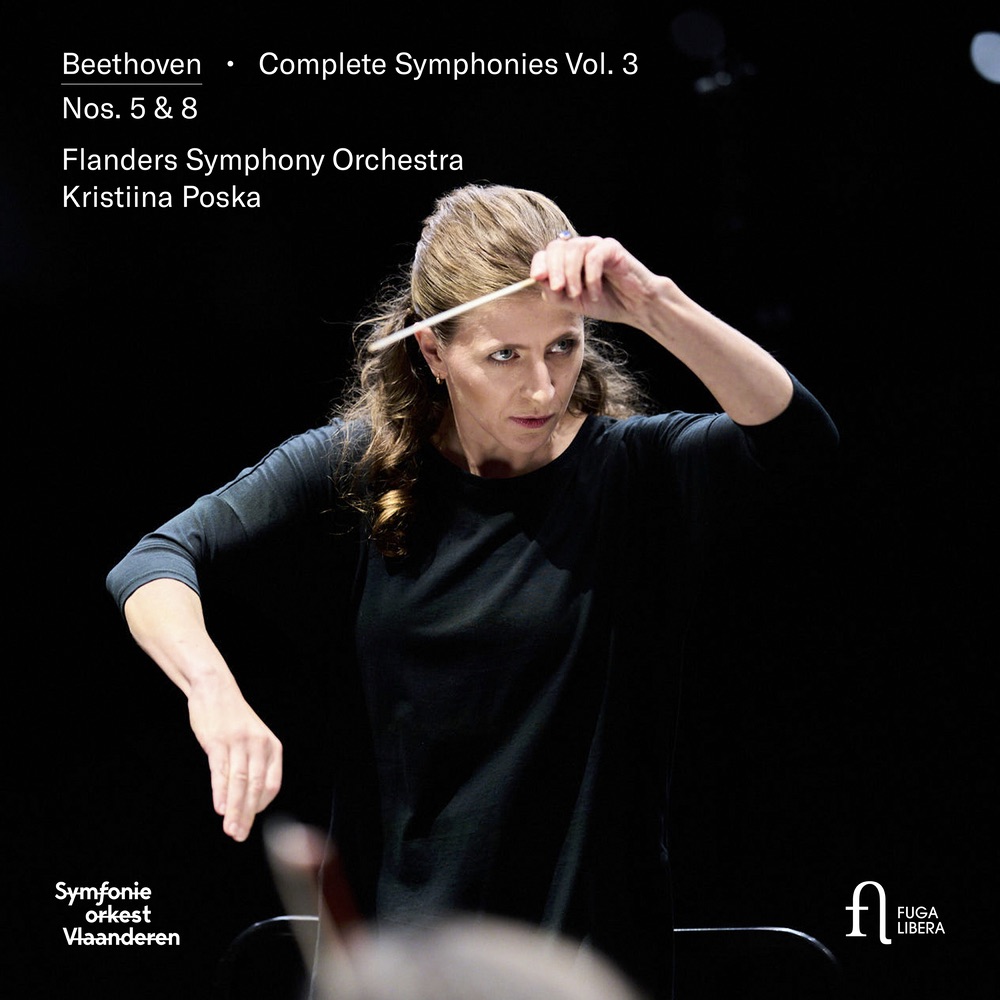
Kristiina Poska, conducting the Flanders Symphony Orchestra, seems to have embarked on the greatest recording of Beethoven’s symphonies since Frans Brüggen, confirming this once again with a new opus featuring Symphonies Nos. 5 and 8. The first volume was devoted to Symphonies Nos. 1 and 7. It offered a brilliant interpretation of the ‘Apotheosis of Dance’, tracing a path as refined, luminous and fiery as the most beautiful concerts of Karajan or Kleiber (and moments that are quite reminiscent of Kleiber’s truly brilliant intuitions). The second was devoted to the Second Symphony and a major version of the Eroica, bringing together everything one would expect from an orchestral interpretation of Beethoven since the paradigm shift resulting from research into the instrumentation of the early Romantic period, juggling with extraordinary vitality while offering total clarity of sound and immense finesse, lending a depth worthy of the greatest to the first monument of the corpus (listen to the intensity in the first movement, or the sublime fugue in the Funeral March, as well as the truly brilliant characterisation of the final variations). Now, the Estonian conductor offers a performance of Symphony Nos. 5 and 8 that is as dazzling and virtuosic as it is meaningful.
The sound of the orchestra is truly fabulous. Without being brilliant, it reveals itself to be of breathtaking formal beauty, starting with woodwinds that are as supple as they are distinct. Each attack is sharp, without detracting from the natural relief. The two symphonies are served by fabulous energy, while revealing an incredible amount of detail. The Allegro con brio of the fifth is certainly light, but the discourse is assertive, while remaining very balanced. The clarity is total, each section is highlighted while serving the whole. The energy that sustains the discourse is transformed into momentum, constantly giving new impetus. Despite certain interpretative choices, notably via rubato, there is no trace of mannerism. The Andante con moto is carried by a wonderful lyricism. Despite the choice of a very lively tempo, the entire orchestral fabric breathes very naturally. The details, particularly in the woodwinds (but also in the strings), are part of a perpetual search for unity, crystallised by this voice that never stops singing. The Scherzo reveals itself to be incredibly supple, which again breathes, and above all compensates for a reduced orchestral ensemble compared to usual expectations. The transition, very fluid without being linear, leads to a concluding Allegro that is quite simply genius. What drive, what intensity, what fervour! Here again, there are countless details, and the movement, like the second, tends towards an almost operatic style. What artistry in flexibility, regularly varying the tempo while maintaining coherence! Above all, the last movement allows us to better appreciate the playing, which borders on breaking the timpani, adding even more depth to the discourse, just as the rubato did to make the Andante con moto sing even more.
Kristiina Poska then offers us what is undoubtedly the greatest interpretation of the Eighth since Hermann Scherchen. As in the German conductor’s recording (available from Westminster), the voice of each section is distinct while resonating with all the others. The Allegro vivace e con brio is carried by a breathtaking intensity, with dramatic tension in the truest sense of the word: theatrical, here again almost operatic. The movement takes on depth and gravity, while continuing to assert more than ever its inspiration straight from Haydn. It’s a real balancing act! The Scherzando is very effective, with a welcome lightness and naturalness. The Tempo di Menuetto displays a very interesting approach: with a very sustained tempo, Poska gives each phrase a bounce, and creates extraordinary sonic depth through a dialogue between individual string sections, which truly characterises each phrase, revealing the structure and internal construction of the movement. Nuance is everywhere, and the breadth of the gesture (both in the flexibility and nuance that each instrument displays phrase after phrase) gives true embodiment to music that is all chiaroscuro. It is truly Kundera’s word: lightness and gravity. But a perceived gravity, a counterweight in a way, because the discourse is never heavy. Finally, the Finale is simply perfect, imbued with a feeling of total freedom. The trills are absolutely perfect, without being as rushed as in Scherchen’s version, but much more tense than in Leibowitz’s and Karajan’s 1977 recordings. There is also a sense of elevation, as if each phrase breathes higher than the previous one. It is an ideal version, no more and no less, undoubtedly the most beautiful I have ever heard.
Kristiina Poska and the Flanders Symphony Orchestra are part of the canon of benchmark complete Beethoven’s Symphonies recordings, alongside the quite recent versions of Brüggen, Immerseel, and even older recordings (Karajan, Scherchen in concert, Schuricht, Gielen…). One senses an awareness of the discoveries that have emerged from renewed research into the historicity of the works, while preserving a great singularity, a true originality that is embodied not only in the details but, even more so, in the overall vision. We eagerly await the fourth and the ‘Pastoral’, and of course the ninth, because we would like this complete recording to never end! One of the greatest recording projects of recent years, if not decades, renewing the conception of a sacred monument of orchestral music.
 Sofronichrist
Laisser un commentaire