
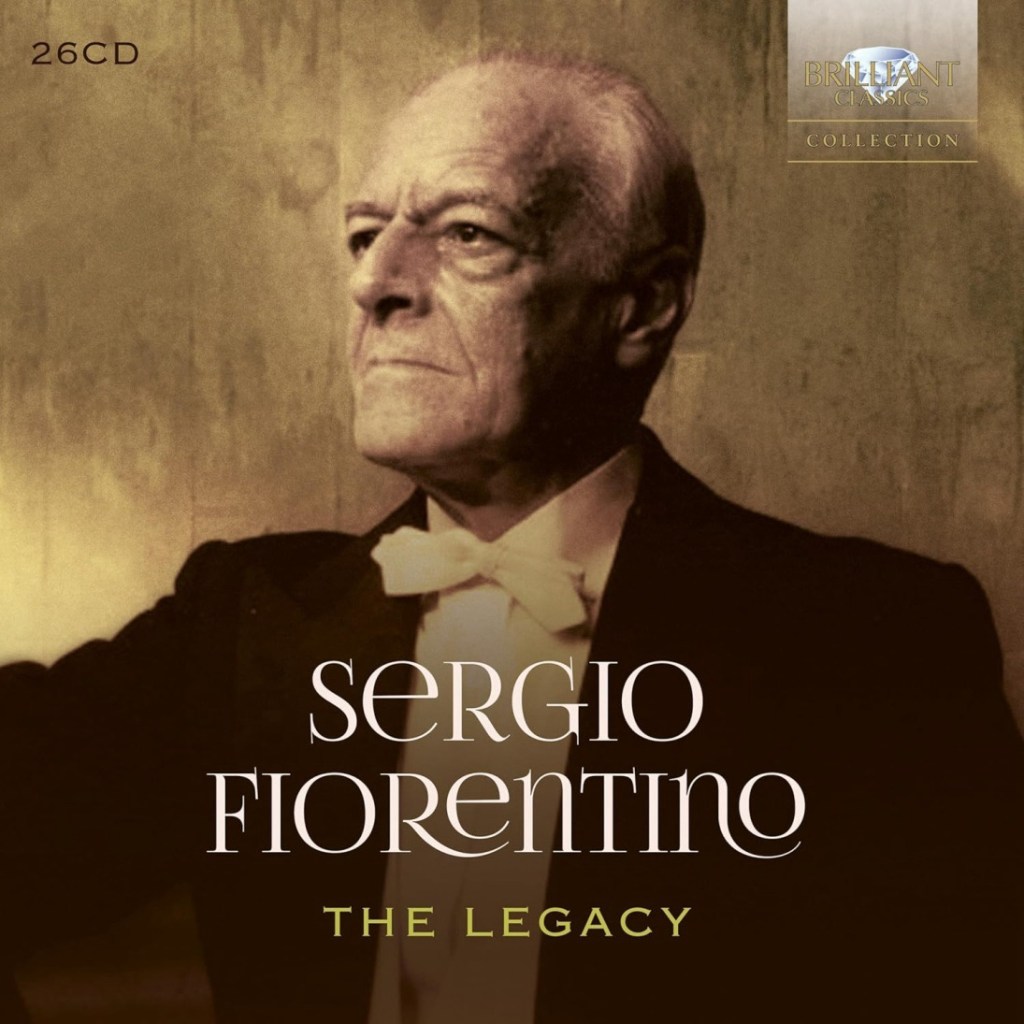
‘He is the only other pianist’, said Arturo Benedetti Michelangeli. This April 2025, Brillant Classics is devoting an extremely exhaustive edition – 26 CDs – to the legacy of one of the greatest Italian pianists of the twentieth century. Having devoted most of his career to teaching, Sergio Fiorentino (1927-1998) was recorded mainly at the beginning and end of his career – the box set includes several recordings made in the 1950s, right up to the last ones made in Berlin in the 1990s. A discreet pianist with a style of remarkable finesse, profound interiority and full of delicacy and colour, Fiorentino is an unjustly underestimated artist. His rarely elegant playing often seemed like a retreat into himself, probing his own conscience. His approach was remarkably clear, with an emphasis on suppleness and fluidity. This fluidity is particularly noticeable in Schumann’s sublime Fantasie, carried along by a profoundly immanent path, and which to my mind constitutes an authentic miracle. Contemplation is matched only by raw sensitivity. Nuance is also at the heart of his interpretation of the Carnaval, which nevertheless displays more power – raw power, since the expressive or evocative power of this Fantasia is perhaps unequalled. The last movement in particular is a summit, calling for farewell.
Voicing is always at the heart of Fiorentino’s discourse, and we hear this particularly well in Liszt’s Consolations, which are also one of the peaks of Fiorentino’s legacy. Time seems suspended, in a latency of unheard-of depth. We are a long way from a demonstrative Liszt – Fiorentino can be a little more demonstrative in Schubert, for example, and a Sonata D.960 that does not show him at his best. Fiorentino’s extraordinary elegance can also be measured in his refusal of any extravagance, in favour of legibility. Liszt’s Sonata in B Minor is an excellent example of this, with its fabulous nuances, especially in the colours. This is an immensely rich and profound Liszt, the antithesis of pyrotechnics.
Clarity and legibility are combined with restraint in the music of Rachmaninov, and finds a way to preserve Bach’s polyphony. The Partitas Nos. 1 and 4 are luminous and well-balanced. Chopin is fairly represented, by Sonatas Nos. 2 and 3, and some superb Ballades and Etudes. Fiorentino’s playing is certainly not the most expansive we’ve heard, but that doesn’t mean he’s analytical: the discourse is underlined, or rather supported, but it’s never forced in one direction or another – the pitfall sometimes being, in fact, a form of in-betweenness when a stronger commitment would be required. Debussy’s Suite Bergamasque is magnified by nuances that complement each other marvellously with the relief preserved by the pianist, the work almost taking on a religious élan at times.
At times, Fiorentino’s playing reveals something of the register of prayer, with its inward-looking quality reflecting an immense wisdom. Brillant Classics offers here an extraordinary retrospective, doing justice – almost exhaustively – to the art of one of the great Italian piano masters of the twentieth century. A magnificent editorial effort accompanies this edition, with splendid remasterings and an extensive booklet, with an essay by Christoph Schlüren and Ottavia Maria Maceratini, and above all under the supervision of Ernest Lumpe, who was behind the last recordings that finally enabled Fiorentino, in the evening of his life, to make his art eternal in Berlin. A splendid box set!
 Sofronichrist
Laisser un commentaire