

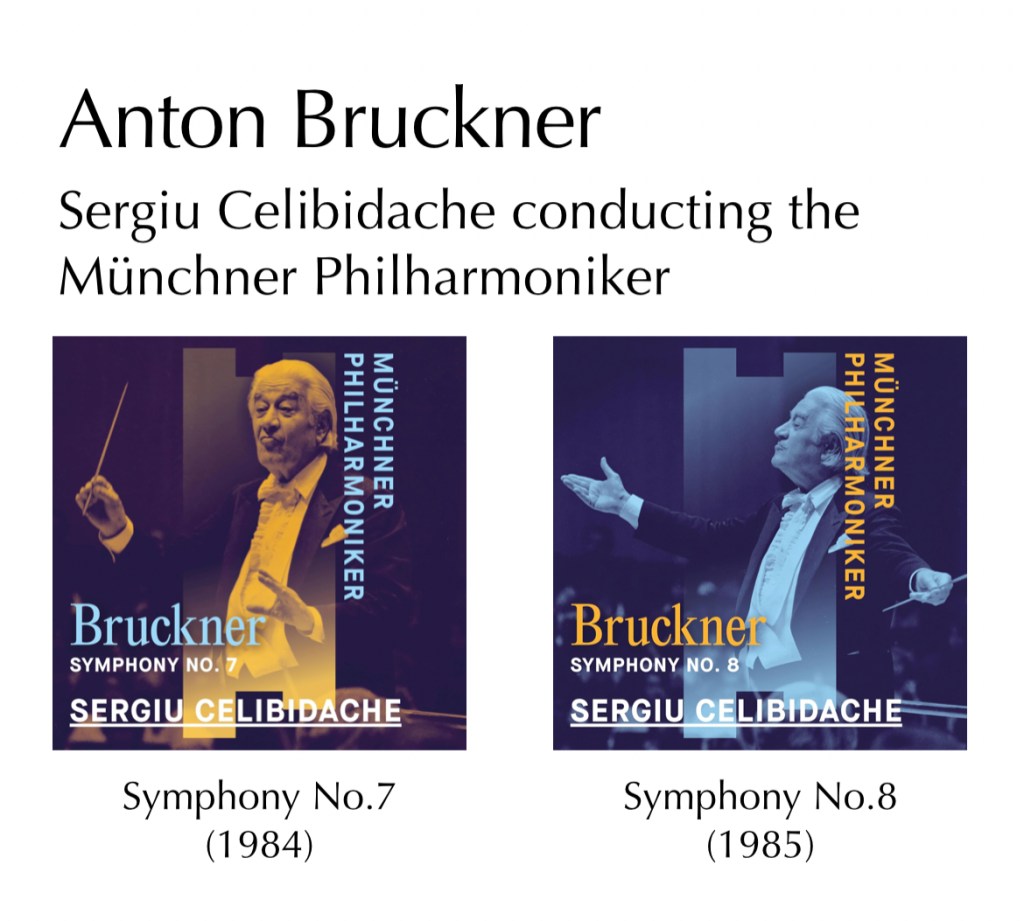
The Münchner Philharmoniker label recently released two Brucknerian recordings by maestro Sergiu Celibidache. As is well known, the osmosis born in 1979 from the Romanian conductor’s encounter with what was to become ‘his’ orchestra, the one through which he would finally be able to implement his precepts and aesthetic conceptions, saw the emergence of an extraordinary alchemy between ‘Celi’ and the master of Saint-Florian. It was, in a sense, a necessary and inevitable meeting. Celibidache was trying to push to its limits the horizontal expressivity of an orchestra unfolding in the richness of its most minute timbres over the long term – hence the sometimes out-of-this-world tempi, and at the same time completely eluding us in retrospect on the disc! -Bruckner’s music finally gave him an architecture, in the sense of both a harmonic and rhythmic base, a setting in which to bring it to life. During his years in Munich, Celibidache somehow restored Bruckner’s complexity, with a finesse that the taut, alert and yet resolutely metaphysical approaches of Jochum and Furtwängler had never explored – and, in a way, this was not the aesthetic that Jochum or Furtwängler were trying to achieve. Celibidache turns the strings into a polished net, iridescent with colour and unheard-of depth of sound. He gives thickness to the woodwinds and weight to the brass. He systematically distinguishes each level of sound with an unprecedented concern for balance and formal perfection, and yet, through the architecture, finds a rhythm of his own that never loses the listener, even though this rhythm can be, for those familiar with Bruckner’s symphonic corpus, quite unsettling at first.
These two live recordings come from the early years of Celibidache’s Munich period. The Seventh is from 1984, the Eighth from 1985. Although Celibidache’s conception of Bruckner’s symphonies has remained essentially unchanged since his Munich debut – no doubt this was the first time the conductor had been able to bring his ideas to life – here the tempi are more lively, the gesture more alert, the discourse more taut. Let’s start with this live recording of the Seventh Symphony from 1984, which I’d never been able to hear before – the mastering here is excellent, and that’s an occasion to say that the official live recordings released by EMI/Warner have been remastered this year, gaining in precision and colour. Perhaps never before has the Seventh begun so pianissimo. The contrasts in dynamics are truly hallucinatory, and the crescendos are all the more striking for having the feeling that they will never end! And yet their resolution, and more generally all the fortissimos, are of total sonic fullness! As is so often the case in Celibidache’s interpretations, the discourse is supported by waves of momentum, and the fullness of sound brings back the tension that could be lost in slowness – the climax of the Adagio is extraordinarily powerful, both expressively and sonically, perhaps even more so in its continuity with what preceded it (or prepared for it) than in the sonic culmination itself, albeit with a presence and length that are truly hallucinatory. The Scherzo impresses with its construction and its architectural rendering – though sometimes somewhat to the detriment of the continuity of the discourse, Celi not being particularly fond of rubato, let alone legato. Although there is no question of lyricism here – the discourse is above all hollow and vague – the fullness of the sound once again satisfies us greatly, and compensates for the destabilisation that overtakes us from time to time – all the more so if you are unfamiliar with the conductor’s conception! The Final is pervaded by a feeling of freedom that seems to return to the path it completes, with as much tenderness as grandeur. More generally, the tension is more present than in 1994, which offered a more total approach, seen from a higher angle – without necessarily being seen from further away. The Munich concerts are, however, of better artistic quality than the – albeit legendary – filmed concert of 1992, and the conductor’s reunion with the Berlin Philharmonic – which had preferred Herbert von Karajan to him on the death of Furtwängler, the only master Celibidache ever recognised, Karajan even going so far as to erase the Romanian conductor’s name from the orchestra’s official list of music directors. With the Philharmoniker, the maestro’s gesture is more borrowed, the interpretation duller, the tension less present. It’s almost as if you can feel Celibidache’s resentment. It’s a far cry from the osmosis that allowed the conductor to unfold his work in Munich. This is yet another milestone to be added to the list of – each more superlative than the last – performances of the Seventh by Celi – 1990 on Sony, 1994 on Warner, among others.
The Eighth is undoubtedly more restless than the conductor’s later readings. There is nothing ethereal here, the tension is felt, with a closeness that is still present in the conductor’s art during his early years in Munich. The first two movements are still in the shadows, oppressive – in tempi that are admittedly slow, but less so than later. The entrance to the Adagio is tense and sombre, before the orchestra takes on a depth – which is never perceived – and the orchestral fabric seems to soar above us! What beauty in the woodwind dialogue, and here again what richness and depth! Celibidache seems to be rediscovering the work, reconstructing it step by step. It’s just as heavenly as in the conductor’s last concerts in the work, but we don’t get there by the same means. The Finale begins in the continuity of the performance, to become a veritable spiritual transition. So what is the basis for this hypothesis? It’s a transition that takes the vision from one spirit to another, the coda accomplishing the triumph of light, which finally emerges from a darker interpretation among those Celibidache left us. The clarity of expression is matched only by the monumentality of the crescendo and the purity of sound that carries it. Celibidache’s vision is absolutely unique!
These two new testimonies to Maestro Celibidache’s art in the music of the master of Saint-Florian add to the panorama formed by all the performances recorded with the Münchner Philharmoniker. If they differ from the kind of absolute that carries the versions that will follow, is this due to research still in gestation in Celi’s mind? Perhaps – it’s hard to say, impossible to be definitive or dogmatic – but they bear witness to a genuine communion between conductor and orchestra, which is the only way to achieve such artistic accomplishment. Plus, it’s a good opportunity to celebrate Bruckner, and his recent two hundred candles!
To listen those two wonderful live recordings: https://youtube.com/playlist?list=PLwovaEVoT1mLxpZmlSyUs9exM04lVLahj&si=wOAoaytAoGrHwd5o
 Sofronichrist
Laisser un commentaire