
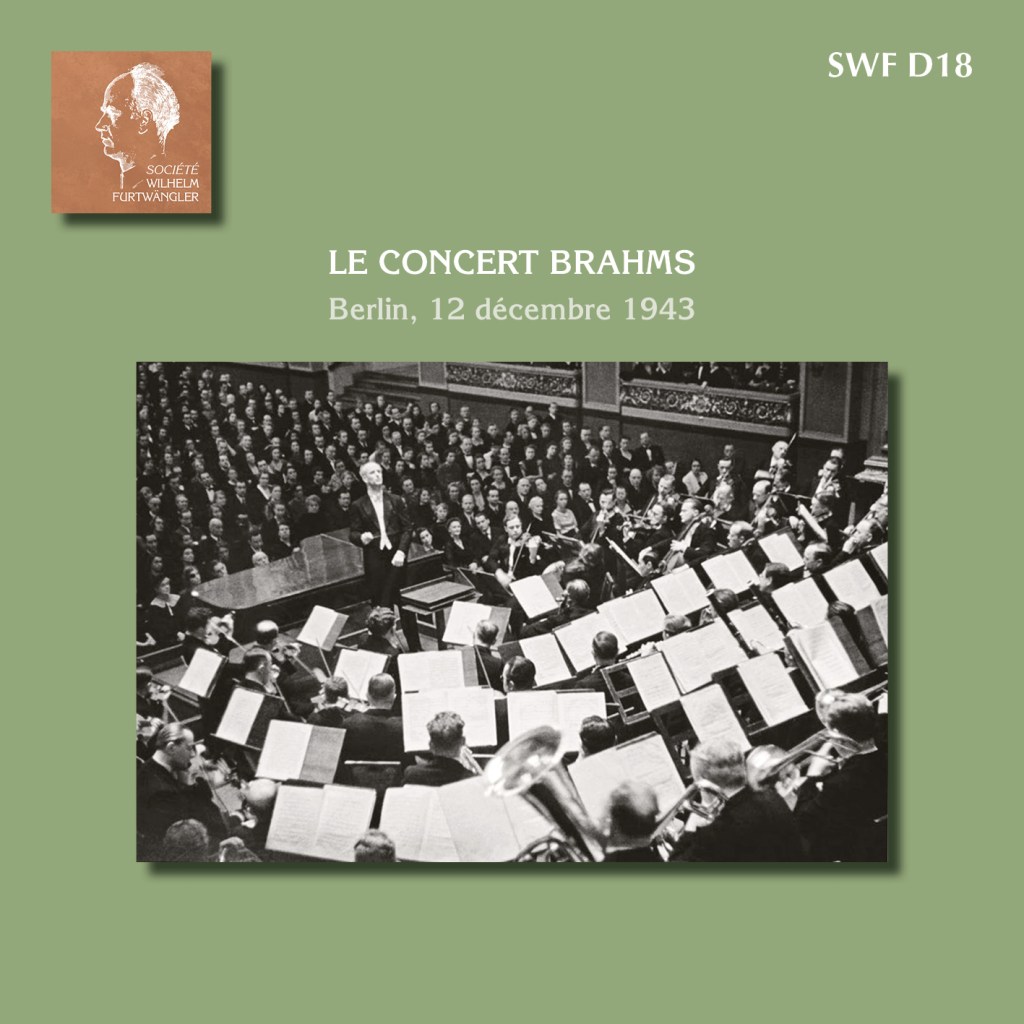
A few months ago, in November, I realised a video study for the Wilhelm Furtwängler Society on Furtwangler’s relationship with the music of Brahms. The Society then asked me to write the booklet (originally in French, translated into English by Susannah Howe) for an extraordinary product: the concert of 12 December 1943, magnificently restored by Christophe Hénault of Studio Art et Son. It’s an absolutely extraordinary programme, entirely devoted to Brahms, featuring the Variations on a Theme by Haydn, the Second Piano Concerto with Adrian Aeschbacher, and a mythical Symphony No.4. I was interviewed by Raphaël Fournier on the occasion of this wonderful release, and here is the text of our interview, transcribed and translated into English.
Raphaël Fournier: Hello everyone! The Furtwangler Society is reissuing the concert given by Furtwangler on 12 December 1943. To mark the occasion I’m pleased to talk to Guilhem Chameyrat. We’re going to talk about this concert and this publication, which is very important in many ways. First, a few words about this series of concerts and their context?
Guilhem Chameyrat: This concert was the first in a series of four, from 12 to 15 December 1943, and it took place in an extremely troubled context in Berlin. Even though German society was not fully aware that the war was lost, the Allied bombing raids were intensifying. The Berlin Philharmonic itself was destroyed about a month later, in January 1944. Adrian Aeschbacher himself, the pianist who played Brahms’s Second Piano Concerto in this concert dedicated entirely to Brahms, had suffered a tragedy a few days earlier when his flat was destroyed by a bomb that fell on it about ten days before the concert, leaving the pianist to stay temporarily in Potsdam. So you need to know that these four concerts – 12, 13, 14 and 15 December 1943 – entirely dedicated to Brahms – Variations on a Theme by Haydn, Piano Concerto No.2 and the famous Fourth Symphony – these concerts took place at five o’clock in the afternoon because of the bombings. Adrian Aeschbacher talks about them in an interview he gave to Serge Dubois. Aeschbacher talks about the Berlin audience who came ‘at the risk of their lives’, he says, to brave the bombardments to attend these four concerts and ‘fill the hall’ each time.
R.F.: What makes this concert unique?
G.C.: That’s a good question. I think the specificity of this concert lies in one word, which is actually quite strange, quite polysemous: liturgy. So ‘liturgy’ doesn’t mean sacredness, but it does refer to a lexical field that is certainly close to it. Aeschbacher, again in this interview with Serge Dubois, says that ‘it wasn’t just a concert, but a cult’. Interesting phrase! So why do I think we can call it liturgical? Because in fact this concert is permeated, irrigated by a kind of energy, something that is transmitted, that passes both between the musicians – we can talk in particular about the osmosis between Furtwangler and Aeschbacher, perhaps we’ll talk about this in a little more detail, about this performance of Brahms’s Second Concerto – what happens between the musicians and then what happens from the musicians to the audience, er in the trace of this concert, this trace which is this magnificently restored recording – we’ll talk about it later – that we’re presenting today, in this trace something of this energy remains, which we can’t fully grasp, but which we can somehow manage to apprehend in a slightly intuitive way, a little ‘around’ as it were.
R.F.: You could say that this liturgy was the result of playing Brahms in these circumstances with two of the greatest interpreters of Brahms, the Berlin orchestra, with its tonality and darkness, and then Furtwangler’s art during the war.
G.C.: We can talk a little about the art of war. The war saw an enormous intensification, a culmination of intensity in Furtwangler’s art. It’s really a pivotal moment, a breaking point in Furtwangler’s art, meaning that we move on from what might be defined as a lyricism – quite pleasant to listen to, by the way, in the Polydor recordings – quite luminous, quite sensual, and we move on to something totally different. A good example of this is Beethoven’s Fifth. It’s the work that Furtwangler conducted the most in his entire career, and you realise that when you listen to the 1937 recording, with its rather brisk tempi, quite luminous, quite clear, and you arrive with this 1939 version as a transition at the start of the war to 1943, a massive version, this sort of mastodon, monumental, colossal, with this much slower tempo, much heavier, much weightier, and the war will leave its mark on Furtwangler’s art. In a way, this imprint remained on Furtwangler’s conception even after the war. For example, in the Fifth he retained this monumental aspect, which he hadn’t had before, and it could be said that in the organic dimension of Furtwangler’s conducting, the war saw the arrival of something new: this organic dimension became more serious.
R.F.: Perhaps we could talk about each of the works performed in this concert, and see what makes this 1943 concert so special compared with other interpretations by Furtwangler? And first of all, the Variations on a Theme by Haydn?
G.C.: On the subject of these variations, I personally feel – well, this is purely an opinion – that they are the most moving in the entire Furtwangler discography. First of all, they are so in retrospect, they are so because of the context, and then they are so musically, because we actually have flexibility. Paradoxically, this concert gives the impression of being ‘out of time’, of something liberating – this is also true of the Concerto, by the way, and we can come back to that. There’s a kind of liberation, Furtwangler seems to be stretching time to take it out of time, out of the circumstances, which are very serious. And if we compare this interpretation, for example, to the famous 1951 recording…
R.F. : In Hamburg, with the NDR…
G.C.: Exactly! Well, with the NDR we have sharpness, we have precision, we still have that organic dimension, but we have something brighter. Paradoxically, the colour is more nuanced. Whereas the phrasing is more nuanced in 1951, the colour is more nuanced and richer in 1943. Furtwangler is with an orchestra he knows better, moreover, than the NDR, and I find that these Variations really hold a special place in Furtwangler’s discography, even though this is a work that Furtwangler really conducted a lot.
R.F.: I’m going to ask you a question, not to play the devil’s advocate, but rather a question of fundamental aesthetics: if you listen to a recording, it’s a sound trace, you’re not listening to the context.
G.C.: That’s true.
R.F.: We listen to a sound result, which was the interpretation at the time. So could you emphasise the characteristics of what we hear?
G.C.: As far as the characteristics of what we hear are concerned, I was talking about the colours, which to me seem decidedly richer. We have something very colourful. You get the impression that Furtwangler – and this applies to all the works in this concert – is really stretching out time in a way he’s never done before in this work, and at the same time expressive power, particularly in the tutti, the chords aren’t hammered out, they’re more so, more precise too in 1951, and above all there’s an immense unity. That’s basically what emerges from these works each time, throughout the concert, and particularly from the symphony, you get this impression of a single organism – and what’s more, and this is very interesting, I think we’ve done the right thing, since in publishing this concert we’ve placed the Variations on a Theme by Haydn on a single track, and I think it’s really very important to grasp the whole continuity. There’s something striking about the last variation and the Final. This last variation is a kind of plunge into the abyss, into a kind of completely organic maelstrom, again very colourful by the way, and Furtwangler dives in to bring back to life – it was Karajan who said that, to bring back to life something new that we hadn’t expected at all before – and Furtwangler, from these low string phrases at the start of the Finale, brings out something that really comes from nothing, I find that quite ineffable in fact!
R.F.: Let’s talk about the Piano Concerto with Adrian Aeschbacher.
G.C.: Exactly! As far as this Piano Concerto is concerned, there’s a great temptation to think about what happened the year before, in 1942, with Edwin Fischer. Let’s say it straight away, Adrian Aeschbacher is not Edwin Fischer, he doesn’t have the depth, he doesn’t probe the abyss like Fischer does…
R.F.: Then perhaps there’s not Furtwangler’s long association with Fischer either, a reciprocal association of interpretation over time…
G.C.: That’s true, but Aeschbacher was a friend of Furtwangler’s. And Aeschbacher was also a friend of Fischer. Moreover, Aeschbacher says that Furtwangler had already worked on the orchestral set-up, and that one arrived almost the same day – especially with the tragedy that had befallen him just before – and that immediately there was an osmosis, a communion – I don’t know whether he’s talking about communion or alchemy. In fact, it all happened very quickly, intuitively, and you can really sense when you hear this recording that it’s a real dialogue. It’s perhaps once again less profound, and where we can talk about liberation, where with Edwin Fischer we have the impression of a struggle that really gets stuck in – Fischer probes the abyss and Furtwangler follows him, and sometimes it almost becomes a competition for the wrong note in the seriousness of the subject – here we have something – once again like the Variations on a theme by Haydn – of the order of liberation.
R.F.: Yes, there’s a naturalness, a freedom, an ‘improvisational’ side to this recording that’s striking when you hear it.
G.C.: Yes, I quite agree!
R.F.: And finally, the symphony, which is really – I know it’s a trivial term – the highlight of the show. It’s the first audio record of Furtwangler’s performance of this grandiose symphony; we don’t have anything before 1943, although we do have a lot of other comparisons from after the war.
G.C.: So before talking about the purely musical aspects, I’d like to come back to the extraordinary work that was done by Christophe Hénault to restore this recording. It has been edited and re-edited. We’ve heard it, we’ve re-heard Brahms’s Fourth Symphony of 1943. And here we really have something quite new, I think. The tutti is a very telling example. When we listened to it before, we had this sort of veil that intervened, colours that were a bit desaturated. Here, the sound mass really swells, the organic aspect is rendered. Christophe Hénault’s work really magnifies this edition, it has to be said, it’s extraordinary what Christophe has done, which also does justice to the work of the sound engineer, who was Friedrich Schnapp. Friedrich Schnapp himself paid tribute to Furtwangler’s art very well indeed. The relationship between Furtwangler and Friedrich Schnapp is an interesting one, and let’s look at it again. Furtwangler met Friedrich Schnapp when Schnapp was, I don’t know if I should say transferred, in any case assigned to Berlin radio for broadcasts from the start of the war in 1939. Two things need to be said about Furtwangler. The conductor was always disappointed with the radio broadcasts, because he couldn’t find the essence of the concert, and not only could he not find the essence of the concert – which you can’t find in reality – but above all he felt that the radio broadcasts did a disservice to his art. And Furtwangler wasn’t very keen on change. So that’s two factors against Friedrich Schnapp! And Friedrich Schnapp met Furtwangler because the master asked him to – all this I’m trying to reconstruct more or less in order, it comes from an interview with Friedrich Schnapp which is available on the Furtwangler Society website, in the ‘Portraits and testimonies’ tab, if I remember correctly, where you can find this interview with Friedrich Schnapp, if you’re a member of the Furtwangler Society run and read it, it’s really extraordinary, And then Friedrich Schnapp spent a lot of time with Furtwangler – it was a real osmosis, a real alchemy, again, artistic and technical, even quite simply artistic – and so Furtwangler first spoke to Friedrich Schnapp about his distrust of radio broadcasts, explaining that it’s never the same as in concert, that it does him a disservice. Friedrich Schnapp nodded in agreement and said that yes, indeed, you don’t find the same thing in the hall as on the radio, it’s not possible. Perhaps he was the first person to say this to Furtwangler, but in any case the conductor was very pleasantly surprised. Then came the testing phase, which was actually quite funny. There are two anecdotes about this. First, when Friedrich Schnapp was in the booth, Furtwangler asked him ‘And the clarinet, can you hear it?’, and Friedrich Schnapp got out of the booth and said ‘But isn’t that the oboe? ‘Yes, yes, it is! And there’s a second one that I find even funnier. Furtwangler, who once again says to the booth, ‘Can you hear the harp? And Friedrich Schnapp, who had a very good knowledge of music and who had a very good ear, a very good ear for music, comes out and says ‘But there’s no harp! And then the musicians replied: ‘We can’t hear it either! And that was that. A great friendship developed between Furtwangler and Schnapp, to the point where, as the war progressed, Friedrich Schnapp was threatened with being called up for military service, and he asked Furtwangler to write a letter to demobilise him, which Furtwangler did, he sent a letter to the Ministry of Propaganda, and he prevented Friedrich Schnapp from being called up for military service and perhaps dying during the war, on the Eastern Front for example. And so, when we come back to the artistic issues, why and how did Friedrich Schnapp manage to serve Furtwangler’s art so well? It’s because, like Furtwangler’s art, these are organic sound recordings. They are sound recordings that have flesh, not just grain but flesh. And Christophe Hénault’s work truly restores Friedrich Schnapp’s ability to capture that famous ‘Furtwangler sound’, which could be embodied in a form of crackling, that impression of a permanent fire that crackles, some would say more transcendent, a force from above rather than below, but that’s a matter of rather subjective appreciation it seems to me.
R.F.: Yes, yes, there’s always an element of subjectivity when we use metaphors to say what inspires us, what the sound trace evokes in us…
G.C.: And on this symphony itself, thanks to the remastering work, we really feel once again the effect of a swelling mass of sound. I was talking about organicity – we talk about it all the time when we talk about Furtwangler, in fact – and Furtwangler, who based his interpretation on the listener’s perception – ‘how it sounds’ – gives me this impression – it’s personal – of a gigantic lung, caught in a single breath. This symphony – and this also applies to the Variations on a Theme by Haydn – is a single breath, which is very strange, because once again it is stretched over an extremely long objective time frame, but you feel it in the duration you experience… it goes by very, very quickly, and there really is something of the order of a breath that awakens. It’s all the more impressive because Brahms’s Fourth Symphony is the art of variation brought to its climax by the composer, and so many conductors choose to characterise the variations. Furtwangler, not that he doesn’t characterise the music, of course he does, he’s Furtwangler, but above all you get the impression of continuity. You get the impression of a single vital entity unfolding, and it’s obviously in the subject matter that you feel all the gravity we were talking about in the style of war, and it gives a kind of play on contrasts, between explosion and implosion for example – what’s more, we don’t have any more saturations today so we can really have a renewed appreciation of this recording, which is nonetheless mythical.
R.F.: Yes, and when you listen to it, it’s already extremely striking. There’s a devastating intensity right from the first movement, and you wonder how this intensity is going to be sustained and surpassed by the final moment…
G.C.: And it is! And something new will emerge! It really is a mythical recording, and what I find very powerful, to quote the details, are those moments when the force seems to come from below. For example, during that famous acceleration at the end of the second movement. Or simply after the dialogue at the start of the last movement. Where one might typically do what an heir to Furtwangler – or at least someone who greatly admired Furtwangler – like Carlos Kleiber would do, i.e. bring in a force that comes from above or even from the side, one might say that in the case of the arrival of the strings with Furtwangler it comes from below. Once again, you could say that it starts from nothing, and it gives you that feeling of vertigo. And, as Stéphane Topakian, who works with us and is the editor of this edition, says, there’s this idea of nailing the spectator to the spot, the breath stops, even though it’s not particularly brutal!
R.F.: Thank you Guilhem for making us want to listen to and download this new publication by the Wilhelm Furtwangler Society, the Brahms concert of 12 December 1943.
 Sofronichrist
Laisser un commentaire