
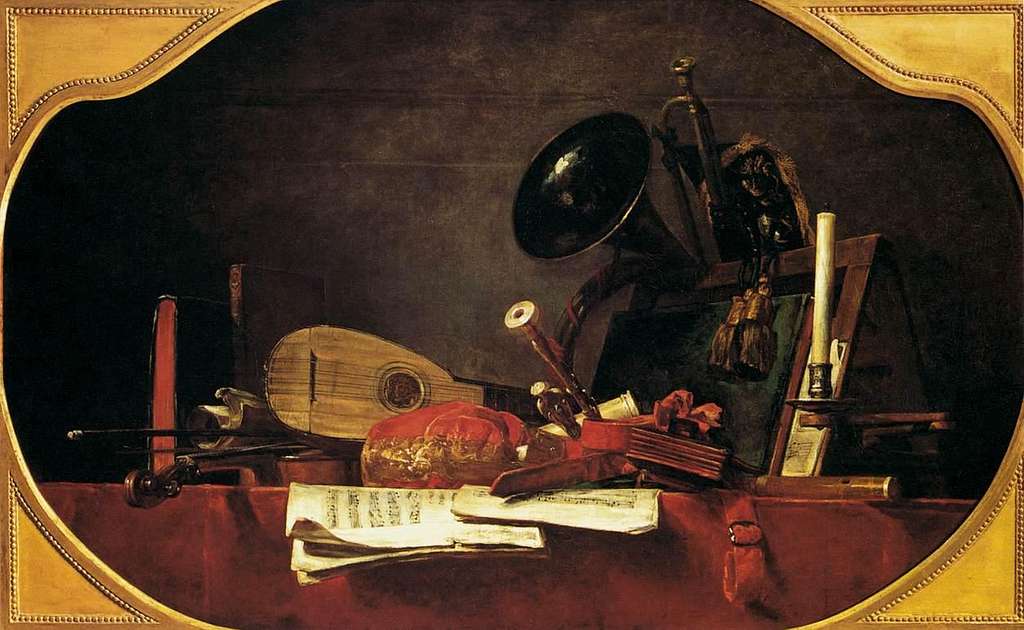
Jean Baptiste Siméon Chardin, Les Attributs de la musique (1765), Paris, Musée du Louvre
Table of content
Introduction
Theoretical errors and the (attempted) historical situation of these approaches
About the composition itslef
Perception is primarily sensible: the contingent nature of interpretation (and the dangers of a dogmatic approach)
When an interpreter takes an interest in a work, he or she generally approaches it, as with any act of interpretation, with a certain number of philosophical presuppositions. These presuppositions can be understood ideally, but not exclusively. In this short article, therefore, I propose to compare two approaches that seem interesting to oppose from a theoretical point of view – and, as we shall see, the boundaries blur as soon as we leave the theoretical domain and move on to practical applications, marked by the diversity and contingency of empirical reality, that of the practice of musicians, as much as I can try to understand it without being a musician myself. The first of these approaches consists of applying an ethical reading, based on ideal principles, to the work. It looks at the work itself, the historical context, the composer and the factors that underlie it. In fact, its anchor point is the score and all that revolves around it. In this article, I propose to call it the ‘principial’ approach. The concepts linked by this approach are already present in the work and its surroundings, and it is up to the performer to put them into practice. The second approach is based not on the work, the composer or the historical context, but on the listener’s perception. When Celibidache asked Furtwangler the famous question about the – insoluble and obviously relative – problem of tempo, the latter replied: « It depends on how it sounds ». This is perhaps in large part what led Celibidache to formulate the hypothesis that « tempo is a condition ». Whereas in the first approach, the performer acted on the work’s potential, he now acts on the listener’s perception. Where the performer’s choices were first and foremost principled, and the performance put these principles into practice – with all the relativity that implies – this time the performance is a permanent adjustment to the diversity of experience. Factors such as the venue, the listening conditions and the context of the performance, factors that are particular and specific to that performance and that performance alone, are at the heart of this approach, which I propose to call « sonnant ». However, a word of warning: I make this distinction solely in order to bring out the philosophical problems that arise in the context of interpretation, and not on the one hand to resolve conjectures that do not call for objective answers, and on the other hand to radically separate types of interpretation – the interpreter’s activity is flexible, and it is not unusual for an interpreter himself to oscillate between these two approaches, between two performances or even within a single one. What’s more, I’m not a philosopher, which may be reflected in the writing and in the implications of this article, which I in no way claim to resolve. I’m simply trying to identify problems and put forward hypotheses, without even being a musician.
Theoretical errors and the (attempted) historical situation of these approaches
But one mistake, I think, would be to try to equate this distinction between a ‘principial’ and a ‘sonnant’ approach with a classical distinction between categories and empiric experience. Why would I do this? For two reasons. Firstly, because any interpretation presupposes principles whose logic will form the internal coherence of the interpretation, and secondly, because any interpretation requires adaptation to the diverse nature of sensitive experience which is an integral part of any performance.
Another error would be to assign to each of these two approaches the monopoly of objectivity and subjectivity, in the same idea of wanting to make the interpretative approach correspond to philosophical approaches. We could be tempted by a spontaneous tendency to produce inferences that would assign the ‘principial’ approach to an objective vision of the text, and the ‘sonant’ approach to a subjective vision of the text. This would imply that the ‘principial’ approach would make less use of the imaginative faculty than the ‘sonant’ approach, which would allow the interpreter more freedom in relation to the text. In other words, the ‘principial’ approach is no more objective than the ‘sonnant’ approach is subjective. The elaboration of principles necessarily involves the projection of subjectivity, and there is indeed an objective effect of the projection of sound in space according to acoustics.
If it is true that the ethical framework of the « principial » approach seems at first sight to be based more on norms, it is mainly because they are explicit. Each of these approaches carries norms with it, but these norms do not seem to be derived from the same method. Where the ‘principial’ approach seems to derive its legitimacy and validity from research – particularly, but not only, historical research – the ‘sonnant’ approach seems to be justified more by a form of tradition. This can perhaps be explained by situating the two approaches historically. The ‘sonnant’ approach depends on the Romantic tradition, and therefore on post-romanticism. Tradition is shaped by the successive addition of different elements and different indications by musicians – and people from the music world – in a chronological logic. The concept of fabrication is essential to the validity of these approaches. Indeed, beyond the fact that no conceptual distinction is natural, each of those approaches tends to imply a different form of fabrication, in the sense that the score passes from one state to another through one or more transformations. And while the ‘principial’ approach was also built on a discourse of validation based on a form of fabrication, it was to some extent built on the limits of tradition. Since the tradition has not explicitly identified the nature and epistemological aspects of its fabrication, the ‘principial’ approach has sought to return to the original text in a more scientific manner – which is why it has sometimes been seen as dogmatic and pretentious to some critics, because it has sometimes shown little concern for purely artistic issues. But to achieve this end, it has used as a means new fabrications, in the new production of an edition supposed to return to the original text, for example.
The primary aim of the « sonnant » approach will therefore be to use the edition that corresponds most closely to the interpretative ideal that it carries and that it wishes to imprint on the mind of the listener. And in the case of a form of aesthetically situated historical drift, this may involve modifying the text. It was to give Tchaikovsky’s Symphony No.5 Final greater impact that Willem Mengelberg modified it, putting his own stamp on it to adapt it to the ideal spirit of what he was trying to convey, the message he wanted the work to convey.
The Romantic tradition puts across a message, populated by ideals and supported by a certain number of values, through its works. This is why Wilhelm Furtwangler’s style was so expressive during the Second World War, and even pushed to the limits of musical expression, because it adapted to a certain message, which in this case depended on a certain context. As Simon Rattle explained about Beethoven’s famous 9th conducted by Furtwangler in 1942, understanding this interpretation, this ‘cry in the desert of a musician lost in the midst of barbarism’, depends above all on the listener’s ability to place the musical discourse, and all its extreme character, in the socio-historical context and its impact – controversial though it may be – on Furtwangler’s psychology, and in the way this was reflected in his work with the musicians of the Berlin Philharmonic during those long war years. The ‘principal’ approach, in particular historically informed performance – on period instruments – seeks to place the work at the centre of the discourse, and to derive from the work a message that is dependent on the context of the work, not the context of the performance – at least, intentionnally. It seeks less to adapt to the audience than to convey a certain accuracy, which is immanent to the work, whereas in the case of Romanticism, it requires a form of « transcendence ». It would seem that in the Romantic – and post-romantic – approach to interpretation, the main idea is to create a form of force that goes beyond the text to irrigate it and carry the declamation. These two approaches are therefore complicated to situate historically. In the history of orchestral conducting, the first sign of this can be seen in the theoritical fighting of the conductors between Felix Mendelssohn, and the Leipzig school of conducting, and Richard Wagner, and the Dresden school. Wagner’s conducting was a paradigmatic example of a ‘sonnant’ approach, since its benchmark was expressivity. For Wagner, the challenge was to bring out feelings immanent in the music through transcendent force and tension. Under Wagner’s baton, the work was seen as a unit, an organic whole, whose contrasts had to be emphasised, its themes presented in their breadth rather than their vertical dimension. This articulation of the interpretative process to the audience was embodied particularly in the transitions, which were supposed to provoke profound transformations, so that the music was never the same, caught up in a flow that was both supple and almost overwhelming for the audience. It is therefore easy to place Wagner and his heirs – Mengelberg, Furtwangler, Abendroth, Golovanov, and Maria Yudina or Edwin Fischer at the piano – in the ‘sonnant’ approach, which Celibidache also linked to phenomenology – in other words, for him the listener’s perception had to be at the centre of the interpretative process. But for Mendelssohn and his heirs, coherence lay less in what drove the interpretation than in what should come from the text itself. Mendelssohn favoured a light approach, whose flexibility was embodied in the most faithful rendering of the changes of atmosphere in the work itself. The challenge was to be as faithful as possible to the composer’s text, and to let the music express itself. We might therefore be tempted to assign Mendelssohn and his heirs – Toscanini and Weingartner in particular – the ‘principial’ approach. But this would be to overlook a fundamental consideration: the context of the emergence of the figure of the interpreter as an artist in his own right, within the Romantic philosophical framework. When Mendelssohn rediscovered Bach’s St Matthew Passion, he did not hesitate to transform it, and even to amputate it. This was a common practice at the time, and one that continued until the middle of the twentieth century without posing any particular problems – but without achieving consensus, far from it. Performers such as Arturo Toscanini should probably be placed in a kind of zone of indeterminacy, since the boundaries between the principial and the sonnant were still fluid and blurred until the 1950s and 1960s. Of course, Toscanini’s intention was undoubtedly to render the text as faithfully as possible – which is why he sometimes loses the melodic line, because as Sami Habra said, ‘it’s too clear’, and the orchestras sometimes clash in the tutti, but he was the product of his time, which did not hesitate to project ideals that were deliberately anhistorical, or supposedly timeless, conceptions inherited from the romanticism and idealism of the nineteenth century, onto works whose historicity did not matter. It seems to me that the interpreters who placed the search for the historicity of works, for character as correlated with a context, at the centre of their understanding of them, were the first to introduce the revolution known as the ‘principial’ approach. Their influence was decisive on the approaches of the interpreters who followed them, from near or far. The idea was now that everything was in the work, and the reality was that you had to start from the work.
When Gustav Leonhardt performs the Art of the Fugue, he seems to be looking much more for an ideal immanent – however, to speak of transcendence and immanence, which are semantically shifting concepts, in these matters is not without other problems, linked as much to questions of meaning as to presuppositions and more or less conscious distinctions underlying the meaning – in the structure, a form of perfection in complementarity, than for a « transcendent » force. The question is what kind of « grace » Bach was referring to, how he understood this term, which is part of spiritual language but also ordinary – in the sense of commonly used language – and we will never know.
About the composition itslef
To say a word about one of the presuppositions of this article, which must be considered as a condition for the distinction I am talking about, we have to consider the musical work of art that is composition as an emancipation. The presupposition here, in order to talk about interpretation and address the issues involved, is that composition emancipates itself from the composer – a modern concept, that of a work of art that is emancipated by its contemplative dimension, which is not natural, but quite arbitrary, and we need to be aware of this. Just as it is impossible, as historical and musicological research proves, to separate a man and an artist within the same person, so the work, once completed, seems to escape the composer. All the difficulties, all the ups and downs, all the emotions experienced by the artist composing his work step by step, with its advances and setbacks, its doubts and anxieties, seem to be evacuated by the completion itself, by its frozen state. And that, of course, poses a problem. Indeed, the choice of edition that governs every performance freezes the composer’s possible hesitations about certain passages, or the order of movements, for example – as in Mahler’s Sixth Symphony, whose philosophical and spiritual meaning changes fundamentally depending on whether the Andante comes before the Scherzo, or the Scherzo before the Andante. And then, because the performer’s work is also to give an account of the tensions and movement that are at work in the work, as principles immanent to the work itself, even though the work is already finished when he or she confronts it.
It is this tension between fixity and movement at the very heart of the creative activity of interpretation that lies at the heart of the difference between the ‘principial’ and ‘sonnant’ approaches. Each, through the process of making, seeks in some way to adapt the work to requirements that pre-exist the performance, and to standards or ideals that correspond to it. It is this tension that underpins their method. The research method of the ‘principial’ approach seeks to rediscover what is moving, most often starting from an original state of the work, drawing on the composer’s biography to derive concrete evidence that justifies the interpretation. The Romantic and post-romantic tradition also draws on the composer’s life, but seeks to introduce intentions in order to infer a form of « spirit » – a really important concept in this approach – that radiates from it and lends theoretical consistency to an interpretative logic.
Perception is primarily sensible: the contingent nature of interpretation (and the dangers of a dogmatic approach)
But we are talking about interpretation, and that is why we should not restrict these two approaches to two irreconcilable and incompatible entities. First of all, they both share their adaptive character, because the phenomenon of interpretation, considered as such, implies an adjustment to various sensibilities. Secondly, insofar as they are conveyed by the medium of performance, they share a character that is properly moving and contingent. Beyond this, however, the two errors I have just outlined have a general problem in common, namely that of a shift in the philosophical character of interpretation, through the presuppositions and conceptions of prior principles that it engages, to the point of wanting to confuse specific problems linked to musical interpretation with conceptions of general philosophy, or, in other words, general philosophical frameworks. Music appears as a specific art form, which handles philosophy in the phenomenon of interpretation, but it is not philosophy, it can only be an object of philosophy – and of its aesthetic branch in this case – or philosophy can come to its aid, but if they are intertwined and can imply each other they cannot confuse each other.
Listening to Nikolaus Harnoncourt conduct Schubert’s ‘Great’ Symphony in Salzburg in 2009, we typically observe a desire to blend these two approaches, and happily reconcile them. Indeed, the results of historical research are combined with an aesthetic rooted in the Romantic tradition. Harnoncourt keeps the contemporary instruments and the rather full orchestra, but marks out the accents and adjusts the dynamics. In this adjustment, we see precisely the way to reconcile a « sonnant » approach, which takes charge of the artistic aspects from the point of view of the subject to whom the performance is addressed, that is to say, here live, the audience.
At the heart of this zone of indeterminacy that mixes these two approaches, there is a decisive question, where a necessary principle, vital to any interpretation to ensure its validity, depends on contingent choices. This can be understood by the following question: is interpretation a single proposition or a set of propositions? In other words, is the holistic approach self-sufficient or does it reject itself when it comes to musical interpretation? The first element of the answer lies in the nature of the musical work, or at any rate in its most classical form. The work is a whole, of course, but it is organised in a certain way, in the sense that if the whole seems to be much more than the sum of its parts, it still includes those parts. In formal terms, we could say that interpretation is a series of propositions that must be logically linked. From an analytical point of view, in a scientific discourse it is the logical organisation of the propositions, the way in which they follow logically – and in this case necessarily – from one another, that enables their theoretical justification. Having said that, this conception of scientific discourse is neither natural nor unique, and it has to be said that it is not commonly shared. It helps us here in our discussion, so I’ll call on it, but it represents a certain vision, for example that of Hans Reichenbach, summed up extremely briefly. Similarly, if we accept that an interpretation can be compared at certain points with a scientific hypothesis – at least, certain interpretative research processes can be analogous to the experimental search for logically linked principles – insofar as they constitute a set of propositions whose sum is undeniably contingent, it is the internal coherence as a logic linking the propositions that make up the interpretation that constitutes the common thread. But I think this overlooks a crucial point: the implications of the artistic aspects. And therein lies the problem of linking the internal coherence of the totality. What does the totality of interpretation relate to? It corresponds – more or less – literally to the basic score, but it must be admitted that it does not necessarily relate to it in all its aspects. Where we speak of justification in the case of the scientific hypothesis, we can speak of the validity of the interpretation. And interpretation, rather than relating to a supposed reality that is necessarily true, relates to the contingency, on the one hand, of the correspondence with the work and, on the other, with the perception of the audience, the recipient of the performance. There is therefore a double implication with regard to the validity of musical interpretation, and it is embodied in internal coherence. The question is: what determines this internal coherence artistically? This is where the philosophical presuppositions that govern interpretative choices come into play, and where all artistic logic, which operates differently this time because it is quite simply subjective in essence, contingent. What constitutes validity, that is to say what constitutes coherence, an absolutely necessary coherence, are contingent principles. Everything therefore consists in keeping to these contingent and subjective choices. It is clear, then, that if it is coherence that makes for validity, mixing these two approaches is necessary, and for a simple reason: these two approaches need each other. The artistic nature of interpretation seems to require that we take charge of the essential aspects immanent to the work itself, in order to combine them with the subjectivity that will construct the interpreter’s singular vision, and this is where the interpreter is totally an artist. And this is perhaps what explains why historically informed interpreters, in their desire to return to the general text, sometimes with a certain dogmatism, all come up with… fundamentally different results! What do the performances of the Goldberg Variations by Blandine Verlet, Gustav Leonhardt, Blandine Rannou and Julien Wolfs have in common? Not much, it seems. And yet the search for historicity, through the instrument – the choice of instrument itself, or the art of registration, for example – but not only, accompanies their interpretative approach.
But this propositional approach to interpretation raises a fundamental question about the very meaning of propositions. Where does the meaning of the proposition come from, and what is it about? Except in the case of programme music, it would seem that the propositions do indeed carry meaning, that the movements are based on them, and that they enter into coherence, complementarity or conflict in order to arouse diegetic tensions within the complete work itself. So it seems we need to distinguish the message of the work from the meaning of the movements and proposals. It could be argued that the movements illustrate, set out a picture, a conceptual or principal framework with a certain stability, whereas the singular propositions, manifested in particular in the particular phrases, carry partial meanings that are necessary because of their revelatory capacity. But this can only remain at the stage of conjecture. More simply, I seriously doubt that an interpreter could decently propose an interpretation of a complex musical work based on such formal criteria. But the problem of semantics does determine the philosophical presuppositions of the interpretive approach. It concerns the way in which the performer lends meaning to his performance, how he introduces meaning and how this meaning will illuminate the work as a whole, giving it its narrative dimension, beyond even its structure. And this manner, this action on the part of the performer which shapes his interpretation and determines it theoretically, is what will enable his vision to continue and to be preserved despite the collision with the variety of sensitive experience, which is a necessary part of the performance.
Our considerations of music, and of art in general, wherever they come from, are in reality the vehicle of heavy philosophical presuppositions. These presuppositions are often historically able to be situate, and they can explain as they lack to legitimise themselves through the discourse they propose. Interpretation, insofar as it seems to be a necessary medium between the work and the audience, cannot be neutral – unless you play software on a computer, but is that really art? What’s more, it has to choose, and is necessarily constrained by the way the text is constructed, and by certain philosophical presuppositions that carry with them a certain number of norms, values and conceptions about art, and sometimes even about life – particularly in the case of Romanticism. A statement like « this interpretation goes beyond the simple framework of music » is made up of propositions, which are themselves decomposable and whose sources can be situated culturally and historically. And here I’m talking about choices with regard to interpretations, but this also applies when you listen to a record, or even when you go to a concert. What are our expectations of the performers? Do they change more as a function of ethical principles, of assessments of values with regard to performers? Do we judge all performers, even within the same instrument, with the same values, and with the same indulgence? Clearly, these are complex issues to resolve – if they can be resolved at all – and they could be the subject of a future article.
 Sofronichrist
Laisser un commentaire