
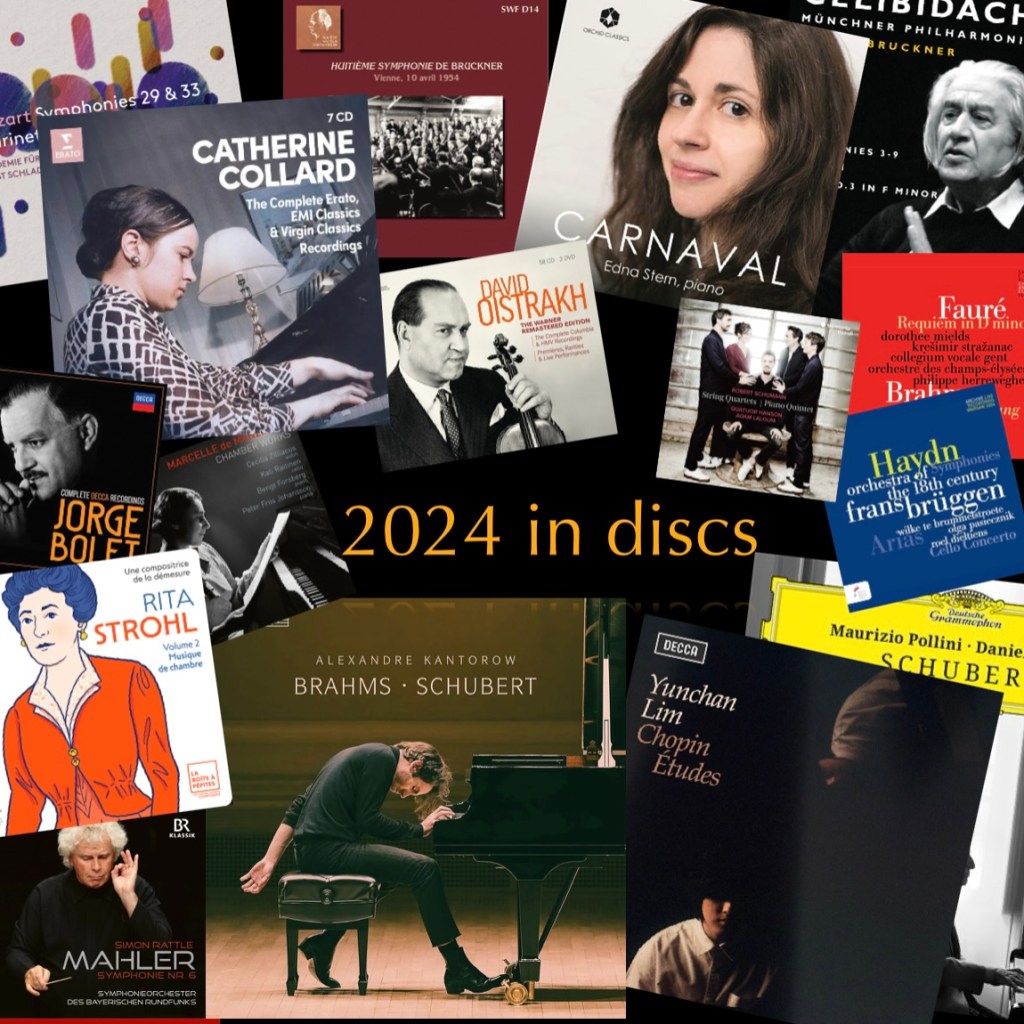
What records will you remember from 2024? Which ones made a particular impression on me, and which ones will go down in history? Here’s a brief overview of the recording year that’s just gone by, backed up by reviews and personal opinions – all subjective, of course!
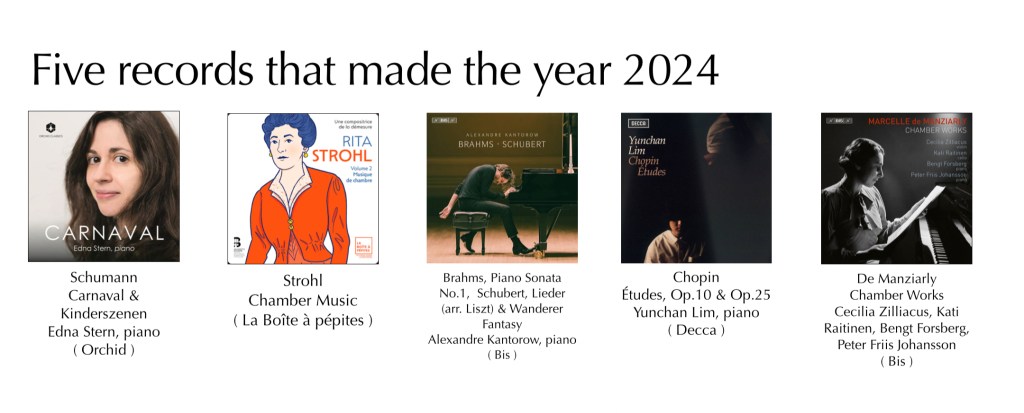
Let’s start with the new pianistic releases. Maurizio Pollini passed away this year, but Deutsche Grammophon was nevertheless able to release one last recording. This Schubert disc includes pieces for four hands played by the Italian pianist with his son, as well as a fabulous Sonata D.894, with great rigour while preserving the poetry, with a strong determination and a beautiful suppleness in spite of everything. It is therefore a far more interesting record than the Hammerklavier previously published by the same publisher. Still with Schubert, Alexandre Kantorow offers us one of his most accomplished discs. Infinitely poetic, with a delicacy matched only by the colours, Kantorow emphasises the nuances while remaining highly restrained. The music of Brahms and Schubert is revealed here in an intimate setting, with a depth of approach that is quite unprecedented, particularly in the first sonata of the former. But what is even more striking is this inspired and even absolutely moving interpretation of Schubert’s Lieder transcribed by Liszt, which enter the pantheon of the discography. With Schumann this time, Edna Stern offered a fabulous interpretation of the Carnaval and the Kinderszenen, as well as her first piece – Opus 1 -, ‘To-nal or not to-nal’. The Carnaval is understood here in its cyclical dimension, each piece is entirely distinctive, but it is the continuity that stands out. And here we have something rare! The music is truly coming to life in the moment, it’s organic, infinitely imaginative and even, we might say, inhabited. There’s a real elegance here, carried by the obviousness of the subject while the refinement of the approach is perceptible. This is a new milestone in the discography. A milestone in the discography, Yunchan Lim also sets a great one in the Chopin Etudes. Here we find an imagination worthy of Cortot, but at the same time great rigour – a modern rigour? -. This is the very opposite of an exercise in style; everything is immensely natural. In a completely different genre, Bertrand Chamayou offered a fascinating interpretation of Cage’s hybrid works for prepared piano. Using inserts in the instrument, the pianist disconcerts but enchants.
Harpsichordists were also particularly in the spotlight this year. First with Francesco Corti, author of a particularly remarkable, lively and dynamic Scarlatti disc. But also in the music of the Leipzig Cantor, with Bertrand Cuiller in a performance full of imagination, and above all in the continuation of the complete works for keyboard offered by Benjamin Alard, with a fabulous English Third Suite, and a Brandenburg Concerto No.5, chamber-like but above all contemplative. Finally, Christophe Rousset also immersed himself in the Cantor’s music this year, with Toccatas that are a little restrained, but above all an Art of Fugue that is beautifully clear, though very slow overall.
On the chamber music front, Cecilia Zilliacus, Kate Raitinen and Bengt Forsberg perform a masterly yet little-known work: the Piano Trio by the French born composer Marcelle de Manziarly, a pupil of Nadia Boulanger. It’s all infinitely poetic, with great finesse and a remarkable sense of narrative. But above all, we are faced with a work of great tension, very anguished, in an architecture and above all a very jerky discourse, but without the colours ever becoming dark in the interpretation. In fact, the album was awarded the Clef d’or Resmusica of the year! Of course, we must also mention the extraordinary retrospective devoted by the La boîte à pépites label to the – very – great composer Rita Strohl. Entitled ‘Rita Strohl, une compositrice de la démesure’ (‘Rita Strohl, a composer of excess’), this immense fresco – in three volumes – retraces the musical journey of an extremely free composer, breaking with convention while offering formidably accessible music. Doubtless forgotten because of her status as a woman, this rediscovery is all the more welcome – as much as it was acclaimed by the specialist press. Her chamber music, particularly the Septet and above all the sublime Grande Fantaisie-Quintette, ideally served by a formidable troupe of performers, is an absolute must! In a more traditional repertoire, the Quatuor Hanson offered a confoundingly obvious reading of Schumann’s string quartets, and above all a highly readable interpretation of the Piano Quintet, accompanied by Adam Laloum. This is a disc of great beauty, driven by splendid clarity and a constant dialogue and attention to detail.
When it comes to orchestral productions, Haydn was particularly well served this year. Firstly, Rachel Podger, conducting the Tafelmusik ensemble, in symphonies Nos. 43 and 49, full of contrasts and buoyed by a beautiful élan. But we should also salute the reissue of a previously unavailable disc: the complete symphonies – unfinished – conducted by Derek Solomons with L’Estro Armonico, which proves to be of great finesse. Finally, in December, the Chopin Institute presented a retrospective of live performances by Frans Brüggen in Warsaw in 2004. The brilliant Dutch conductor’s vision, at once cathedral-like and organic, takes Symphonies Nos. 59, 83, 101, 103 and 104. The sound of the Orchestra of the 18th Century has a lot to do with it, adding to the orchestral breadth and the feeling of fullness of sound. The lyricism of the phrases is exceptional, as always with Brüggen. This is an invaluable document from the Polish label! Mozart is also in the spotlight, with an extraordinary performance of Symphony No.29 by Bernhard Forck, conducting the Akademie Für Alte Musik Berlin. The gesture is lively, the orchestral fabric silky, it’s very lively, even swinging! And the contrasts are brought out with a rare finesse, which is also evident in the rest of the disc. In the Romantic repertoire, the boxed set of recordings of the music of Peter Benoit, the ‘Wagner of Flanders’, by the Antwerp Symphony Orchestra was awarded the Clef d’or by the Resmusica website, and is indeed a superb discovery! Ottavio Dantone ventures bravely, albeit somewhat scholastically, into Schumann’s ‘Rhenish’ and Mendelssohn’s ‘Italian’ symphonies, producing a thoroughly convincing performance with a lively, alert baton. Simon Rattle gave a reading of Mahler’s Symphony No.6 that was confoundingly beautiful. The discourse is teeming with detail, and the orchestral sound of the Bavarian Radio Symphony is absolutely sublime, vertiginous even. It’s certainly not the most ‘tragic’ vision in the entire discography, but it becomes more interesting with each listen. The articulation is breathtaking.
Justin Doyle had particularly distinguished himself in Handel’s sacred repertoire – a Messiah of high quality, and above all a splendid Dixit Dominus. His interpretation of Bach’s Magnificat is more ethereal, contemplative and above all luminous, in short Apollonian. But speaking of sacred music, it’s worth remembering that this was above all a year dedicated to Gabriel Fauré. The composer died just over a century ago. Hervé Niquet gave a splendid reading of the chamber version – more touching to my ears – of the Requiem, but the finest reading of the year undoubtedly went to Philippe Herreweghe. His interpretation – a 2011 live recording – is totally intelligible, with a sunny light and a highly spiritual clarity. This is a new milestone in the discography.
Finally, 2024 saw some fine reissues. First and foremost is the work of Warner Classics in reissuing a major part of Catherine Collard’s recording legacy. These Schumann recordings are among the finest ever made, carried by an absolutely marvellous sense of narrative and overall clarity. Collard’s version of the Davisbundlertanze is without doubt the greatest of all time to date. Still in the piano field, Decca has reissued all the recordings made by Jorge Bolet for the label. It is an immense sum, testifying to the art of a romantic and passionate artist above all else, the whole being carried by a mastery that gives these interpretations a feeling of achievement rarely attained. Eloquence devoted a fascinating boxed set to the art of Rudolf Firkysny, a Czech pianist whose playing was extraordinarily elegant and distinguished – if sometimes a little discreet, or even distant. We should also mention the complete recordings by David Oistrakh – who died just fifty years ago – on Warner, supplemented by a large number of live recordings.Warner has also undertaken to restore the Bruckner concerts given by Sergiu Celibidache, much to our delight! The whole set, a sum unrivalled in its genre, is available on SACD in Japan and on streaming platforms. And speaking of Bruckner, Warner has also digitally reissued Nikolaus Harnoncourt’s stunningly elegant performance of Symphony No.7. Lastly, Warner has reissued a wonderful early recital by Maurizio Pollini, in tribute to the Italian pianist. La Dolce Volta have reissued the complete recordings of André Isoir playing Bach. In my opinion, this remains the greatest interpretative achievement in the organ works, with unequalled clarity and legibility. Isoir is always guided by a concern to respect the text, with the melodic line always in the foreground. Sony also devoted a boxed set to the fabulous recordings of Schoeberg by Pierre Boulez, an indispensable – and moving – work. Finally, we must mention the Wilhelm Furtwangler Society, which this year has graced us with four precious testimonies to the art of this legendary conductor. First we rediscover the concert featuring Bruckner’s Symphony No.8 from 1954, with the silky, rich sound of the Wiener Philharmoniker. It’s an interpretation at the end of the world, almost mystical. The SWF has also offered a facsimile of the score used by Furtwängler in his famous recording of Schumann’s Symphony No.4 in 1953. But two documents of unprecedented quality were subsequently published. Firstly, the famous Bayreuth recordings of Lohengrin in 1936, and secondly a marvellous concert in Stockholm in 1950, featuring Sibelius’s En Saga.
 Sofronichrist
Laisser un commentaire