
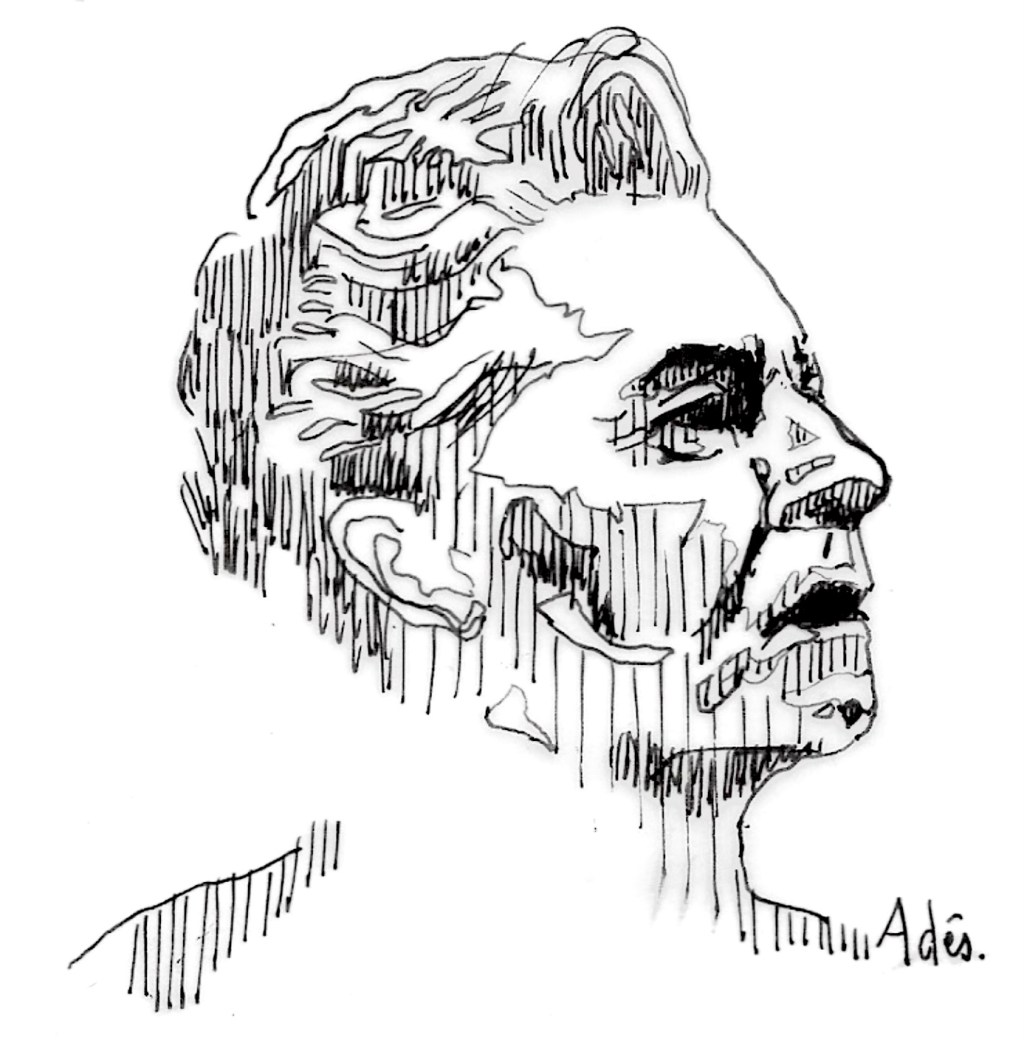
Herbert von Karajan is, along with Leonard Bernstein, perhaps the most significant figure in conducting in the second half of the 20th century. With over two hundred million albums sold, Karajan was what you might call a real star, and yet I never really got into most of his commercial recordings. Of course there are great, great successes, we’ll get to that, but it was listening to live recordings, in public, that I really understood what made Karajan such a genius.
It seems to me that one cannot talk about Herbert von Karajan without mentioning several periods that gradually followed one another in his artistic career. The first is that of a lively classicism, with its sometimes sharp accents, its marked relief and the capital importance given to the melodic line, while remaining relatively faithful to a form of romantic tradition. This was the period that marked the beginning of his career, the rise of Karajan until the end of the Second World War. Then came the second period, which could be dated from 1947 to 1954. This is the period in which Karajan’s style asserts itself, despite the interpretative differences still linked to the characters of the different orchestras that the conductor leads, as we shall see later. Then came the third period, during which the conductor’s ideas became even more assertive until they became almost definitive, where legato took on an important role, where lightness began to fade away and where Karajan became more technically demanding, taking an interest in all the areas that touched his music in any way. Let’s place this period between 1954, when he began as Music Director of the Berlin Philharmonic, and the mid-1960s, when his landmark commercial recording was the complete Beethoven symphonies in 1963. Then comes the last period, when what was already fixed is certainly refined, sometimes becomes more refined, and then most of the time becomes fixed, especially in the studio. This was the period from the second half of the 1960s until his death in 1989. The major projects that mark this period are staggering – the Tetralogy in the late 1960s, the recording of almost all of Richard Strauss’s orchestral works – but there is also something of everything – literally – as Karajan records just about everything that can be recorded.
Karajan’s style is probably at its most vivid between 1947 and the early 1960s. The tempi are lively – even very lively, Karajan is often extremely fast – the relief is not yet completely eaten up by the legato that will come to cover everything from the 1970s onwards – at least in the studio – and of course the timbres are of almost total refinement. The Cosi fan tutte made in 1954 – with Elisabeth Schwartzkopf in particular – is one of the opera recordings of the century, Mozart’s 20th concerto with Haskil is a sensitive and lively masterpiece, and the « Eroica » recorded as part of the Beethoven collection with the Philharmonia in 1952 is a reference of luminous inspiration, The Missa Solemnis with the Berlin Philharmonic and a crazy cast – Janowitz, Berry, Ludwig, Wunderlich – or the German Requiem in 1947 – with Schwarzkopf and Hotter -, what remains of the Tetralogy and the Master Singers in Bayreuth in 1951 are what can properly be called miracles.
Karajan’s music is truly organic, and it seems that he is much more an heir to Furtwangler than to Toscanini – this opposition is often returned to, but it is less clear that Karajan’s art is a synthesis of the arts of the two most important conductors of the first part of the 20th century than are those of Guido Cantelli or Carlos Kleiber, for example. Karajan seemed to possess the orchestra in an almost innate sense, he seemed to have it so much in his blood, that the orchestra as a single instrument was intuitive to him. This is probably why Karajan, who achieved results rather quickly in rehearsal, was much more natural in public than in the studio – let’s add that during the last period we have distinguished the conductor doctored his recordings for the forthcoming discs.
Herbert von Karajan was a jack-of-all-trades: by turns producer, director, television director, sometimes even pianist, he was a genius whose megalomania was embodied more in what was around his music than in the way he worked with the orchestra: if he was not a dictator in rehearsals, he demanded, for example, that bald musicians wear a wig. The last years of Karajan’s career were marked by several great public successes, such as a marvellous Schumann Fourth in 1987, a Brahms premiere of mind-boggling intensity in 1988 in London, and Bruckner’s Eighth and Seventh in 1988 and 1989, which were simply fabulous, opulent and tragic, luminous and contrasted with an unprecedented concern for coherence – the Seventh was, in fact, his last recording.
In this retrospective, I propose to look at some of Karajan’s « live » recordings, in Berlin, Salzburg and Vienna of course, but also in Bayreuth, Tokyo or New York.
It is interesting to note that even in the post-war period and even afterwards until the end of the 1950s, a period when Karajan’s art was already asserted, as shown by the choices he made and wonderfully followed in what remains, I think, the greatest Cosi fan tutte in all history (in 1954), the conductor’s sound continued to evolve according to the orchestra. I suggest that you take the example of a work that Karajan conducted throughout his life: Beethoven’s Ninth.
With the Berlin Philharmonic, the sound is rather thick, but still relatively silky, the string sound is extremely rich, and if there is a good flow, it seems to move forward in fits and starts. But you can hear the colours of the orchestra that Furtwangler conducted for years, and the way it links the phrases in an organic, even sensual way. There is a lot of clarity, and this does not prevent a form of metaphysical floating.
Now, here is a version with the New York Philharmonic in 1958:
Now there is no more light, the clarity is perhaps even more drowned out by the sound recording, but above all you can hear that the spirit has changed. Right from the start there is a potential violence – which will obviously be released with the first tutti – and there is a tension, an urgency and a much darker material. This time it’s Mitropoulos’ orchestra, which he conducted as if in a trance, with a power and violence that are absolutely out of the ordinary. And it is easy to hear, the sound of the orchestra was combined with certain cardinal points of Karajan’s conception, starting with the drive and the colours. But there is a mass that this time advances in a much more spontaneous way, like a kind of organic matter that is now much more liberated than in the Berlin version.
But this organic matter and this drive bordering on mass in power, on a form of violence itself, is not new in Karajan’s art. It is already apparent in his early recordings, for example in a magnificent « Eroica » symphony from 1944 with the Prussian Staaskapelle.
It is also with this tightly bound string sound, with a rich orchestral colour but in a beautifully coherent vision, that one hears the influence that Furtwangler had on the young Karajan. This is how Karajan spoke of Furtwangler:
« Furtwängler was a whole world to me. I came into contact with him quite young; I attended for the first time one of his concerts when I was about 13-14 years old, and since then, his appearance has always accompanied me in my career, in my activity.
I remember for example that when I was already Generalmusikdirektor in Aachen, a friend invited me to a Furtwängler concert in Cologne and I went. There was an Overture, then Schumann’s Fourth and finally a Tchaikovsky Symphony. Furtwängler’s performance of the Schumann Symphony opened up a whole new world to me. So I was deeply impressed, and in order not to destroy this impression, I didn’t stay at the concert and went back home to Aachen. And this same friend then met Furtwängler and said to him: « Ah, you know, your concert was wonderful – Schumann’s Fourth! And Furtwängler replied: « Oh, so the Tchaikovsky wasn’t good? The impression made by the Fourth was really strong, and I remember quite well, for example, the transition between the third and the fourth movement, which was really colossal.
It was really characteristic of him that something would come to an end and then, out of the silence or the momentary calm, something new would develop. These were moments that had an unusual strength of expression with him. And there he did something admirable, which Siegfried Borries, who was Konzertmeister when I took over the Berliner Philharmoniker and who had worked with him all the time, told me: « You know, in those moments, you suddenly had the impression that he was looking for a way out. He was looking for a way out of the uncertainty, he was trying to find a new interpretation.
This was indeed the case with him, it was not a search and an invention, but it was truly the disappearance of one thing before something else already existed.
[…]
This shows what was important to him, what was, after all, a fundamental situation in life, namely: a new decision after doubt. And you can always see this in him; whether in the transition from the third to the fourth movement of Beethoven’s Fifth or elsewhere, it was always the same thing. »
This allows us to relate Furtwangler’s art to that of Karajan in a work that was a stalking horse for both: Schumann’s Fourth.
Neither Furtwangler nor Karajan are improvising conductors, as Knappertsbusch was, and their transitions and thematic work are always well controlled. There is always something behind it, beyond what is present at the time, and this something that is in itself, that is in the making, rises above, transcends what has been in the foreground until then.
Karajan, in the transition between the last two movements of the Fourth Symphony, gives an extremely controlled vision, proceeding as if in stages while maintaining a certain sense of line. This is particularly noticeable in 1972, in a version with the Dresden Staatskapelle, although Furtwangler naturally seems a world away, with a crescendo that never seems to end. If you’ve never heard the 1953 recording, run to it quickly because I don’t think it’s ever been outdated.
Here’s Karajan, in public in 1987, in Schumann’s fourth :
Karajan worked throughout his career with renowned soloists, including, for the record, Dinu Lipatti, Anne-Sophie Mutter, Walter Gieseking and Hans Richter-Haaser.
One of the great collaborations between Karajan and a soloist was with Geza Anda. It is interesting to see in the surviving concert recordings how the opulence of Karajan’s conducting contrasts happily with Geza Anda’s almost skeletal, articulation- and structure-based style. This is also due to the choice of a very fast tempo, not to say fast, and a relative lightening of the orchestral fabric. Karajan, if he had his style and did not deviate from it, nevertheless knew how to adapt, more or less, to the works, but above all to his soloists. This is also the case in a fabulous third concerto by Beethoven with Glenn Gould, or, above all, in the Mozart concertos, especially the 20th. There are two really outstanding versions, the first with Clara Haskil, the second with Wilhelm Kempff.
The version with Kempff is very spirited, lively, dynamic and at the same time colourful. Kempff’s phrasing, extremely refined, responds to the orchestra, whose sound remains somewhat thick, and a dialogue between the two performers ensues.
No doubt the fact that the version with Clara Haskil is much lighter and brighter while retaining this very colourful and dynamic aspect is partly due to the orchestra, which is no longer the Berlin Philharmonic but the Philharmonia Orchestra. There is a delicacy, a tenderness and sometimes even an almost contemplative quality to Haskil’s playing that Karajan adapts to, with slightly more contrasting dynamics and a wide range of colours, especially in the woodwinds, but above all the dialogue is much more interesting. There are more nuances, more meanings revealed in this form of simplicity, of elegance even, which makes the whole scope of the Concerto intelligible.
Perhaps one of the problems that remains when Karajan conducts ‘his’ Berlin Philharmonic – he almost never invited his colleagues – is that legato which seems to set back structure and relief in favour of very smooth, sometimes systematic, articulations, and sometimes this legato seems to literally eat up everything else. But Karajan’s live recordings are more variable as regards legato, sometimes it is extremely present, and sometimes it is more discreet, which enhances the complexity, intelligibility and overall sense of the interpretation. Perhaps this has something to do with the acoustics of the halls, and not just the orchestra. Indeed, when one listens to Karajan’s live recordings in Tokyo’s Fumon Hall, one finds that the dryness of the hall brings out the relief and articulation. This is particularly noticeable in Beethoven’s Fifth from a concert cycle on tour with all nine Beethoven symphonies in 1977. This version is much drier, but above all much more lively overall than the one recorded a few months earlier in the studio:
Salzburg was an extraordinary field of expression for Karajan, who could conduct practically any repertoire he wished. While he gave some of his finest operatic performances there, and we’ll come back to that, he also regularly brought his Berlin Philharmonic to Salzburg, especially for symphonic concerts. So I suggest you listen to Karajan conducting the Berlin orchestra, with all his usual legato, thickness and strength, alongside a soloist with a much drier, more incisive playing, while still being of great vitality: Maurizio Pollini, in Brahms’ 2nd piano concerto:
Salzburg is in essence an emblematic place for Mozart’s interpretation. Karajan took over the direction of Mozart’s operas from Wilhelm Furtwangler after the latter’s death in 1954, with the exception of Cosi fan tutte, which he left to Karl Bohm. In Salzburg, Karajan pushed Mozart’s Don Giovanni into what could be called the quintessence of post-romantic interpretation: even if it is not theatrical like the versions that came out of the revival due to the old instruments, there is an opulence, a richness and here again a strength and an almost total refinement. And this is not the Berlin Philharmonic, but the Vienna Philharmonic: the sound is less thick, less monolithic, more nuanced and silky. In 1968, Karajan had an exceptional cast, perhaps the finest ever assembled in a single ensemble: Nicolai Ghiaurov in the title role, Gundula Janowitz as Donna Anna, Mirella Frenni as Zerline, and above all, a role that often fails, Martti Talvela as the Commander, perhaps the greatest in history. Even if the sound quality of the document is mediocre, it gives an idea of what this historical performance could be.
But Karajan did not conduct opera in Austria only in Salzburg, but also in Vienna. The Vienna Opera Orchestra, largely the Philharmonic, gave Karajan’s conducting a suppleness and elegance that his Berlin orchestra did not. In this respect, Karajan’s finest operatic achievements on disc are often either with the Vienna Philharmonic – with, for example, the finest cast in history in The Marriage of Figaro, or an anthological Fledermaus – or with the Philharmonia Orchestra – Cosi fan tutte, The Knight of the Rose, for example – with the exception of the Ring recorded with the Berlin Philharmonic – whose thick sound paradoxically gives rise to an exceptional surrender, very chamber-like thanks to the singers, of Wagner’s music, particularly in Siegfried.
At the Vienna Opera, Karajan has conducted Mozart and Strauss, but I propose to focus on a work that is not immediately associated with Karajan’s name: Parsifal. Yet, in a Viennese version from 1961, Karajan was able to combine the vivacity and urgency of Clemens Krauss’ conducting with the spirituality and grandeur of Hans Knappertsbusch’s. The result is profound, solemn and beautiful. The result is profound, solemn, human but still mystical.
In Wagner, Karajan’s baton performed what can truly be called miracles. If the sound of the orchestra is still relatively thick, in contrast to the lightening of Furtwangler or Krauss, for example, speed and precision come together admirably. Karajan’s Wagner is thus powerful, lively but also sensual, almost corporeal at times, much less metaphysical than that of Furtwangler or Knappertsbusch for example – which in a sense is no less legitimate, in Tristan for example.
The Bayreuth Festival in 1951 was the scene of several legendary performances conducted by Karajan. Of course there was the Master Singers, which is my personal reference, but also a Ring, of which we still have Siegfried, the Rhine Gold, Siegfried, but above all the third Act of the Valkyrie, which is still a reference among the greatest today.
I suggest that you listen to Karajan conducting the Valkyrie at the Salzburg Festival, for copyright reasons, in 1967, when the Tetralogy was recorded in the studio:
It was clear that Karajan was a great accompanist. He was so for his instrumental soloists, but he was also so for the singers. This is of course particularly noticeable in opera, but also in certain less theatrical vocal works, such as the last four Lieder of Richard Strauss – with this absolute version recorded with Gundula Janowitz – or, to speak of a public performance, in Mahler’s fourth symphony, with Edith Mathis.
Karajan knew how to support the soloists while allowing the orchestral fabric to breathe, and he also knew how to infuse choral passages with extraordinary power, whether in opera or of course in sacred music. Of course, we no longer count the fabulous Verdi Requiem recorded on the spot, but it is perhaps in Brahms’ German Requiem that Karajan was the greatest. One finds there that organic unity of the orchestra, almost as protoplasmic as in Furtwangler’s work, that mastery of transitions and that magnificent superimposition of themes, in the sense that the lines intersect without ever merging. There is in Karajan’s interpretation of the German Requiem a substance, a life of its own, and the orchestra does not only support the choir, it is its complementary element and, in this, this vision verges on perfection. I therefore suggest that you listen to Karajan conduct the German Requiem, with the Berlin Philharmonic:
Herbert von Karajan was an heir to the Romantic tradition in a sense, with his organic conception of music, his way of looking at the orchestra as a whole, and this was combined with his almost innate ability to communicate his ideas to the musicians. Karajan’s public performances are natural, coherent, animated by an overall spirit that is at once singular, specific to the work, and always imbued with Karajan’s very personal style – whether we are talking about legato, singing lines or refinement, richness of sound. In this respect, Karajan was – and his live recordings confirm this – one of the most influential conductors of the second half of the 20th century, and not only in technical or commercial terms.
 Sofronichrist
Laisser un commentaire