
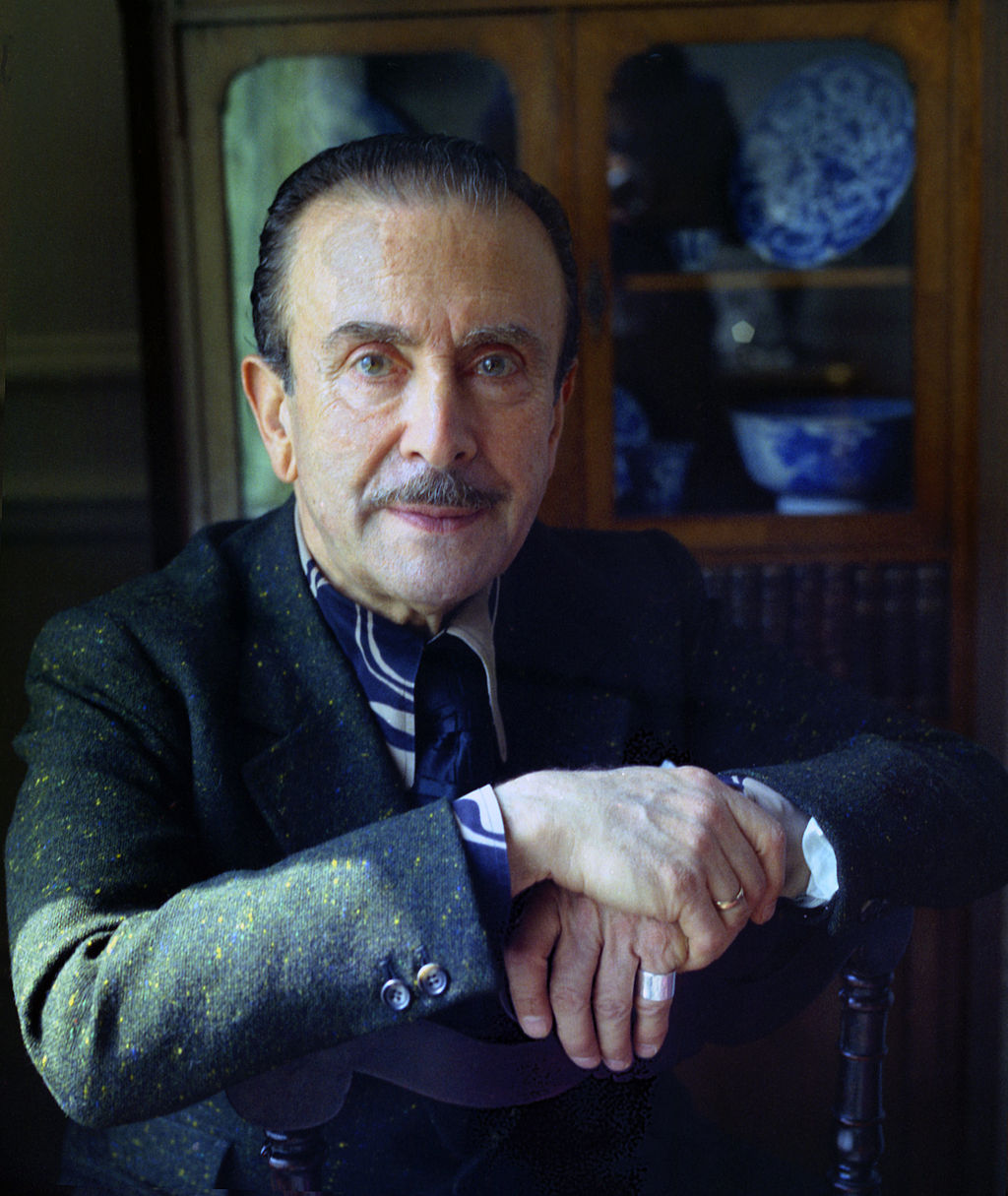
Claudio Arrau, photography by Allan Warren
Between May 1980 and July 1981, Arrau gave a series of interviews to Joseph Horowitz, who published the collection in 1982. In them, Claudio Arrau talks about his practice of the instrument, his ideas about music and interpretation, and his own experience of the great historical movements of the twentieth century. By the time he gave these interviews, Arrau was an established pianist, particularly in the United States, and recognised worldwide. He has now overcome certain critics who criticised him for his cold playing, particularly during his youth. And indeed, while his playing is obviously warm, his sound colourful, his tempi slow – « it’s a mistake to equate speed with passion », he says himself – and his attacks very rounded, Arrau was opposed from his youth to pure virtuosity, which he already considered gratuitous, and from which he firmly defended himself.
I would therefore like to return to the subject through the prism of Joseph Horowitz’s work, which I read in French in the translation by the celebrated critic André Tubeuf and of which I was unable to obtain an English copy (the quotations may therefore be somewhat altered, but the meaning will be there). A selective discography is available at the end of the article.
The first thing that comes to mind when reading this series of interviews is the extent to which Arrau insists throughout on the need for an ethical commitment on the part of the performer. In fact, he takes works that have a strong historical and emotional significance.. But we must not think that a performer is only capable of playing the things he is close to. For Arrau, « the true performer is the one who knows how to transform himself into something he is not ». In interpretation, « it’s as if an actor were playing himself ». In reality, you can’t really interpret if you don’t have « the capacity to invest yourself in worlds that are distinct » from your own. The interpreter would only have access to the composer’s world through the intermediary of what the composer has bequeathed to him or her, i.e. the score, in all its unfortunate fixedness. For Arrau, the interpreter is someone who changes, both during the performance and afterwards, and Horowitz points out that interpreters are often assigned to a repertoire according to their nationality – for example, the relationship between French conductors and the music of Debussy or Ravel, But Arrau denies what he considers to be a prejudice – and indeed, it is enough to listen to how Charles Munch, Pierre Monteux and Paul Paray, to name but a few, have an extremely different style in music that would seem to belong to a common tradition. For Arrau, the national element is in fact not as important as it is made out to be, and even less so the more ‘genius’ the work – Furtwangler was, according to Arrau, the best interpreter of Debussy he had ever heard, and he was not a French conductor.
One might immediately think that this commitment to principle on the part of the interpreter would run counter to certain freedoms inherent in the very concept of interpretation. But Arrau is unequivocal on this point: for him, « there is not the slightest incompatibility » between respect for the text and interpretation itself. « You have to start by respecting the text exactly as it is written [….], but that’s only the first step […]. Interpretation is a synthesis between the world of the composer and that of the interpreter », and the interpreter’s work lies at the very heart of this a posteriori relationship between interpreter and composer. And even if the public does not, for the most part, notice all this work prior to the performance, this pre-performance commitment to understanding the work is no less necessary: « we should always play for the ideal listener », says Arrau. Horowitz immediately points out a major difficulty with this type of assertion: dogmatism. Arrau seems to be arguing that this ideal listener is unique, and that the ideal performance is therefore one and the same. Yet « it’s the last thing [Arrau] would want [to be dogmatic]. There will always be more than one possibility. But there are also things that are not a matter of interpretation. If Beethoven writes piano and you play forte, you’re wrong. Quite simply wrong. Heinrich Neuhaus said that « there is no such thing as a bad piano, only bad pianists », and Arrau confirms this with his vision of the performer’s commitment: « I’m convinced that you have to be able to adapt to the piano, instantly ». This idea of adaptation is at the heart of the performer’s work, according to Arrau. This is why, after hearing Wanda Landowska rediscover ornamentation by playing Bach on the harpsichord, Arrau simply stopped playing Bach, feeling that the piano was distorting the original harmony.
Arrau says he mourned his teacher Martin Krause for a very long time. Krause was an extremely demanding teacher, but he wanted each of his pupils to be able to develop their own individuality. Arrau saw him as a second father, shaping his education – given that he didn’t go to school. His authority was total,, and he only paid compliments in public. Arrau believes that he took charge of the child he was because he was so young that he was mouldable material, even though Krauss was already very old. It was in the face of the pain of losing Krause that Arrau turned to psychoanalysis, which enabled him to identify certain implicit aspects of his art, aspects that he knew but had not really put into words. And the commitment of the performer is accompanied in the interpretation by a will, an immense will. « Before you can play, you have to learn to want to play, » explains Arrau. He « wanted to please, and was afraid of not pleasing ». In its sincerity, this will was opposed to a form of vanity. « As much as you lose in vanity, you gain in creativity. You have to get to the point where you sometimes find the courage to displease, as the composer sometimes demands ». The sound of Arrau’s piano changed after he gained confidence, becoming « richer, more assertive. Everything took on a fuller meaning ». For Arrau, « to be a man is to experience anguish », something he has come to understand through psychoanalysis. « But it seems to me that the gift of feeling anxiety, the anxiety linked to the simple fact of being a man, gives us the power to invest ourselves in any other emotion – in anything human. I see this gift of sympathy as one of the essential virtues of the performer », says Arrau. This anxiety, and the work of interpreting, which is above all the work of the self on the self, are absolutely exhausting for Arrau. To be a great interpreter is to experience anxiety and to suffer the consequences. And that is terribly distressing. And yet, Arrau believes that he must never withdraw; on the contrary, he must relax in accordance with these challenges. The instrument must never be abused, and he must work to « never get tired », and this work must not be a « physical characteristic of playing », which is the cause of the cramps and aches that afflict pianists in general. So how can one be both ‘so committed and so relaxed’, as Joseph Horowitz put it? Arrau replies: « It’s by becoming one with the music. You manage to become one with the audience. You can’t divide things up like that. Controlling emotions – I don’t think that helps ». It is because Arrau is in tune with what he feels, that he does not repress his inner self, that he can in a sense feel at one with the audience during a concert. In this way, Arrau feels neither emotionally nor physically exhausted by a concert. Krause thought that « it makes you nervous » to warm up before a concert. According to Arrau, people who warm up « ruin that really wonderful thing about a performance – the spiritual energy as it begins! ) « .
For Arrau, one never plays for others and, above all, the artist is never objective. Any artist who claims to be objective renounces interpretation. Arrau explains, for example, that although Toscanini infused his performances with prodigious energy, he never produced any interpretation. In Arrau’s view, playing Liszt with pyrotechnic effects was tantamount to substituting all his depth for superficial emotion. From his youth, Arrau was opposed to pianists who tried to produce effects on the audience by playing on the mystery that virtuosity produces on the audience. As far back as the 1930s, Arrau deplored the fact that pianists like Edwin Fischer and Artur Schnabel, who favoured a natural, simpler approach to achieving a deeper understanding of the works, were unable to fill the halls in Vienna.
For Arrau, there is « a great risk » of technique becoming too conscious, and this depends above all on the physical way in which he plays: « very early on I realised that playing in a relaxed way encourages my creative vein, simply because you are more natural […]; because the soul and the body then become one », he says. When Horowitz asks whether there isn’t a certain fatigue, at least emotional, in working on intellectually and technically difficult works such as the Liszt sonata, Arrau replies: « When I’m working, I don’t put any emotion into it. It’s like being in the studio ». Yet Arrau still refuses to accept any form of objectivity. That would mean losing all interpretation. « One of the main problems in playing the piano […] is to be able to relax at moments when emotion is at its highest. Busoni had this strange theory that the less emotionally involved you are, the more the audience is gripped. I’ve never been able to understand such a thing. It’s just that, in my opinion, from my observations, someone who controls himself and balances himself gives the impression that he remains cold. And he is. I don’t like that kind of dissociation ». Conversely, Arrau shows admiration for performers who demonstrate « authentic creation », such as Busoni or Furtwangler. To be a performer « is to be possessed », and Arrau even identifies Edwin Fischer, another pupil of his teacher Martin Krause and one of his contemporaries whom he most admired in the world, as having a form of « divinatory gift », so that playing does not have to be a physical characteristic.
But make no mistake, for Arrau, « it is practically impossible for a performer to ever entirely rid himself of this desire for prowess. And at certain ages in life this will is forced upwards, indispensable. Even then, you have to fight vanity with all your soul. The older you are, the more harmonious your personality becomes – so I think that certain inhibitions due to vanity can be combated with some chance of success ». However, what is most important in Arrau’s thinking is interiority, a form of immanence in the principles of interpretation. And this explains why he praises Krause so highly, who allowed each of his students to blossom in his singularity. Just listen to Rosita Renard, Edwin Fischer and Claudio Arrau, all of whom were pupils of Martin Krause, and yet their playing seems to have little in common.
While in these interviews Arrau does indeed offer a reflection on his own practice, and in particular, as we have already seen, on his artistic commitments, these commitments also relate to the artist’s relationship with other artists, composers, but also his contemporaries, in addition, of course, to the public and the critics. On the subject of critics, Arrau is very clear-cut: « to defer to the taste of a clan is dangerous ». While he accepts the advice and manners of certain conductors, and even then only on certain passages, Arrau does not hear them from other pianists. Arrau’s most admired contemporary was undoubtedly Edwin Fischer, but he also revered Artur Schnabel and Wilhelm Kempff. According to Arrau, what all three had in common was that they did not consider themselves above technique. Moreover, they did not impose technical exercises on themselves, leaving room for the inspiration of the moment, even if it meant being possessed by it. But what fundamentally links them is that « they all thought only of making music ». In Fischer’s case, « you didn’t feel you were dealing with a pianist, but with a poet ». Arrau adds that « technical difficulty in itself has an expressive value ». As for his pupils, Arrau doesn’t play for them. There would be « too great a risk of imitation ». Moreover, the naturalness would be lost in trying too hard in an empirical way. On hearing this, Joseph Horowitz immediately contrasted these considerations with the practice of Glenn Gould, for whom good ideas could only arise from chance and pure experimentation – which is why Gould spent so much time in the studio, each take being fundamentally different, and only one ending up being retained. And beyond imitation, illustration and narration pose a serious problem: representing without overdoing it. In this respect, programme music « obviously poses a problem […], it’s a received idea that a musician has to worry about absolutely nothing other than the notes. I agree when you get to the final stage, the performance. But I’ve often found, as a teacher, that when students can’t get into the music, the only way to do it is to put a programme in their heads. At least while they’re working on it », in the words of Arrau himself. But looking back on the past and the ideals it embodies does not make Arrau pessimistic. On the subject of the younger generation at the time, Arrau believes that « there is an amazing talent among young pianists. There is no lack of talent. It’s the conditions for their possible development that are in question. The competition is so terrible. They’re thrown in front of the public so early. And from their point of view, they have to accept what they’re given. It’s a very dangerous situation ». But the current situation – the early 1980s – is « marvellous » for Arrau: « It’s true that back then hearing music was more of an event. Access is so easy today! You can play yourself a record while taking a bath. That’s something that’s always worried me a bit – that it’s becoming too easy to enjoy what’s really great about art. On the other hand, it has now become possible to live with masterpieces. And then there is the whole issue of age. Arrau enjoys growing older, gaining in maturity and perspective. « It seems to me that I’m expanding my world more and more. It’s as if my breathing becomes deeper. I feel it in my playing, » he says.
Faced with this need for solitude explained by Arrau, Horowitz asked him whether he thought that the conception of the Romantic genius – solitary, suffering, struggling – was the basic personality of a great artist, in this case a great performer, the concept of interpretation having taken off in the nineteenth century. However, Arrau opposes head-on the Romantic conception of the solitary genius who draws his genius from misfortune. On the contrary, for him, it is Carl Gustav Jung’s distinction between the extrovert and the introvert that tells us much more about what a great artist should be. According to Arrau, the introvert achieves much more than the extrovert, provided he has the stamina to face up to all the conflicts of artistic development. Critics in particular have idealised genius, Arrau taking as an example the golden age of piano performance at the beginning of the twentieth century, when false notes were seen as « the birthright of genius », in the era of pianists such as Eugen d’Albert and Teresa Carreño. The training of a great artist, on the other hand, can be intuitive, the fruit of an interiority that derives not from the work but from the personality of the performer. « I got my hands on the music and, one way or another, I deciphered it. I was on my own, you see, because my mother was afraid of these gifts. She certainly didn’t want to push me. Wonderful attitude. She never forced me to do anything » is how Arrau sums up his own musical education.
Arrau does not see music as an abstract art form; on the contrary, it is a form of continuous imitation that points towards an organicity, something that points towards the very impulse of life itself. Art confronts us with ourselves. Basically, what the musician is doing is imitating the human voice, never playing « two notes with the same force » because « you have to remember that you have to change. The notes must move in waves ». Imitation lies in this ability to take account of the shifting, the uneven that is to be found in nature itself. For Arrau, we should never learn to play equal scales; we should never play « like a typewriter ». For Arrau, art is opposed to any form of mechanical execution; interpretation is on the side of nature, and its shifting character. For Arrau, a genius interpreter is one who knows how to perceive nature, both in natural things and in the way they are reflected in great works set down on paper.
 Sofronichrist
Laisser un commentaire