

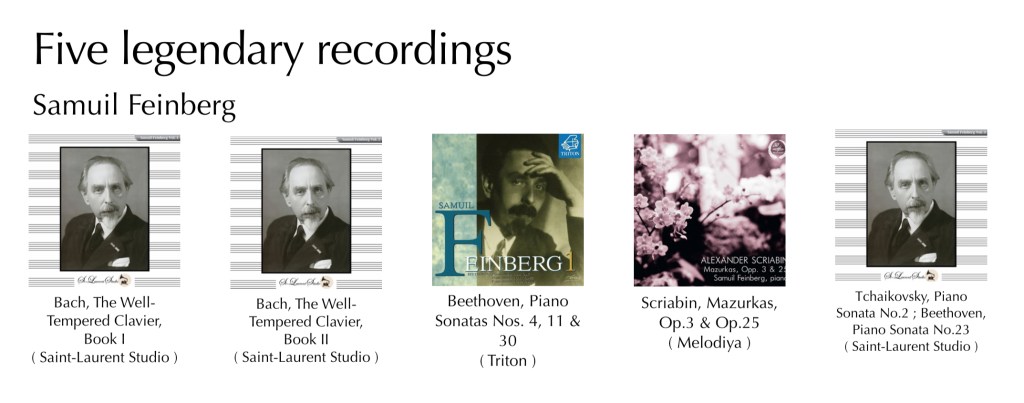
Samuil Feinberg was an embodiment of the accuracy and intelligibility of the text. But even beyond the formal perfection, admittedly quite absolute, of his interpretations, the spirituality that emanated from them gave his readings of the great works of the repertoire an unheard-of depth. Feinberg was, like Artur Schnabel, both an important, if long forgotten, composer and a revolutionary performer. His discography covers three composers in particular: Scriabin, of whom he was one of the greatest readers of the first part of the 20th century alongside Vladimir Sofronitsky and Heinrich Neuhaus; Beethoven – whose fourth and thirtieth sonatas have perhaps never been rendered with such imagination and light – and, of course, Bach, of which he remains for me one of the finest ambassadors on the piano, conveying the spirituality of the Cantor.
What radiates from each of Feinberg’s interpretations is above all poetry, a way of evoking in a way that reconciles impressionism and precision: the discourse is of an impressive clarity and verticality, and it is this that allows the expression of an extraordinary freedom in the narration. But Feinberg’s interpretations all tend towards an absolute light, and it is truly an ideal, far from physical – and sometimes even human – torment that Feinberg sketches. The diversity of forms that the discourse can take, embodied in a multiplicity of tempi, colours, in an alternation of restrained force and restraint conditioned by an immanent tension, does not prevent Feinberg’s interpretations from being coherent, precisely because this multiplicity of means are combined or expressed successively with a view to one and the same end, the light or the ideal. There is something about Feinberg’s overcoming, about the capacity of music to emancipate itself from human contradictions, and a sense, when one examines the available discography of Bach’s piano works, that it is under Feinberg’s fingers that Bach’s music takes on the most theological meaning, Bach regularly writing for God alone, the latter being grace itself – theologically, God is everywhere where there is grace. There is thus an expression of mysticism in Feinberg’s music, or at least his music truly tends towards a spiritual and purely spiritual ideal. Moreover, Bach’s Toccatas, which are perhaps more rooted in humanity than in deity – apart from BWV.911 – are drawn towards formal intelligibility, and therefore grace, by Feinberg – BWV.911 and 912, which can be listened to on YouTube. When one listens to Feinberg’s Well-Tempered Clavier, perhaps the greatest ever, it is this ability to make all the voices sing with unheard-of poetry, and to privilege the intellectual dimension – at least, the intellection that can be drawn from the senses – rather than the purely corporeal dimension of the work. There is a preponderance of place given to the intelligibility of the form rather than its capacity to resonate in a physical way. And indeed, even in Beethoven’s music, under Feinberg’s fingers it is the capacity for intellection that seems to take precedence. However, this does not mean that Feinberg’s music is completely free of physical considerations. Indeed, Feinberg takes into account the temporal dimension of music, whose first receptacle is physical – the ear – and modulates his interpretations according to an art of breathing. It is indeed a renewed breath, thought out according to the silences and breaths, which allows Feinberg to give his interpretations their capacity to render the text intelligible, and to make the mind sing rather than the body alone.
But there was indeed, always with this ideal in mind, a deep reflection at the source of Feinberg’s perpetual adaptation. When one listens to him playing Scriabin, for example, there is an articulation of contrasts according to the breathing that Scriabin’s music requires, which allows the discourse to be intelligible throughout the piece. Feinberg’s piano is an extremely philosophical piano, for all the formalism – fabulous it is true, the range of sounds of which Feinberg is capable is breathtakingly beautiful – is in the service of something greater.
 Sofronichrist
Laisser un commentaire