
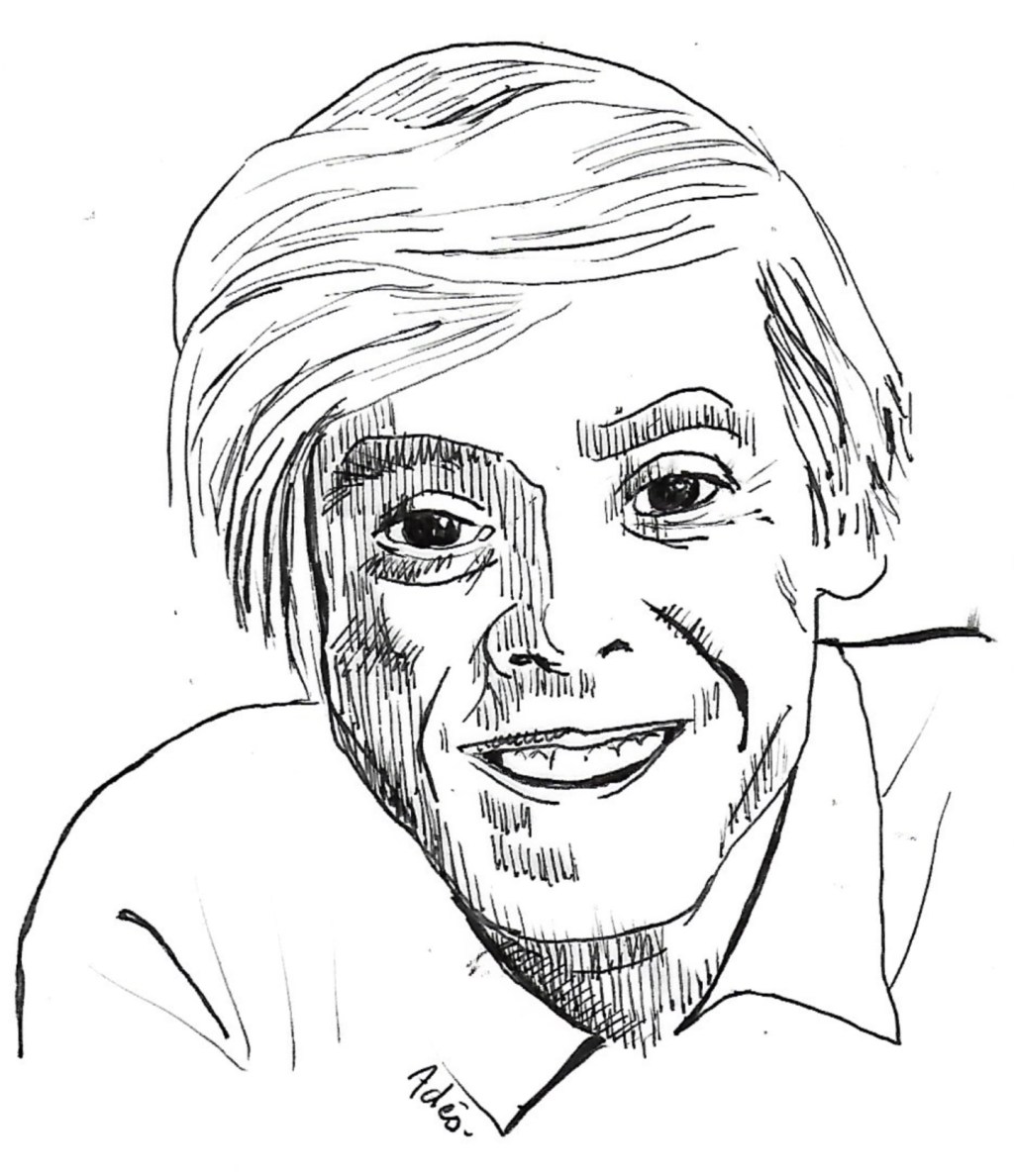
Frans Bruggen is one of the most singular exponents of historically informed conducting – in other words, conducting with period instruments. The conductor has shown that it is not an oxymoron to be a ‘barroqueux’ while claiming Furtwangler as his main inspiration. There is an organic vision of music in Bruggen’s art, and under his direction – without a baton – the works become cathedrals of sorts that emancipate themselves from a form of monumentality – which avoids any form of caricature, as the sound of the strings is reduced and that of the timpani accentuated – to turn towards a profound verticality. This verticality is based in particular on the primacy given to silence and breathing, which completes the organic status of his music. Indeed, the organic character of Bruggen’s music lies as much in its dynamics and contrasts – with an ever tense flow, again a legacy of Furtwangler – as in the primacy given to breathing, particularly through silence.
The first part of Frans Bruggen’s career was that of a flautist, perhaps the greatest of his time – at any rate on a period instrument, as evidenced by a somewhat dated but nonetheless very important recording of the Brandenburg Fifth with Leonhardt and Bylsma, among others – and the second that of a conductor who was perhaps the most inspired and influential – along with Harnoncourt – in his speciality.
Bruggen’s eighteenth-century orchestra had a golden, sparkling sound, brilliant in the true sense of the word, and it was this factor that enabled him to give architecture such a central place in his interpretations. The conductor knew how to illuminate both the strictly Baroque repertoire – his Bach Mass in B is truly a miracle, as is his St John Passion (first version, his recordings of Rameau – as well as the more classical repertoire – his fortieth symphony by Mozart is a masterpiece of dialogue between the different styles that an orchestral page can contain – or the more romantic repertoire – his complete works of Beethoven’s symphonies are a benchmark, that of Schubert’s symphonies a synthesis, that of Mendelssohn’s symphonies an indisputable summit.
But let’s get back to Mozart, since that’s what we’re talking about today. The most successful versions of the symphonies on period instruments are most often those that manage to combine the legibility of the different sound levels, the relative dryness of the attacks and the roundness, the very warm and even happy side of the sonorities – starting with the woodwinds. The orchestra as a whole can sound gilded, teeming, and this is particularly the case with Frans Bruggen, who adds to these colours and details a concern for construction and architecture. A great admirer of Furtwangler, Bruggen takes extraordinary care with the transitions – not regular, but incredibly natural – both in their preparation and execution, while preserving the originality of each theme. The atmospheres are superimposed and follow one another in an extremely coherent way, while preserving the complexity of Mozart’s symphonies. But Bruggen adds what makes him unique in the world of performance on period instruments: that form of metaphysics, of almost mystical spirituality that transcends each of his interpretations. This is clearly evident in his reading of the introduction to the 39th symphony, with this introduction as if in suspension, floating but nonetheless taut enough for the line never to get lost, with a flute of simply staggering formal beauty.
Obviously, Bruggen’s style is probably not the best suited to the vivacity of the early mature symphonies – Nos. 29 and 33 in particular. However, as soon as Mozart fleshed out his architecture with timpani and tutti that were much sharper, the organic aspect of Bruggen’s conducting transcended the music. And it should be added that all the metaphysics of his art also transcend the slow movements, and the sense of architecture in the Scherzi and Menuets. The ‘Haffner’ and ‘Prague’ symphonies are thus excellent summaries of everything that makes Bruggen’s art so complex. But there is also a sense of drama, particularly in the rubato and speed. The « Linz » and No.40 symphonies are meteors, completely out of time, with an intensity that truly takes the listener hostage, all with an expressive force that amplifies either the narrative – the 36th symphony – or the tragic – the 40th. Finally, how can we not mention the 39th and ‘Jupiter’, which showcase Bruggen’s talent for building architectures, without the naturalness ever taking a back seat, thanks, once again, to the organic aspect.
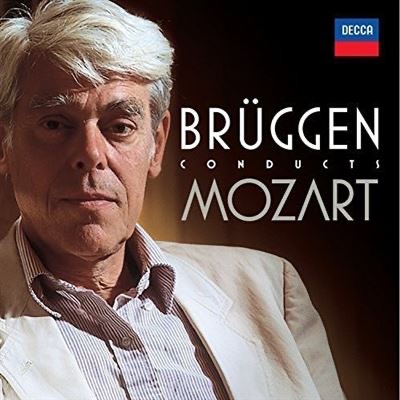
I was referring here to the recordings available on Philips, brought together in a sumptuous ‘Bruggen conducts Mozart’ box set. The Glossa recordings are more contemplative, and a little more static too, but they are also full of marvels – starting with the concertos, with the immense Thomas Zehetmaier.
 Sofronichrist
Laisser un commentaire