
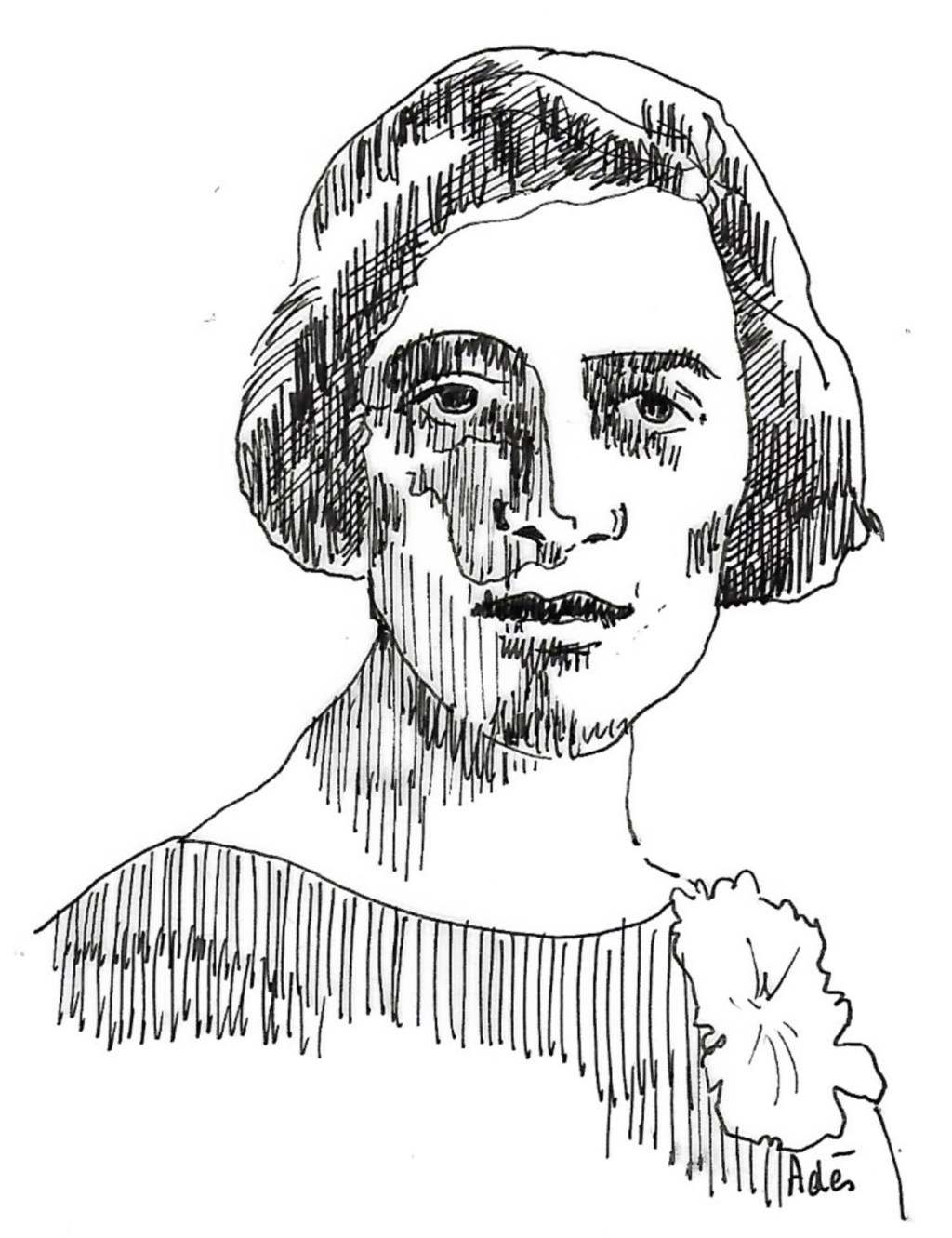
When we try to identify a form of « French piano tradition » – which is sometimes already debatable – we often tend to speak of « pearl playing ». Marcelle Meyer’s style lies in a way of linking this pearled playing to an extraordinary expressive power, with notably an infinite palette of nuances in the high notes and absolutely enormous bass. Like Dinu Lipatti or Clara Haskil, there is a Marcelle Meyer mystery. Here we touch on the ineffable, the inexplicable. Meyer’s interpretations oscillate at times between pure joy and the most painful sadness, at other times between opulent sonority and phrasing based above all on articulation. All the balance that Meyer infuses into his interpretations does not deprive them of excitement, on the contrary. There is a central place devoted to the legibility of the lines and an extraordinary humility before the score, as with Cortot. Indeed, Meyer was, like many other great pianists of his time, a student of the great master. This is evident in the way in which every liberty taken by Marcelle Meyer is placed in a process of understanding the spirit of the composer.
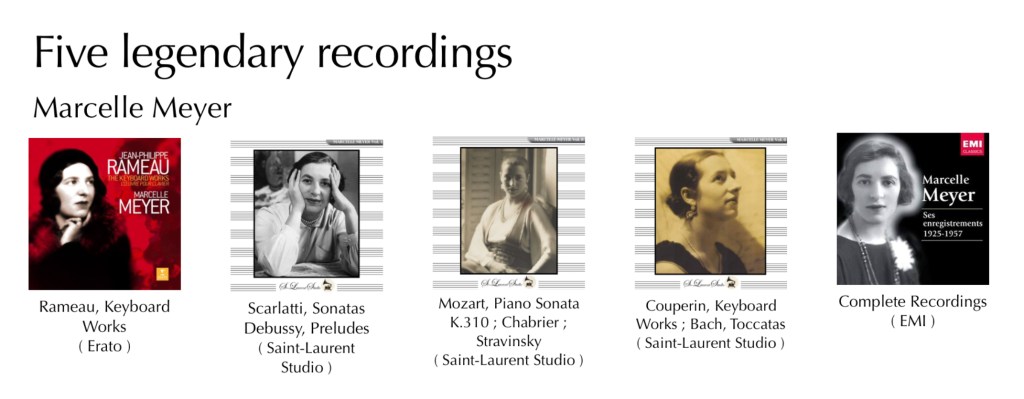
In her interpretations, Meyer guarantees coherence through a certainty: there is a direction imprinted from the beginning of the piece and it will be followed from one end to the other. Yet this certainty of discourse does not prevent Meyer’s interpretations from lacking complexity. Sometimes Marcelle Meyer’s playing even becomes impressionistic in melody, as is particularly evident in Ravel’s Alborada del gracioso for example. And this complexity is especially magnified in the music of Rameau, whom Meyer raised to the rank of absolute genius. Perhaps never before has Rameau, at the piano or the harpsichord, been carried by so much urgency, so much tenderness, so much tragedy, and all at the same time! One seems to find Bach here, Mozart there, but the whole remains remarkably homogeneous. Perhaps there is something to be said for authenticity – if only to play Rameau on the piano – but I believe that we are dealing here with one of the greatest recordings of the 20th century, quite simply.
But there is something about Marcelle Meyer that I think is unique in the whole history of the piano in the 20th century, because it is only found systematically in her work. It’s this way of finding the moment that will be outside while at the same time being part of the logical continuation of the preceding moments, it’s the surprise that is hoped for but not expected, in a way. And this explains Meyer’s extraordinary capacity to reveal totally unknown aspects, and to prove the obvious that we were unaware of until now. For example, I have heard the Gigue from Bach’s first partita probably by dozens of interpreters before her, but her interpretation revealed a facet of the work to me – perhaps also because I am not a musician – and since then I have been waiting for her every time I hear an interpretation. For me, Marcelle Meyer is one of those unique artists whose admiration only grows with each attentive listening, and whose discovery of a new recording is always a source of permanent wonder.
 Sofronichrist
Laisser un commentaire