
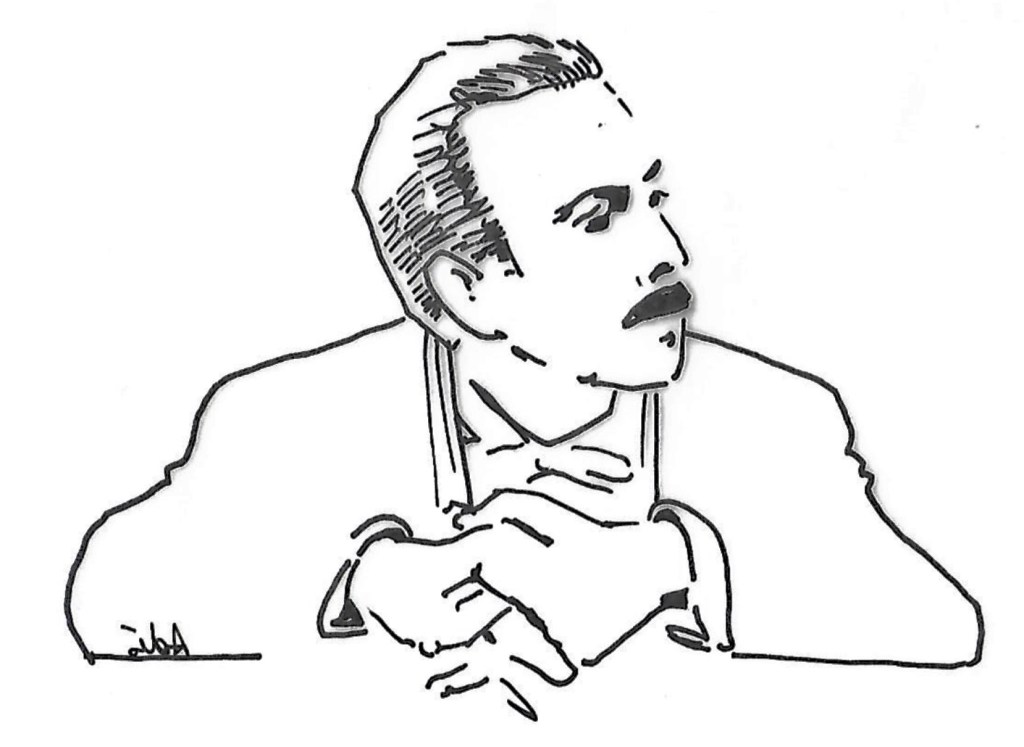
There is something elusive about Arrau’s art. His interpretations seem to take on an additional dimension with each new listening, and one seems to understand new meanings, sometimes radically different from the previous ones, as one moves through the pianist’s considerable discographic legacy. Arrau is a Chilean pianist, but it is the Germanic repertoire that seems to have guided him throughout his life. He studied in Germany with a pupil of Liszt’s, Martin Krause, who was also the teacher of Edwin Fischer and Rosita Renard – so many pupils with so many different styles, it gives an idea of the teacher’s talents. Arrau was the last pupil of Krause, who taught him to respect exact fingerings – and we shall see that there is no shortage of arguments supporting the sincerity and authenticity of Arrau’s style. Arrau’s touch is broad, with a sound that covers extraordinarily different timbres, resulting in an enormous intensity and vertiginous depth. This depth and intensity that runs through each of Claudio Arrau’s interpretations is like an inner journey. Arrau’s highly reflective, sometimes suspended playing is caught up in a continuous flow, which is marked out by the full sound and the rounded but detailed phrasing. This is particularly noticeable in Arrau’s interpretation of Liszt’s Sonata in B Minor, between interiority and solemn power – but this is not Horowitz, this is not « Satan at the piano ».
Arrau spreads out like a moving carpet, with colours that are at once so different and so complementary, with an extraordinary intensity. It is in this sort of ocean that prefigures a kind of horizontality, in a landscape of true immensity, that the Chilean pianist proposes a playing of absolutely unheard-of reflexivity and depth. This colourful and relief-rich landscape is above all an inner evocation, for Arrau’s playing appeals as much to the mind as to the body. And even in the recording of the Beethoven sonatas from the end of Arrau’s life, in the 1980s, if everything is more spiritual, more interior than in the recording from the 1960s, it remains human and above all properly anchored in an emotivity that is above all physical – again this orchestral form and extremely diversified timbres. And yet, even though there is undoubtedly something corporeal in Arrau’s music, listening to his interpretations seems to constantly lift us up. This spiritual ideal towards which listening to Arrau’s interpretations seems to lead us calls for something ineffable, something impossible to summarise without losing elements of it, which again is a sign of the whole horizontal landscape he represents. But if it cannot be summed up rationally, and I think it would be wrong to do so, Arrau’s style, with all its singularity, inclines towards an ideal that seems so universal that, despite the particularity of his interpretations, they are still and always considered as references. This goes hand in hand with an extraordinary homogeneity of Arrau’s discographic legacy. I don’t think it’s possible to find a pianist who has recorded so many works and composers and who has offered interpretations that are always coherent and, above all, resonant with the spirit of the composition, while maintaining an original style. For Arrau retains his own style, and this is also one of the main factors in the coherence of his interpretations. Although Arrau’s interpretations seem to follow a certain direction, the path is not without questions. Whether meditative or even metaphysical in nature, these questions are also part of the whole, and in this Arrau’s interpretations are both extraordinarily coherent and deeply complex. This is particularly apparent in Arrau’s recording of the Chopin Etudes on HMV – recently reissued by Warner in a remastered version – a vision made up of questions that do not necessarily need answers, but without the need to get lost in the nuances. Basically, what Arrau seems to be trying to do here is to allow the listener to imagine his or her own ideal through the complexity of the interpretation, a complexity that in fact allows an extraordinary multiplicity of possible readings. There is therefore, in this permanent search for an ideal, in these meditations in which there is never a risk of getting lost – because everything is skilfully mastered – a humanity that breathes, that is embodied in the choices and doubts, always resolved with a profound sense. Arrau’s interpretations privilege meaning over certainty, and this is also what makes them complex. Arrau sculpts the music more into a multi-layered relief than into a precise narrative. And indeed, when one listens to Arrau play Debussy, the image that comes to mind is much more that of an impressionist painting than a Gothic cathedral: it is up to the listener’s mind to reconstruct the music. But it is a reconstruction that Arrau naturally allows, the listener does not have to make an effort for it, it is intuitive, and music remains an organic and, above all, natural art.
Arrau’s interpretations wonderfully reconcile German romanticism and the balance of modernity, with a roundness that is not without accents when necessary, and above all with a search for an ideal that is above all lived at human level. It is a profoundly human style, extraordinarily romantic, but there is indeed a form of timelessness in Arrau. For example, when Arrau plays Mozart, who is not a romantic composer, he plays him above all with naturalness, between tenderness and gravity, sketching out the natural rough edges of the work, and it is indeed an interpretation of immense balance that reaches us, rather than a vision made of contrasts or distinct moments.
Arrau’s interpretations wonderfully reconcile German romanticism and the balance of modernity, with a roundness that is not without accents when necessary, and above all with a search for an ideal that is above all lived at human level. It is a profoundly human style, extraordinarily romantic, but there is indeed a form of timelessness in Arrau. For example, when Arrau plays Mozart, who is not a romantic composer, he plays him above all with naturalness, between tenderness and gravity, sketching out the natural rough edges of the work, and it is indeed an interpretation of immense balance that reaches us, rather than a vision made of contrasts or distinct moments.
If there is indeed a radicalness in Arrau’s art, there is no urgency; on the contrary, it is indeed a certain idea of eternity that emerges from the marvellous discographic legacy that Arrau has left us. If there is one adjective to describe Claudio Arrau’s interpretations, it is timeless. There is a grace and a depth that sends the listener back to a form of eternity and not to his anguish, as can sometimes be the case with other pianists, for example Sviatoslav Richter and his much more extroverted playing – except in Schubert, of course.

 Sofronichrist
Laisser un commentaire