
The historical versions
Felix Weingartner delivers a sharp, and in a sense rather acidic, vision of the Seventh in a complete work that was a landmark because it was the first. The chords are marked, there is a remarkable clarity of line and the ensemble sings rather well. For all that, and perhaps this is due to the sound recording, but this interpretation remains a bit external, not necessarily very committed, nor even very lively – although it is otherwise conducted at relatively fast tempi.
It is a real pity that Richard Strauss’ version with the Staatskapelle Berlin, recorded in 1926, is not available in better quality. It is also incomprehensible that, knowing what Strauss could produce in Beethoven’s music – just in the fifth, which has come down to us in much better sound conditions – he was not given more recordings – but perhaps Strauss himself did not want to, it was a different time, a different relationship to the record. From what we can hear, Strauss’s vision was light, airy even – ‘when you think the brass are not playing hard enough, you still have to restrain them’, writes Strauss in his Golden Book of a Young Conductor. Like Mozart’s last three symphonies, this Seventh is a precious testimony to the art of Richard Strauss, who was one of the greatest conductors of the first half of the 20th century.
The two versions by Leopold Stokowski that should be remembered are those of 1927, with the Philadelphia Orchestra, and the much later one – on Decca – with the New Philharmonia Orchestra. In the first, Stokowski is an innovator – if not an inventor – and his pronounced legato is a factor of unity, and any eccentricity counts as part of the genius that illuminates the interpretation; in the second, it is a seriousness that is grafted on to all the light without dulling either the dance or the clarity.
Willem Mengelberg’s seventh – with ‘his’ orchestra of the Amsterdam Concertgebouw – is quite symptomatic of his art. Some passages are absolutely irrational and unreal but absolutely hallucinating, others in a form of total excess. It remains an interesting performance, but the interest comes as much from the conductor’s artistic choices as from his historical ones.
Arturo Toscanini – with the New York Philharmonic, in 1936 – offers a clear but relatively rigid version. If the first movement is quite readable – at least that’s to be given credit for – the Allegretto is dry, almost insensitive, jerky – not danceable, in fact it is a kind of perfect antithesis to Wagner’s word. For all that, at times there are beautiful moments – they are just not transcendent as in Furtwangler, nor immanent as in Kleiber. Perhaps the 1951 NBC version is ultimately more spontaneous, less violent, but more luminous and – truly – singingly lyrical.
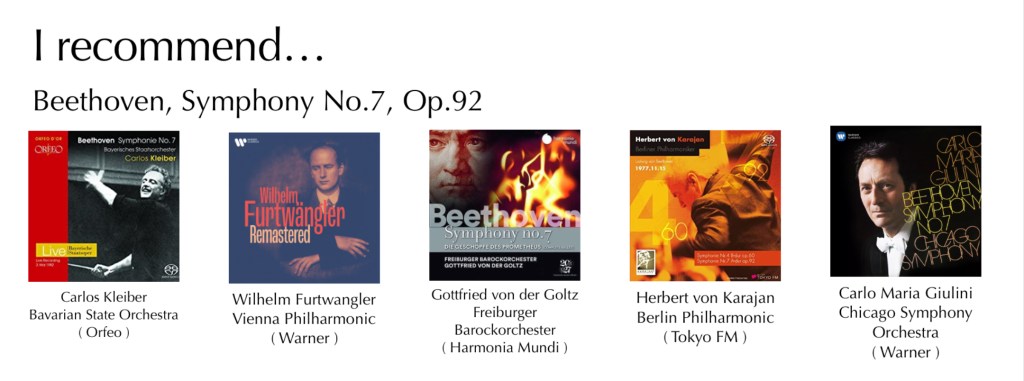
Wilhelm Furtwangler, on the other hand, offers a truly metaphysical vision, with a philosophical character coming from the outside – he is transcendent – rather than the inside – as was the case with Kleiber. If Furtwangler’s interpretations are a little fixed, though very profound, in 1953 and 1954 with the Berlin Philharmonic, two recordings should be kept in the pantheon of all the sevenths that could be given. Firstly, the completely overexcited version, with its unparalleled savagery and heightened tragedy, which would seem extreme if it were not for Furtwangler, in 1943 with the Berlin Philharmonic. Then the studio with the Vienna Philharmonic, in 1950, a luminous but serious version, which almost contains an idea of revelation, and retains an extraordinary power without abandoning the liveliness.
Erich Kleiber is clearly less inspired than his son, and in his interpretation there is a curious alternation between, on the one hand, a great deal of dryness and, on the other, plaintive moments, Viennese in the caricature of the term. Although Kleiber senior was a remarkable opera conductor, he did not always excel in the symphonic repertoire – his interpretations of the Fifth or the « Pastoral » were preferred to his Seventh.
With Bruno Walter, and the New York Philharmonic in 1951, it is the conductor’s shortcomings that are more evident than his qualities. Walter’s lyricism is present, the singing is remarkable, but there remains a kind of dryness, and the whole seems in some ways too smooth, seamless, remarkably well executed but without all the sunshine that can illuminate the Seventh.
Fritz Busch’s version is not the most famous, but it really deserves to be popularised. With the Vienna Symphony, Busch delivers a lively, luminous, danceable and sufficiently free interpretation – spontaneity is one of the keys, and one of the most striking characteristics. The major drawback – no pun intended – is obviously the sound recording, given that we cannot benefit from a correct edition – which we are still waiting for -, the only one seeming to be that marketed by Urania.
Hermann Scherchen has delivered two versions of the seventh. The studio is to be absolutely avoided, between its really too slow tempi – since it is not supported at all – and its cramped orchestra. The live in Lugano is much more interesting. This is a supercharged interpretation, absolutely exhilarating and, moreover, very free, even if some of the choices made may, if not surprise, confuse. Not for the ears of a neophyte, therefore.
The version given by Hermann Abendroth in Warsaw is worth listening to. It has the transcendence that we hear in Furtwangler, but it lacks the metaphysics: it is a powerful, committed, coherent interpretation, but some of its choices actually seem a little gratuitous, in short, slightly vain. Nevertheless, it is an interesting interpretation, pleasant because it is truly alive.
The Golden Age
Herbert von Karajan has always been a privileged interpreter of the Seventh, if we put aside the first recording he made of it – with the Amsterdam Concertgebouw – as well as the version with the Philharmonia – a complete recording from which we must retain what is undoubtedly the best Eroica in Karajan’s entire discography, along with that of 1944 perhaps. He gave it superb clarity and great verticality in Vienna in 1959, a beautiful unity in 1963 – his first complete performance with Berlin – but above all he brought together all the best of the work in his public performance in Tokyo in 1977, to which must be added the ardour, the sensation of improvisation, of uncertainty, which makes the dance organic. Karajan is an essential interpreter of the Seventh Symphony, but it is necessary to favour live recordings as much as possible – sometimes in mediocre sound quality, unfortunately, but sometimes well recorded as well, one could cite the masterly performance of 1978, the more restrained one of 1957 in Vienna, with the Symphonic.
Evgeny Mravinsky undoubtedly reveals himself as the face of strength and power in the Seventh. The question is: is this what he needs? Mravinsky builds a monument that is both clear and overwhelming, but one struggles to see the sunshine, the lightness, and more simply what Wagner saw: the dance. It is probably better to listen to Mravinsky conducting symphonies Nos. 1, 3 – obviously, on Erato or the Bergen version -, 4 – the Praga version is absolutely brilliant – and 5 – the third movement is unequalled.
Ferenc Fricsay’s interpretation with the Berlin Philharmonic is truly brilliant, but in the truest sense of the word: brassy, sparkling, but not necessarily very natural or alluring, on the contrary, very worked, refined and in a sense elegant – because it is also sufficiently light. The version with the Deutsches-Symphonie-Orchester-Berlin, available from Audite, is undoubtedly to be preferred by those who prefer more lively, more spontaneous interpretations, and this is remarkably evident in the first movement – one of the most successful in the discography, with an absolutely masterly balance.
Guido Cantelli and the Philharmonia give us a remarkably complex, lively but tragic vision, in which we find the great Beethovenian moments. The symphony is here shot through with a sharp emotionality, and confirms without a doubt that Cantelli was the perfect synthesis between the art of Toscanini and that of Furtwangler. To be preferred in the wonderful remastering recently released by Warner.
Karl Bohm’s versions oscillate between relatively blurred chords whose lines are not really distinguishable and then unsustainable slowness. In the studio with the Vienna Philharmonic the beginning of the Allegretto has a clarity that is noteworthy, but perhaps also to point out that there must be some mystery in the Seventh.
Paul van Kempen’s version is remarkably light, with a real sparkle throughout. Although the first movement is a bit staid, the Final movement is feverish and wild, and ends the symphony with an exhilarating ardour. A somewhat forgotten version, which is a real pity because it is one of the greatest in the entire discography.
Carl Schuricht’s Seventh, in his complete symphonies with the orchestra of the Paris Conservatoire, is not the best production contained in this set. Lively, but above all rather dry, despite some very successful passages Schuricht’s interpretation does not necessarily convince, it seems to remain in a form of in-between, hesitating to really commit itself. In the complete works it is probably better to listen to the Eroica, the Fourth or the Ninth.
Pierre Monteux, with the London Symphony Orchestra in 1961, sketches a neat and elegant course, with lightness and drive. Monteux’s vision is both luminous and solemn, and there is a great accuracy in the sobriety that seems to guide him in his approach. There is also a real tension that is maintained throughout the performance. This Seventh confirms that Pierre Monteux was – and remains thanks to the recording – an immense interpreter of Beethoven – and for those who are still in doubt after the Seventh I strongly encourage them to go and listen to the 1962 Concertgebouw Eroica, an exemplary interpretation, humble and of unequalled elegance.
Fritz Reiner and the Chicago Symphony Orchestra produce light, but a light that is a little pale at times. This version certainly lacks colour and in a sense even naturalness, but it remains a brilliant, if somewhat scholastic, performance and a reference for anyone wishing to study the work. Reiner is undoubtedly at his best in the Fifth, and his Seventh is undoubtedly somewhere in between his Eroica, which is a little stiff but very fast – which is rather paradoxical – and his Fifth – lively, violent but also shining with a rare brilliance.
Otto Klemperer seems very much at home in the Seventh, too much so in fact. The orchestra is certainly opulent – very woody as usual – but the Philharmonia struggles to follow Klemperer in his choice of a very – really too – slow interpretation, and so it is sometimes difficult to discern the construction. The Seventh does not have the same metaphysical quality as the Missa Solemnis – in which Klemperer excels.
Eugen Jochum and his grandeur, his monumental architecture but where breathing remains fundamental – which makes him one of the, if not the, greatest of the Brucknerians – do not necessarily give the Seventh much drive – even if the music remains organic. The 1938 version with the Berlin Philharmonic, available from Tahra, was preferred to the Concertgebouw version, which is more natural while retaining this very constructed aspect, even if the work seems in general to be rather circuitous.
The interpretation offered by Hans Schmidt-Isserstedt, in his complete work with the Vienna Philharmonic, is slightly static. The conductor embellishes the line, smoothes out the contrasts a little, but an exceptional sound recording – Decca in the 1960s – and a powerful orchestra allow a formidably controlled rendering. The filmed version with the NDR orchestra is perhaps to be preferred, more passionate and simply more romantic.
René Leibowitz offers us, as usual, a « degreased » vision of Beethoven, but yet in the Seventh, which a priori lends itself particularly well to lightness and energy, Leibowitz seems less inspired. Indeed, the interpretation seems a little effete, hesitating to really engage, and the whole thing gives a rather lukewarm impression – better to listen to Leibowitz in the Fifth, of which he offered an incredibly danceable and lyrical version, and the Second, of which he remains without doubt the absolute reference along with Scherchen.
Charles Munch offers a beautiful, coherent version, but a little smooth, somewhat lacking in inspiration. It is very successful, but not necessarily innovative or necessary for anyone looking for something beyond a simple performance. But it is very well executed, no doubt about it. It is probably best to concentrate on the Ninth recorded by Munch on RCA, and in a sublime recording.
Leonard Bernstein seems to have a number of good points in his two versions in New York and Vienna, but the whole does not seem very coherent, and if these interpretations contain some very beautiful passages, the fact remains that they are not the American conductor’s greatest successes, which here lack originality, ardour, in short, inspiration.
Rafael Kubelik and the Bavarian Radio Symphony Orchestra, on Deutsche Grammophon, deliver a very contemplative but rather frozen interpretation, the orchestral sound is very beautiful, round and full, but it lacks relief despite an interesting attempt at construction. Let’s just say that this version lacks above all tension.
Eduard van Beinum, with the Phiharmonia, delivers a tortured, dark and violent vision of the work in a 1958 concert. The orchestra has a rare substance and monumentality here. If this is not the « apotheosis of the dance » – we always come back to that – the Allegretto is absolutely heartbreaking and the whole symphony is suffocatingly tense.
Istvan Kertesz, with the Japan Philharmonic, delivers an interpretation of pure classicism, very carefully crafted, of great clarity. The lines and dynamics are extremely legible, and the music breathes a lot. Kertesz is a conductor who deserves to be heard, he is far too little known – his Dvorak symphonies are absolute references, as are his Mozart concertos with Clifford Curzon.
The Moderns
Carlos Kleiber is without doubt the greatest interpreter that Beethoven’s Seventh has ever known. Even if it seems that his initial conception was a little more fixed – as the live recording in Cologne in 1972 testified – from 1976 onwards it is the term genius that best suits his interpretation – a genius that will endure right up to the last concerts and the farewell tour in 1999. A genius that would intensify in the presence of the public, culminating in the concerts recorded in 1982 – with the Bavarian State Orchestra, on the Orfeo label – and 1983 – with the Concertgebouw of Amsterdam, on the Philips label. The Orfeo version is the preferred choice, with its superb sound recording that captures the colours and lyricism of Kleiber’s conducting. Kleiber’s Seventh is the one that best embodies the dance – of which the Seventh was « the apotheosis » in Richard Wagner’s words – but also the sunshine, the vivacity, the spirit and the whole exhilarating construction – except that Kleiber is the only conductor to be exhilarating from the first chord to the last.
Claudio Abbado’s 2001 recording of the complete works at the Academy of St Cecilia in Rome is a chamber version full of wonder and enchantment. The Berlin Philharmonic follows the conductor on each side of his exploration of some of the less usual aspects of the work. The first movement has a post-Kleiberian light, the Allgretto a candlelight glow, with the impression that it is a string quartet playing, and the last movement a beautiful brilliance and vivacity, truly alert.
Nikolaus Harnoncourt is undoubtedly one of the major conductors of the 20th century – his Bach Passions or his Schubert « Great » in Salzburg in 2009 are particularly striking proof of this – but not in Beethoven, where he never seems completely at ease. With the Chamber Orchestra of Europe, Harnoncourt’s interpretation lacks naturalness, the accents are too pronounced, and it is Beethoven who becomes almost a caricature of himself: all Harnoncourt’s faults seem to be condensed in his Beethoven. With the Vienna Philharmonic in 2003 – on Orfeo – it is even worse, the accents coming across much better with a chamber orchestra: this Beethoven is, in addition to being caricatured, completely mannered.
Bernard Haitink offers a version that is, by and large, quite traditional, classic without any bad taste, remarkably clear and with a beautiful relief. Haitink and the Concertgebouw offer an Apollonian and chiselled vision, in a very careful interpretation. However, one might expect more risk here, for although this is a recording of apparent perfection, it perhaps lacks a little asperity, that something that makes genius surpass tradition. But, of course, it is beautifully done. The performance with the London Symphony Orchestra is perhaps a little more lively, but also a lot messier.
Sergiu Celibidache’s versions, whether in his filmed live with the Italian Swiss Orchestra or on the disc available from Warner – also a live recording – with the Munich Philharmonic, are catastrophic. The orchestral sound is fabulous in Munich, but this is hardly the repertoire to listen to Celibidache, for whom the word ‘dance’ is merely an ‘epiphenomenon’ to be found on paper.
Carlo Maria Giulini, with the Chicago Symphony Orchestra, gives a slow but extraordinarily coherent performance teeming with detail and sovereign grandeur. This is the most successful of the purely slow version, a luminous vision of total sonic fullness – served up by a very fine recording. The sound planes are magnificently differentiated, amplifying the monumental aspect of the whole. It’s not heavy at any point – even if it is sometimes rather heavy, it’s not thick with sound. Giulini gives the symphony great energy, which is amplified by the architecture. The conductor sticks to his vision and all the interpretive choices are in line with the same logic.
Riccardo Muti’s version is interesting, without however being among the essentials. Rather than the 1979 version, which is rather stiff, it is better to prefer the one recorded in 1988 – in both cases it is the Philadelphia Orchestra – but which remains irregular. The first movement is superb, the last is quite successful, the rest less convincing – sometimes too sharp, too brassy or, on the contrary, too linked and a little too melancholy, like the Allegretto.
Gunter Wand, with his NDR orchestra, offers in his complete recording available on RCA a lighter, almost slimmed down Seventh, but ultimately a little bland. The orchestra sounds very good, the accents are marked, but the orchestral flow is a bit stale. Nevertheless, this performance is full of flashes of brilliance, magical moments here and there, and a very good sound recording.
Frans Bruggen offers a truly sparkling version, in which strings and brass respond to each other with clarity and construction. In addition, Bruggen allows a lot of breathing space, which is not always the case in historically informed versions, and silence is given a prominent place – as is always the case in his music. The downside is that there is a lack of spontaneity, as one senses the extent to which Bruggen’s interpretation is carefully crafted from start to finish.
John Eliot Gardiner and his Revolutionary and Romantic Orchestra come up with some very valid ideas, but they are somewhat banal. There’s a good deal of drive, but even though the use of period instruments would seem to suggest otherwise, their performance is woefully lacking in depth. There seems to be no real bias, and the whole thing sinks into a sad monotony, without even taking advantage of the colours that this type of orchestra can offer – as we can hear very well with Bruggen and his Orchestra of the XVIIIth century or Jos van Immersel and his Anima Eterna.
Jos van Immerseel’s version, with the Anima Eterna ensemble, tries to respect Beethoven’s own intentions. The orchestral numbers are reduced, the tempi at a speed that seems quite untenable for the time, but as usual with van Immersel in Beethoven, the whole thing holds together, with a beautiful drive, a myriad of colours and details while maintaining the melodic line. A completely successful gamble, in contrast to what Roger Norrington, for example, has been able to offer.
The vision of Gottfried von der Goltz, who conducts the Freiburger Barockorchester, is guided by a sense of detail and surgical precision that in no way detracts from the musical discourse as a whole. The music really comes to life, and although light dominates, this does not prevent the contrasts from being delicately underlined. The dynamics are fabulous, as is the architecture, and here the symphony takes on a chamber music aspect, where everything is caught up in a constant dialogue of incredible harmony. The introduction to the first movement is wildly noble and elegant, and the Vivace that follows has tremendous momentum, while the two central movements, especially the Alegretto, are on the borderline between orchestral music and chamber music, full of detail and again of great elegance, without ever becoming demonstrative. Finally, the finale is driven by incredible energy. The period instruments never detract from the full scope of the music. This is undoubtedly a benchmark version on period instruments.
 Sofronichrist
Laisser un commentaire